Freedom251 › Network Testing Software
M-Lab NDT
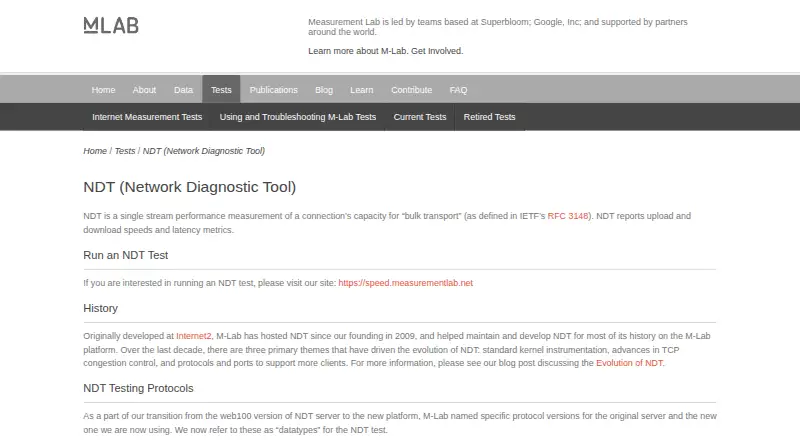
What M-Lab NDT is
M-Lab NDT measures a connection’s capacity for bulk data transport and reports upload speed, download speed, and latency. A test begins only when a person starts it and measures the network’s response to a synthetic data stream. NDT supports ndt7, which uses TCP BBR where available and HTTP(S) ports 80 and 443, as well as ndt5 for compatibility with legacy clients. M-Lab encourages integrations to use ndt7; support for ndt5+raw ended in January 2024. NDT is free and available through web, Android, iOS, Linux, and API platforms. Test results are published for Internet research, and NDT data can be queried in BigQuery for free through Google Group subscription. Published results include the connecting IP address and are retained indefinitely; M-Lab says an individual test’s data cannot be deleted after collection. The tests do not collect information about other Internet traffic or personally identifiable information. Organizations can host servers with Docker Compose if they meet M-Lab’s registration and technical requirements.
Who it suits
NDT suits people seeking connection-speed diagnosis, as well as researchers, operators, regulators, and others using public Internet measurement data. Organizations that meet the stated requirements can also host M-Lab servers.
What it does well
- Reports upload speed, download speed, and latency.
- Tests start only when a person runs them.
- Available free across web, mobile, Linux, and API.
- NDT results can be queried through BigQuery.
- Organizations may host servers with Docker Compose.
What to know first
- Published results include the connecting IP address.
- Test data is retained indefinitely and cannot be individually deleted.
- Support for ndt5+raw ended in January 2024.
Limits
Published test data, including connecting IP addresses, is retained publicly indefinitely, and M-Lab says it cannot delete data associated with an individual test once collected. Support for ndt5+raw ended in January 2024; M-Lab encourages client integrations to use ndt7.
Getting started
- Open the NDT page on M-Lab’s website.
- Run a test when you want to measure the connection.
- Use the web, Android, iOS, Linux or API access route.
- For data queries, join the Google Group for free BigQuery access.
- For hosting, register with M-Lab and meet its technical requirements.
Verdict
M-Lab NDT provides free connection measurements and publishes results for Internet research. Before running a test, users should consider that results include their connecting IP address and cannot later be removed individually.
Questions
Is M-Lab NDT free?
Yes. NDT is free, and M-Lab offers free BigQuery query access through Google Group subscription.
What does an NDT test measure?
It measures a connection’s capacity for bulk transport and reports upload speed, download speed and latency.
Which platforms are available?
The listed platforms are Android, iOS, Linux, web and API. M-Lab also lists reference clients for Go and JavaScript and community-supported clients for iOS, Android and C++.
What happens to test data?
Results, including the connecting IP address, are published publicly and retained indefinitely. M-Lab says it cannot delete data associated with an individual test after collection.
Is NDT open source?
M-Lab states that all hosted tests are open source and created and maintained by researchers.
Can an organization host M-Lab servers?
Yes. Organizations can host servers using Docker Compose, subject to M-Lab registration and technical requirements.
Facts from M-Lab NDT's own pages
- Audience
- M-Lab says its free, open Internet measurement data is intended to help researchers, regulators, advocacy groups, and the public understand Internet performance. · measurementlab.net, 7 Oct 2026
- Client integrations
- M-Lab lists reference clients for Go and JavaScript and community-supported clients for iOS, Android, and C++. · measurementlab.net, 7 Oct 2026
- Client platforms
- The NDT page links to community-supported iOS and Android clients and reference Go and JavaScript clients. · measurementlab.net, 7 Oct 2026
- Collected information
- NDT collects the user’s IP address along with measurement results; M-Lab says NDT does not collect information about the user as an Internet user. · measurementlab.net, 7 Oct 2026
- Data collection
- NDT collects the user’s ISP-provided IP address with measurement results and publishes test results to support Internet research. · measurementlab.net, 7 Oct 2026
- Data retention
- M-Lab says test data is published publicly and retained indefinitely, and it cannot delete data associated with an individual test once collected. · measurementlab.net, 7 Oct 2026
- Diagnosis
- M-Lab describes NDT as testing connection speed and providing a sophisticated diagnosis of problems limiting speed. · measurementlab.net, 7 Oct 2026
- Founded
- 2009 · measurementlab.net, 28 Sept 2026
- Host eligibility
- Host-managed contributions are accepted from organizations such as ISPs, hosting providers, network operators, universities, research institutions, public-sector bodies, and qualifying nonprofits. · measurementlab.net, 7 Oct 2026
- Hosting limits
- Host-managed nodes require Linux with Docker and tcp_bbr support, at least four 2 GHz CPUs, 4 GB RAM, 50 GB disk, and specified network connectivity and ports. · measurementlab.net, 7 Oct 2026
- Host-managed data
- M-Lab says it does not manage host-managed servers or their software services, and keeps their data separate from data produced by M-Lab-managed servers. · measurementlab.net, 7 Oct 2026
- Integrations
- M-Lab publishes NDT data through BigQuery and archives raw measurement data in Google Cloud Storage. · measurementlab.net, 7 Oct 2026
- Intended users
- M-Lab describes its platform as supporting researchers and says its open performance data can be used by consumers, operators, regulators, researchers, and civil society. · measurementlab.net, 7 Oct 2026
- Open source
- M-Lab states that all hosted tests are open source and created and maintained by researchers. · measurementlab.net, 7 Oct 2026
- Privacy
- M-Lab says its tests do not collect information about other Internet traffic or personally identifiable information, while collected test data, including connecting IP addresses, is made public indefinitely and cannot be deleted per individual test. · measurementlab.net, 7 Oct 2026
- Protocols
- NDT supports ndt5 for compatibility with legacy clients and ndt7, which uses TCP BBR where available and operates on HTTP(S) ports 80 and 443. · measurementlab.net, 7 Oct 2026
- Protocol status
- M-Lab says support for ndt5+raw ended in January 2024 and encourages client integrations to use ndt7. · measurementlab.net, 7 Oct 2026
- Purpose
- NDT measures a connection’s capacity for bulk transport and reports upload speed, download speed, and latency metrics. · measurementlab.net, 7 Oct 2026
- Raw data
- Raw data and log files from the measurement fleet are archived in Google Cloud Storage, including packet captures for most NDT tests. · measurementlab.net, 7 Oct 2026
- Research data
- NDT results are published for Internet research, and M-Lab offers query access to NDT data in BigQuery for free by Google Group subscription. · measurementlab.net, 7 Oct 2026
- Self hosting
- Organizations can host M-Lab servers using Docker Compose, subject to M-Lab registration and technical requirements. · measurementlab.net, 7 Oct 2026
- Support
- M-Lab directs NDT users to contact [email protected] for support. · measurementlab.net, 7 Oct 2026
- Test method
- M-Lab tests run only when a person starts them and measure the network’s response to a synthetic data stream. · measurementlab.net, 7 Oct 2026
- Transfer limit
- The ndt7 client supports an opt-in data transfer limit. · measurementlab.net, 7 Oct 2026
Where M-Lab NDT stands on Freedom251
- Network Testing Software#17 of 33