Freedom251 › Container Engines
LXC
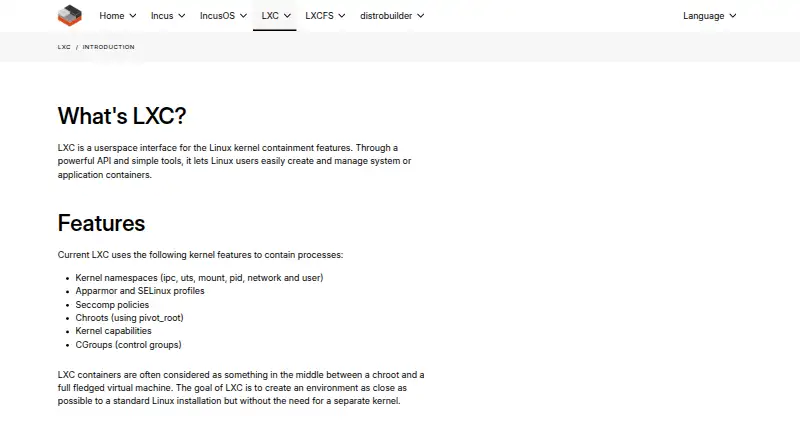
What LXC is
LXC is free software for creating and managing Linux system or application containers through a userspace interface to Linux kernel containment features. It aims to provide an environment similar to a standard Linux installation without a separate kernel. Its components include the liblxc library, container control tools, distribution templates, and API bindings for Python 3, Lua, Go, Ruby, and Haskell. LXC uses kernel namespaces, AppArmor and SELinux profiles, seccomp policies, chroots, kernel capabilities, and cgroups to contain processes. The project describes unprivileged containers as safe by design because container root maps to an unprivileged host user. However, LXC does not prevent denial-of-service attacks by default, and advises configuring cgroup limits for untrusted containers. It warns that privileged containers run processes as host root. LXC is included in most Linux distributions and is generally installed through the distribution package manager. Listed requirements include a supported C library and Linux kernel version 2.6.32 or later. The project lists LXC 7.0 and 6.0 as long-term support releases, supported through June 1, 2031 and June 1, 2029, respectively.
Who it suits
LXC suits Linux users who need system or application containers without a separate kernel. It may fit teams able to configure cgroup limits and manage container privilege carefully.
What it does well
- Free software for Linux containers.
- Includes liblxc, control tools, and distribution templates.
- Provides API bindings for five languages.
- Unprivileged container root maps to an unprivileged host user.
- LXC 7.0 and 6.0 have listed long-term support.
What to know first
- Requires Linux kernel version 2.6.32 or later.
- Denial-of-service attacks are not prevented by default.
- Privileged containers run processes as host root.
- Untrusted containers require configured cgroup limits.
Limits
LXC does not prevent denial-of-service attacks by default, so the project advises cgroup limits for untrusted containers. Privileged containers run processes as host root.
Plans
| Plan | Billed and limits | Price |
|---|---|---|
| LXC | Free software; no charge stated · Linux kernel required · No separate kernel for containers | Free |
As linuxcontainers.org lists them, read 8 Oct 2026. The maker's own page has the final word.
Getting started
- Check that the system has a supported C library and Linux kernel 2.6.32 or later.
- Use the Linux distribution package manager to install LXC where it is included.
- Choose the LXC release that fits the project's listed long-term support options.
- Configure cgroup limits before running untrusted containers.
Verdict
LXC provides Linux-native containers with several process-containment mechanisms and language bindings. Its security caveats matter: configure resource limits for untrusted containers and do not expose privileged container root to untrusted users.
Questions
Is LXC free?
Yes. LXC is free software, with no charge stated.
What operating system does LXC support?
LXC is for Linux hosts and requires Linux kernel version 2.6.32 or later, along with a supported C library.
How is LXC installed?
It is included in most Linux distributions and is generally installed through the distribution package manager.
What licenses does LXC use?
Most code is under GNU LGPLv2.1+. Some components use BSD 2-clause or GNU GPLv2 licenses.
What are the security limits to consider?
Denial-of-service attacks are not prevented by default, so cgroup limits are advised for untrusted containers. Privileged containers run processes as host root.
Which LXC releases have long-term support?
The project lists LXC 7.0 and 6.0 as long-term support releases. Their support runs through June 1, 2031 and June 1, 2029, respectively.
Facts from LXC's own pages
- Components
- LXC includes the liblxc library, standard container control tools, distribution templates, and API bindings for Python 3, Lua, Go, Ruby, and Haskell. · linuxcontainers.org, 8 Oct 2026
- Container model
- LXC aims to provide an environment close to a standard Linux installation without requiring a separate kernel. · linuxcontainers.org, 8 Oct 2026
- Founded
- 2008 · linuxcontainers.org, 28 Sept 2026
- Installation
- LXC is included in most Linux distributions and is generally installed through the distribution package manager. · linuxcontainers.org, 8 Oct 2026
- Licensing
- LXC is free software, with most code under GNU LGPLv2.1+ and some components under BSD 2-clause or GNU GPLv2 licenses. · linuxcontainers.org, 8 Oct 2026
- Minimum requirement
- The listed hard requirements include a supported C library and a Linux kernel version 2.6.32 or later. · linuxcontainers.org, 8 Oct 2026
- Privileged container caution
- The documentation warns that privileged containers run processes as host root and should not give untrusted parties access to container root. · linuxcontainers.org, 8 Oct 2026
- Purpose
- LXC is a userspace interface to Linux kernel containment features for creating and managing system or application containers. · linuxcontainers.org, 8 Oct 2026
- Release support
- The project lists LXC 7.0 and 6.0 as long term support releases, with support through June 1, 2031 and June 1, 2029 respectively. · linuxcontainers.org, 8 Oct 2026
- Security features
- LXC uses kernel namespaces, AppArmor and SELinux profiles, seccomp policies, chroots, kernel capabilities, and cgroups to contain processes. · linuxcontainers.org, 8 Oct 2026
- Security limits
- LXC says it does not prevent denial-of-service attacks by default and advises configuring cgroup limits when running untrusted containers. · linuxcontainers.org, 8 Oct 2026
- Security model
- The project describes unprivileged containers as safe by design because container root maps to an unprivileged user outside the container. · linuxcontainers.org, 8 Oct 2026
- Security reporting
- Security issues can be reported by email to the project security address or through a private GitHub security advisory. · linuxcontainers.org, 8 Oct 2026
Where LXC stands on Freedom251
- Container Engines#13 of 31
- Container Runtime Software#14 of 28