Freedom251 › Container Engines

AppJail
What AppJail is
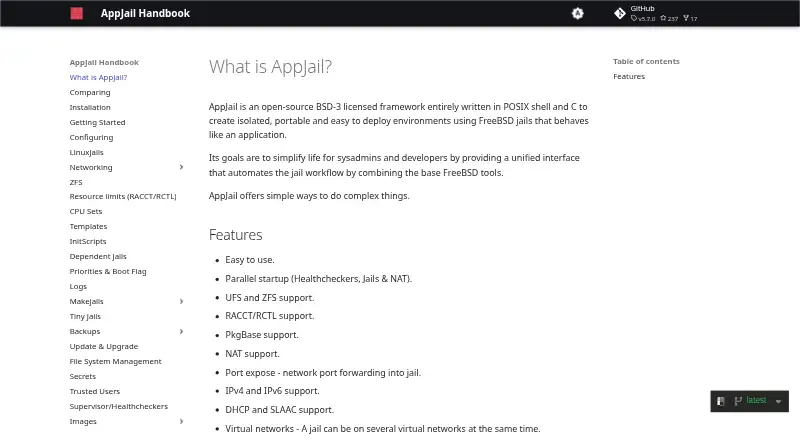
AppJail is a free, open-source framework for creating isolated and portable environments with FreeBSD jails. It is BSD-3 licensed, runs on FreeBSD, and is intended to simplify jail workflows for system administrators and developers. You can install it from source, the sysutils/appjail-devel port, or the sysutils/appjail package. AppJail supports thin and thick jails, dependencies, startup ordering, and parallel startup for healthcheckers, jails, and NAT. Healthcheckers can monitor a jail, its services, or other targets. Storage options include UFS and ZFS, with RACCT/RCTL resource limits. Networking includes NAT, port forwarding, IPv4, IPv6, virtual networks, bridges, VNET, DHCP, and SLAAC. Makejail files automate jail creation by generating InitScript and BuildScript files. OCI-compatible containers can run in jails, with buildah and jq required for the OCI command. Linux distributions in jails require debootstrap. TinyJails are experimental, and raw-image backups require ZFS.
Who it suits
AppJail suits FreeBSD system administrators and developers who need isolated environments, jail automation, networking controls, or OCI container deployment. It is also relevant to users running Linux distributions in FreeBSD jails.
What it does well
- Free and BSD-3 licensed
- Supports thin and thick jails
- UFS, ZFS, and resource limits
- Broad IPv4 and IPv6 networking
- Automates creation with Makejail files
What to know first
- TinyJails are experimental
- Raw-image backups require ZFS
- OCI command requires buildah and jq
- Linux jails require debootstrap
Verdict
AppJail provides a broad FreeBSD jail framework covering lifecycle automation, storage, networking, monitoring, and container deployment. Its experimental TinyJails and dependency requirements matter when planning a setup.
Facts from AppJail's own pages
- Application deployment
- Makejail files automate jail creation by generating an InitScript and a BuildScript. · appjail.readthedocs.io, 9 Oct 2026
- Audience
- The project says it aims to simplify jail workflows for system administrators and developers. · appjail.readthedocs.io, 9 Oct 2026
- Experimental feature
- TinyJails are described as experimental stripped-down jails intended to be useful for distribution. · appjail.readthedocs.io, 9 Oct 2026
- Installation
- AppJail can be installed from source, as the sysutils/appjail-devel port, or as the sysutils/appjail package. · appjail.readthedocs.io, 9 Oct 2026
- Intended users
- The project says its goal is to simplify jail workflows for sysadmins and developers. · appjail.readthedocs.io, 9 Oct 2026
- Jail features
- It supports thin and thick jails, jail dependencies, startup ordering, and parallel startup of healthcheckers, jails, and NAT. · appjail.readthedocs.io, 9 Oct 2026
- Language
- AppJail is written in POSIX shell and C. · appjail.readthedocs.io, 9 Oct 2026
- Linux jails
- Linux distributions can run in jails for isolated applications unavailable in the FreeBSD ports collection, and this method requires debootstrap. · appjail.readthedocs.io, 9 Oct 2026
- Monitoring
- Healthcheckers can monitor a jail, its services, or other targets the user specifies. · appjail.readthedocs.io, 9 Oct 2026
- Networking
- Features include NAT, port forwarding, IPv4 and IPv6, virtual networks, bridges, VNET, DHCP, and SLAAC. · appjail.readthedocs.io, 9 Oct 2026
- Notable limitation
- TinyJails are identified as experimental, and raw-image jail backups require ZFS. · appjail.readthedocs.io, 9 Oct 2026
- OCI compatibility
- AppJail supports deploying OCI-compatible container images in environments such as FreeBSD jails. · appjail.readthedocs.io, 9 Oct 2026
- OCI integration
- AppJail supports deploying OCI-compatible containers into FreeBSD jails; its OCI command requires buildah and jq. · appjail.readthedocs.io, 9 Oct 2026
- Purpose
- AppJail is an open-source BSD-3 licensed framework for creating isolated, portable environments using FreeBSD jails. · appjail.readthedocs.io, 9 Oct 2026
- Secrets
- AppJail documents encrypted secrets on disk and unencrypted secrets in a non-swap-backed in-memory filesystem, mounted read-only for jails by the recommended option. · appjail.readthedocs.io, 9 Oct 2026
- Secrets limit
- The default in-memory filesystem size for secrets is 32 MiB, and the documentation advises increasing it for larger needs or using disk encryption for larger blobs. · appjail.readthedocs.io, 9 Oct 2026
- Storage and limits
- It supports UFS, ZFS, and RACCT/RCTL resource limits. · appjail.readthedocs.io, 9 Oct 2026
- Storage and networking
- Documented capabilities include UFS and ZFS, NAT, port forwarding, IPv4 and IPv6, virtual networks, bridges, and VNET. · appjail.readthedocs.io, 9 Oct 2026
- Support
- The project repository links to a support page for users who need help with AppJail. · github.com, 9 Oct 2026
- Unprivileged use
- The handbook recommends allowing unprivileged users to run AppJail through a configured privilege tool such as doas, sudo, or FreeBSD's mdo. · appjail.readthedocs.io, 9 Oct 2026
- What it does
- AppJail is an open-source BSD-3 licensed framework for creating isolated, portable environments using FreeBSD jails. · appjail.readthedocs.io, 9 Oct 2026
Where AppJail stands on Freedom251
- Container Engines#15 of 31