Freedom251 › Performance Testing Software
Locust
What Locust is
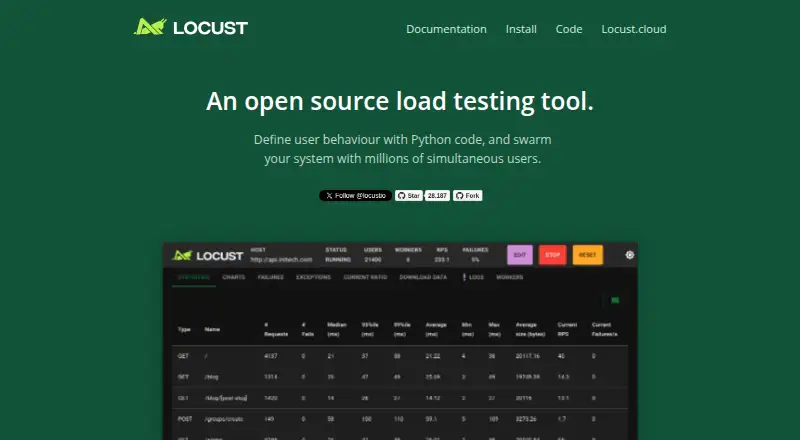
Locust is a free, open-source tool for performance and load testing HTTP services and other protocols. Write test scenarios in Python and use regular Python libraries within them. Run tests from the command line or web interface; the interface reports throughput, response times, errors, and progress while a test is running. It also lets you change the load mid-test, and results can be exported for later analysis. Locust can distribute tests across multiple machines and says it can support hundreds of thousands of concurrent users. You can add a client to test other systems and protocols, and its documentation lists community extensions for protocols and reporting. Optional OpenTelemetry support can export traces, metrics, and logs to compatible backends including OTLP, Prometheus, Jaeger, and Tempo. Automatic instrumentation currently covers the requests library. Installation is documented with pip install locust, with uvx as another option. Locust uses the MIT license and is available through command-line and web interfaces.
Who it suits
Locust suits teams and developers who want to define load tests in Python and inspect results as runs progress. It can also suit projects that need distributed tests or protocol extensions.
What it does well
- Free software under the MIT license
- Write scenarios using Python libraries
- View throughput, response times, and errors live
- Adjust load while a test runs
- Distributed tests across multiple machines
What to know first
- Automatic instrumentation covers only the requests library
- Remote hosted testing is described through Azure Load Testing
Plans
| Plan | Billed and limits | Price |
|---|---|---|
| Locust | Open source · MIT license | Free |
As locust.io lists them, read 30 Sept 2026. The maker's own page has the final word.
Getting started
- Open https://locust.io/.
- Install Locust with pip install locust, or use uvx.
- Write a test scenario in Python.
- Run the test from the command line or web interface.
Locust is a Python-based tool for load-testing HTTP services and other protocols. It is best suited to engineering teams comfortable writing test scenarios as code. Its strongest case is free, adjustable distributed load testing; teams relying on automatic telemetry instrumentation should note its narrow requests-library coverage.
Overview
Locust uses regular Python code for test scenarios, including access to Python libraries. That flexibility suits developers who want to model behavior directly in code, but it is a poor fit for teams seeking a no-code test authoring workflow. It is open source under the MIT license and has a free plan at no cost.
Tests can run from the command line or web interface. Locust's deployment model is hybrid, so it fits teams able to work across self-hosted tooling and web-based operation rather than those looking only for a hosted service.
Key features
The web interface reports throughput, response times, and errors as tests run, and lets operators adjust load mid-run. This is useful when teams want to react to observed behavior instead of locking in a load level beforehand. Results can also be exported for later analysis.
Locust supports distributed tests across multiple machines and says it can support hundreds of thousands of concurrent users. That gives it room for large exercises, though distributed execution entails using multiple machines. It supports load, stress, API, and browser-based testing.
For systems beyond HTTP, teams can add a client; community extensions also cover protocols and reporting. Optional OpenTelemetry support exports traces, metrics, and logs to compatible backends including OTLP, Prometheus, Jaeger, and Tempo. Automatic instrumentation is currently limited to the requests library: HttpUser requests generate spans and metrics without extra configuration, while other coverage is not automatic.
Installation is documented with pip install locust, with uvx as another option. The project points support questions to Stack Overflow and discussion to Discord; Locust.cloud offers dedicated commercial support. The documentation also describes hosted load testing through Azure Load Testing, with built-in reporting, Azure Application Insights integration, and CI/CD support for Azure DevOps and GitHub Actions.
Pricing
The Locust plan costs nothing and provides open-source software under the MIT license. There are no paid tiers or plan quotas to weigh in this pricing model. It suits teams prepared to run the tool themselves; hosted Azure Load Testing and dedicated commercial support are separate options described through the documentation and Locust.cloud.
Platforms
Locust supports API, Linux, macOS, self-hosted, web, and Windows environments. Its command-line and web-interface execution gives teams a choice of operating style, while the broad platform coverage makes it usable across common desktop and server setups.
Who it's for
Choose Locust if your team can write Python and wants control over scenario logic, live load adjustment, and distributed execution without a software license fee. Look elsewhere if test authors need a visual, no-code workflow or if automatic telemetry coverage beyond requests is central to the evaluation.
Pros and cons
- Pros: Python-authored scenarios can use regular Python libraries, giving developers broad control over test behavior.
- Pros: Live reporting and mid-test load adjustment let operators respond as a run unfolds.
- Pros: Distributed execution and support for multiple test types cover substantial load-testing needs without a license charge.
- Cons: Scenario authoring requires Python, which rules it out for teams seeking a no-code tool.
- Cons: Automatic OpenTelemetry instrumentation currently covers only the requests library, limiting out-of-the-box telemetry for other traffic patterns.
- Cons: Distributed testing uses multiple machines, adding operational requirements for large runs.
Alternatives
Artillery is worth comparing if a freemium option with a paid team tier better fits your group: its Team plan is $199 a month for 1,000 reports/month, six months of data retention, eight team members, and up to 25 workers per distributed test.
Fortio is another free, open-source option for readers comparing tools in this category.
Taurus is a free, open-source alternative under the Apache 2.0 license.
Apache JMeter is a free, open-source alternative for teams whose environment can meet its Java 8+ requirement.
Grafana k6 may suit teams seeking a freemium alternative with a defined usage allowance: its Free plan includes 500 virtual user hours per month.
Loader.io is a hosted-leaning alternative for smaller tests with a defined free cap of 10,000 clients per test, one target host, one-minute tests, and two URLs per test.
LoadFocus is another freemium choice, with a free API Monitoring plan offering 10,000 checks per month and five-minute check frequency.
OctoPerf may appeal to teams wanting a free plan with a stated allowance of 50 VUs, unlimited tests, a 20-minute maximum duration, and one parallel run.
Browse the wider Performance Testing Software category to compare more tools.
Verdict
Locust is a strong choice for Python-capable engineering teams that want free, programmable load testing with live controls and distributed execution. Its main reason to look elsewhere is equally clear: teams needing no-code authoring or broader automatic OpenTelemetry instrumentation will find its approach restrictive.
Verdict
Locust combines Python-authored tests with live reporting, adjustable load, and distributed execution. Its automatic OpenTelemetry instrumentation is currently limited to the requests library.
Questions
Is Locust free?
Yes. Its listed plan is free, and it is open source under the MIT license.
Which platforms does Locust support?
The listed platforms are API, Linux, macOS, self-hosted, web, and Windows.
What does Locust test?
It supports performance and load testing for HTTP and other protocols, including load, stress, browser-based, distributed load, and API testing.
Can Locust send telemetry to other tools?
Optional OpenTelemetry support exports traces, metrics, and logs to compatible backends, including OTLP, Prometheus, Jaeger, and Tempo.
How do I install Locust?
The documented installation method is pip install locust, with uvx offered as an alternative.
Where can users get support?
The project README directs support questions to Stack Overflow and discussion to Discord. Locust.cloud offers dedicated commercial support.
Facts from Locust's own pages
- Execution and reporting
- Tests run from the command line or web interface, which displays throughput, response times, and errors in real time; results can also be exported for later analysis. · docs.locust.io, 30 Sept 2026
- Hosted option
- Locust documentation describes hosted load testing through Azure Load Testing, with built-in reporting, Azure Application Insights integration, and CI/CD support for Azure DevOps and GitHub Actions. · docs.locust.io, 30 Sept 2026
- Installation
- The documented installation method is pip install locust, with uvx also offered as an alternative. · docs.locust.io, 30 Sept 2026
- Integrations
- Optional OpenTelemetry support exports traces, metrics, and logs to compatible backends, including OTLP, Prometheus, Jaeger, and Tempo. · docs.locust.io, 30 Sept 2026
- License
- Locust is licensed under the MIT license. · docs.locust.io, 30 Sept 2026
- Load adjustment
- The web interface shows test progress in real time and allows load to be changed while a test is running. · docs.locust.io, 30 Sept 2026
- OpenTelemetry limit
- Automatic instrumentation currently covers the requests library, so HttpUser requests generate spans and metrics without additional configuration. · docs.locust.io, 30 Sept 2026
- Protocol extensibility
- Locust can test other systems and protocols by adding a client, and its documentation lists community extensions for protocols and reporting. · docs.locust.io, 30 Sept 2026
- Purpose
- Locust is an open-source performance and load testing tool for HTTP and other protocols. · docs.locust.io, 30 Sept 2026
- Scale
- Locust supports distributed tests across multiple machines and says it can support hundreds of thousands of concurrent users. · docs.locust.io, 30 Sept 2026
- Support
- The project README directs support questions to Stack Overflow and discussion to Discord, while locust.io says Locust.cloud provides dedicated commercial support. · github.com, 30 Sept 2026
- Test authoring
- Users define test scenarios in regular Python code and can use regular Python libraries in their tests. · docs.locust.io, 30 Sept 2026
Where Locust stands on Freedom251
- Performance Testing Software#11 of 38
- Software Testing Tools#10 of 33
- Testing And Qa#10 of 33