Freedom251 › Performance Testing Software

HammerDB
What HammerDB is
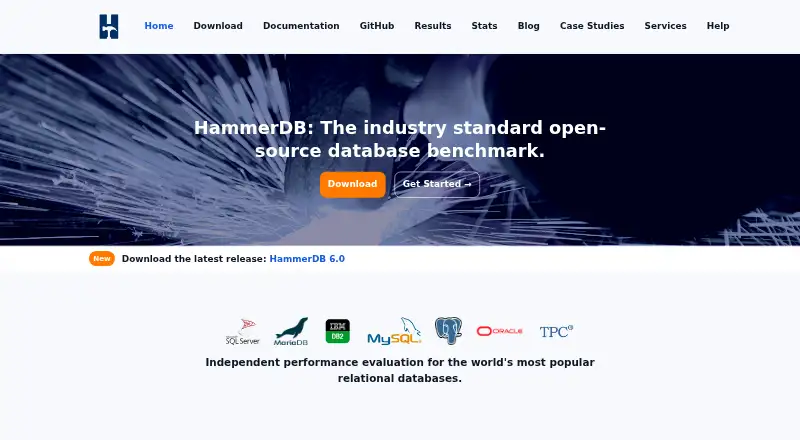
HammerDB is a free database benchmarking application for running workloads across SQL Server, Db2, Oracle, PostgreSQL, MariaDB, MySQL and VillageSQL. It offers graphical, command-line, web and automation interfaces, with Windows and Linux builds, a Docker image and on-premise deployment listed. Version 6.0 adds CI and pipeline workflows for MariaDB, MySQL and PostgreSQL, covering schema sizing, workload execution and result capture. It also includes I/O measures such as IOPS and MB/s and Active Session History viewers for MySQL and MariaDB. Timing profiles use reservoir sampling and extended percentile reporting to compare response-time distributions. Users can upload benchmark artifacts containing workload results, database versions, metrics and system metadata for publication or review. The web service can run as an SCGI application behind a web server or automation gateway. HammerDB is licensed under GNU General Public License Version 3. CI and pipeline automation is described as an advanced capability; workflows may require a compiler, database build dependencies, client and runtime libraries, and operating-system tools for the selected database and workload.
Who it suits
It suits database teams benchmarking supported systems, including those running workloads through graphical, command-line, web or automated workflows. CI and pipeline features are aimed at users automating database builds and benchmark processes.
What it does well
- Free plan costs nothing.
- Supports seven listed database systems.
- Offers graphical, command-line, web and automation interfaces.
- Version 6.0 includes CI and pipeline workflows.
- Benchmark artifacts can be uploaded for review.
What to know first
- Automation workflows may require build and runtime dependencies.
- CI and pipeline automation is described as advanced.
Plans
| Plan | Billed and limits | Price |
|---|---|---|
| HammerDB | Free and open source; GNU General Public License Version 3 · Database benchmarking · Windows and Linux builds · Docker image | Free |
As hammerdb.com lists them, read 9 Oct 2026. The maker's own page has the final word.
Getting started
- Visit the HammerDB website.
- Choose the Windows or Linux build, or use the listed Docker image.
- Select the database system and workload to benchmark.
- For automated workflows, prepare the required compiler, database dependencies, libraries, and operating-system tools.
- For version 6.0 upgrades from 5.0, remove existing persistent configuration database files before the first start.
- Consult the documentation or use GitHub Discussions and Issues for further support.
Overview
HammerDB is for database engineers and operations teams who need to generate repeatable benchmark workloads against systems they manage. Its broad database coverage and several execution interfaces are compelling; its advanced automation is best suited to teams comfortable assembling the required build and runtime environment.
Key features
HammerDB supports SQL Server, Db2, Oracle, PostgreSQL, MariaDB, MySQL and VillageSQL, with graphical, command-line, web and automation interfaces. That range lets teams choose interactive benchmarking or integrate runs into technical workflows. The trade-off is that the most extensive automation is narrower than the database list: version 6.0's CI and pipeline capabilities cover MariaDB, MySQL and PostgreSQL, including schema sizing, workload execution and result capture.
Version 6.0 adds I/O measures such as IOPS and MB/s, along with Active Session History viewers for MySQL and MariaDB. Timing profiles use reservoir sampling and extended percentile reporting, which can help compare response-time distributions rather than reducing performance to a single figure. Benchmark artifacts can be uploaded with results, database versions, metrics and system metadata for publication or review.
The web service can run as an SCGI application behind a web server or automation gateway, making it an option for teams integrating it into an existing deployment. HammerDB supports load, stress and distributed-load testing, and is deployed on-premise. These capabilities make it a benchmark tool for infrastructure under the user's control, not a managed hosted testing service.
Pricing
HammerDB costs nothing. Its free and open-source GNU General Public License Version 3 plan includes database benchmarking, Windows and Linux builds, and a Docker image. There are no paid tiers to weigh against the free plan; the license permits users to work with the software under its stated open-source terms.
The cost is not the only practical consideration. Automated workflows may require a compiler, database build dependencies, client and runtime libraries, and operating-system tools, depending on the selected database and workload. First-level support comes through the documentation; further support via GitHub requires an account, with questions in Discussions and bugs or feature requests in Issues.
Platforms
HammerDB supports Windows and Linux and is also categorized for web and self-hosted use. The Docker image provides another deployment option. Its on-premise model suits teams that need to run benchmarks within their own environments; it also leaves setup and runtime dependencies in their hands.
Who it's for
HammerDB is a strong fit for database administrators, performance engineers and infrastructure teams comparing database workloads or building repeatable benchmarks. Its CI and pipeline automation is explicitly an advanced capability, best suited to users automating database builds and benchmark workflows. Teams wanting a ready-made, low-dependency testing service should look elsewhere.
Users upgrading from version 5.0 should remove existing persistent configuration database files before starting version 6.0 for the first time. That makes upgrade planning important for teams with established installations.
Pros and cons
- Pros: Broad support across seven database systems gives teams one application for benchmarking varied database environments.
- Pros: Multiple interfaces, distributed-load support and result artifacts with system metadata suit repeatable, reviewable performance work.
- Pros: Free, open-source licensing and Windows, Linux and Docker options make it accessible for self-managed deployments.
- Cons: Version 6.0 pipeline automation is stated for only MariaDB, MySQL and PostgreSQL, not the full set of supported databases.
- Cons: Automation can involve compilers, database build dependencies, libraries and operating-system tools, so setup may be demanding.
- Cons: Support beyond documentation runs through GitHub and requires an account, rather than a stated dedicated support channel.
Alternatives
For a different kind of database testing, Amazon Deequ is a free Apache 2.0 open-source library for Linux, macOS, Windows and self-hosted environments; it requires Apache Spark, and its release must match the Spark version. Pick it when that library model and Spark dependency suit the work better than HammerDB's benchmark workloads.
DataKitchen TestGen offers a free-forever open-source plan limited to one user, one connection and one project, with unlimited tables and data volume plus community support. It is worth considering when those stated plan limits fit the use case; HammerDB is the more direct choice for database workload benchmarking.
Atlas is an open-core database migration tool, with an Apache 2.0 core engine and advanced features available in proprietary form. Consider it when migration tooling, rather than workload benchmarking, is the priority.
Great Expectations has a free Developer plan for up to five data assets under test per month, three users and unlimited rows per asset. Choose it when those data-asset testing limits suit the task; HammerDB focuses on benchmarking database performance.
pgroll is a free open-source option for PostgreSQL 14.0 or later, distributed as a single cross-platform binary. It is a narrower alternative for users who need that PostgreSQL tool rather than multi-database benchmarking.
Soda offers a free plan with processing units, pipeline testing, metrics observability and alerting and ticketing integrations. It may fit teams seeking those testing and observability functions instead of HammerDB's benchmark workloads.
Sqitch is a free database change-management application. Consider it when managing database changes is the need, rather than measuring workload performance.
SQLancer is a free MIT-licensed option with no paid tiers listed. It is an alternative for readers comparing database tools whose specific needs do not require HammerDB's stated benchmarking scope.
Browse more options in Database Testing Tools and Performance Testing Software.
Verdict
Choose HammerDB if you need a free, self-managed way to benchmark several database systems and can handle the setup required for advanced automation. Its mix of database coverage, execution interfaces and detailed performance profiles is the main reason to choose it. Look elsewhere if you need a managed service, simpler deployment, or pipeline automation for a database outside the three covered in version 6.0.
Verdict
HammerDB covers benchmarking across several database systems and provides multiple ways to run workloads. Its 6.0 automation features are suited to advanced workflows, which may involve additional build and runtime requirements.
Questions
How much does HammerDB cost?
The plan is free.
Is HammerDB open source?
Yes. It is released under the GNU General Public License Version 3.
Which platforms are available?
Windows and Linux builds are listed, along with a Docker image. The deployment model is on-premise.
Which databases can it benchmark?
It runs workloads across SQL Server, Db2, Oracle, PostgreSQL, MariaDB, MySQL, and VillageSQL.
Does HammerDB support automated benchmarking?
Yes. Version 6.0 adds CI and pipeline capabilities for MariaDB, MySQL, and PostgreSQL, including schema sizing, workload execution, and result capture.
Where can users get support?
Documentation provides first-level support. GitHub Discussions and Issues provide further support and require a GitHub account.
Facts from HammerDB's own pages
- Automation requirements
- Automated workflows may require a compiler, database build dependencies, client and runtime libraries, and operating-system tools for the selected database and workload. · hammerdb.com, 9 Oct 2026
- Intended users
- The documentation describes CI and pipeline automation as an advanced capability for users automating database builds and benchmark workflows. · hammerdb.com, 9 Oct 2026
- Interfaces
- HammerDB supports graphical, command-line, web and automation interfaces. · hammerdb.com, 9 Oct 2026
- License
- HammerDB is released under the GNU General Public License Version 3. · hammerdb.com, 9 Oct 2026
- Metrics
- Version 6.0 includes I/O metrics such as IOPS and MB/s, plus Active Session History viewers for MySQL and MariaDB. · hammerdb.com, 9 Oct 2026
- Performance profiles
- Timing profiles support reservoir sampling and extended percentile reporting for comparing response-time distributions. · hammerdb.com, 9 Oct 2026
- Platforms
- The official version 6.0 downloads include Windows, Red Hat Enterprise Linux 9 and Ubuntu 24.04 builds, source archives and a Docker image; Linux packages include x86-64 and ARM64 variants. · hammerdb.com, 9 Oct 2026
- Purpose
- HammerDB is a database benchmarking application for running workloads across SQL Server, Db2, Oracle, PostgreSQL, MariaDB, MySQL and VillageSQL. · hammerdb.com, 9 Oct 2026
- Result sharing
- Users can upload benchmark result artifacts with workload results, database versions, metrics and system metadata for publication or review. · hammerdb.com, 9 Oct 2026
- Security and compliance
- The maker's About & Support page identifies the GPL Version 3 license and does not state a security certification or compliance standard. · hammerdb.com, 9 Oct 2026
- Support
- First-level support is available through the documentation; further support through GitHub requires a GitHub account, with questions handled in Discussions and bugs or feature requests in Issues. · hammerdb.com, 9 Oct 2026
- Upgrade note
- Users upgrading from version 5.0 are instructed to remove existing HammerDB persistent configuration database files before first starting version 6.0. · hammerdb.com, 9 Oct 2026
- Web service
- The web service can run as an SCGI application for deployment behind a web server or automation gateway. · hammerdb.com, 9 Oct 2026
- Workload automation
- Version 6.0 adds CI and pipeline capabilities for MariaDB, MySQL and PostgreSQL, including schema sizing, workload execution and result capture. · hammerdb.com, 9 Oct 2026
Where HammerDB stands on Freedom251
- Performance Testing Software#8 of 38
- Database Testing Tools#8 of 28