Freedom251 › Database Testing Tools
SQLancer
What SQLancer is
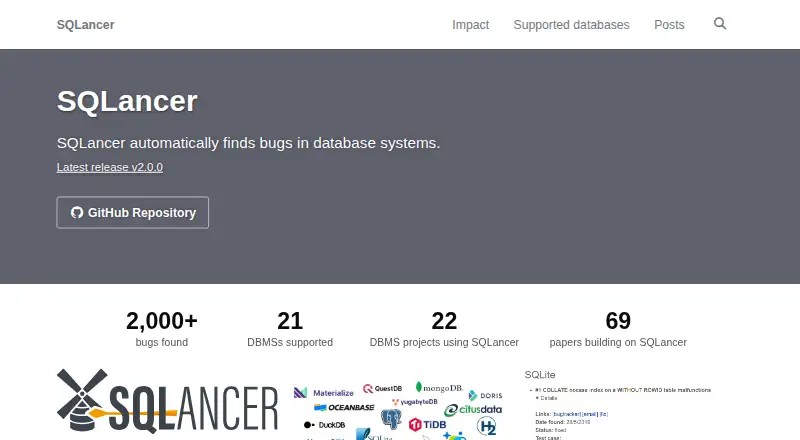
SQLancer is a tool for finding bugs in database management systems by generating SQL statements and database states, then checking query behavior with test oracles. Its targets include logic errors, performance problems, unexpected internal errors, and crashes. The listed oracle methods are TLP, NoREC, PQS, DQP, CODDTest, and CERT. Its supported-databases page names 21 implementations, including PostgreSQL, MySQL, SQLite, DuckDB, and ClickHouse; an impact page reports evidence of use by 22 DBMS projects. SQLancer runs on Linux, macOS, and Windows, and requires Java 11 or later and Maven. It is free under the MIT License, with no paid tiers listed. Releases are available through GitHub, Maven Central, and DockerHub, while the README recommends the latest GitHub source. DuckDB, H2, and SQLite can run embedded, with binaries included as JAR dependencies. A run may continue indefinitely if no bug appears, though options can stop it after a chosen bug count or timeout. The README also points to a Slack workspace for discussion.
Who it suits
SQLancer suits database developers and testers who want to generate SQL-based checks for supported DBMS implementations. Users should be comfortable with Java 11 or above and Maven.
What it does well
- Free under the MIT License, with no paid tiers listed.
- Supports Linux, macOS, and Windows.
- Lists 21 supported database implementations.
- Offers several named test oracle methods.
- Can run DuckDB, H2, and SQLite embedded.
What to know first
- Requires Java 11 or above and Maven.
- Runs may continue indefinitely without a stopping option.
- Other DBMS versions may produce false alarms.
Limits
SQLancer can run indefinitely when it finds no bugs, although options can stop it after a chosen bug count or timeout. The README says tests against DBMS versions other than the specific versions used by the project can produce false alarms.
Plans
| Plan | Billed and limits | Price |
|---|---|---|
| Free | MIT License · no paid tiers listed | Free |
As sqlancer.github.io lists them, read 4 Oct 2026. The maker's own page has the final word.
Getting started
- Choose a release through GitHub, Maven Central, or DockerHub; the README recommends the latest source on GitHub.
- Install Java 11 or above and Maven.
- Select a supported DBMS and configure a run using SQLancer’s available options.
- Set a bug-count or timeout stopping option if you do not want a run to continue indefinitely.
Verdict
SQLancer combines generated SQL testing with multiple test-oracle methods across a broad listed set of database implementations. Check the supported DBMS versions and configure a bug-count or timeout stop if needed.
Questions
How much does SQLancer cost?
SQLancer is free under the MIT License. No paid tiers are listed.
Which operating systems does it support?
It runs on Linux, macOS, and Windows.
What does SQLancer test?
It automatically tests database management systems for bugs, performance issues, unexpected internal errors, and crashes.
What does it require?
The README lists Java 11 or above and Maven as minimum requirements.
How can I obtain SQLancer?
Releases are available through GitHub, Maven Central, and DockerHub. The README recommends the latest source on GitHub.
Can a run be stopped automatically?
Yes. Options can stop a run after a chosen number of bugs or a timeout; otherwise, it can continue indefinitely if no bugs are found.
Facts from SQLancer's own pages
- Adoption
- The impact page reports 22 DBMS projects with evidence of using SQLancer. · sqlancer.github.io, 4 Oct 2026
- Bug types
- It targets logic bugs, performance issues, unexpected internal errors, and database crashes. · github.com, 4 Oct 2026
- Database support
- The official supported-databases page lists 21 implementations, including PostgreSQL, MySQL, SQLite, DuckDB, and ClickHouse. · sqlancer.github.io, 4 Oct 2026
- DBMS version limits
- The README says SQLancer is tested against specific DBMS versions and that testing other versions can produce false alarms. · github.com, 4 Oct 2026
- Distribution
- The README says releases are available through GitHub, Maven Central, and DockerHub, and recommends the latest source on GitHub. · github.com, 4 Oct 2026
- Embedded databases
- DuckDB, H2, and SQLite are supported as embedded systems with binaries included as JAR dependencies. · github.com, 4 Oct 2026
- License
- The project says it is free to use under the MIT License. · sqlancer.github.io, 4 Oct 2026
- Purpose
- SQLancer automatically tests database management systems to find bugs in their implementation. · github.com, 4 Oct 2026
- Requirements
- The README lists Java 11 or above and Maven as minimum requirements. · github.com, 4 Oct 2026
- Run behavior
- SQLancer can run indefinitely when it finds no bugs; the README describes options to stop after a chosen number of bugs or a timeout. · github.com, 4 Oct 2026
- Support
- The project README points users to a Slack workspace for SQLancer and DBMS testing discussions. · github.com, 4 Oct 2026
- Test generation
- It generates SQL statements and database states, then validates queries using test oracles. · github.com, 4 Oct 2026
- Testing methods
- Its listed test oracles include TLP, NoREC, PQS, DQP, CODDTest, and CERT. · github.com, 4 Oct 2026
Where SQLancer stands on Freedom251
- Database Testing Tools#16 of 28