Freedom251 › Database Testing Tools

Database Rider
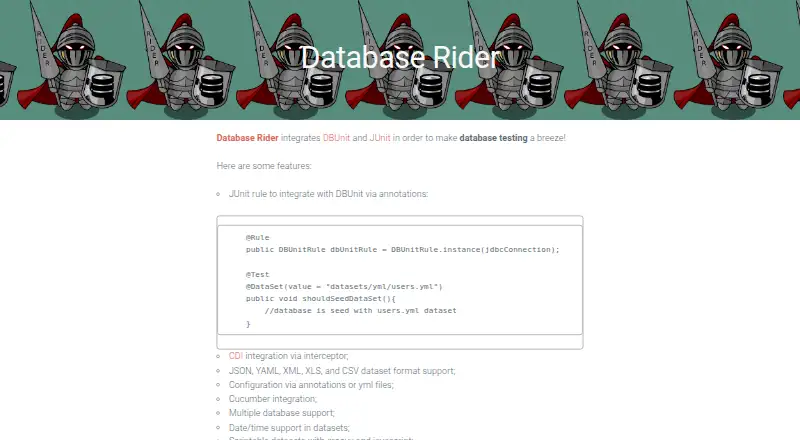
What Database Rider is
Database Rider connects DBUnit dataset handling with JUnit tests so developers can prepare database state for testing. It provides rules for JUnit 4 and an extension for JUnit 5; CDI tests can use an interceptor that reads @DataSet, and a CDI-aware Cucumber runner supports database-backed tests. Datasets can be supplied as JSON, YAML, XML, XLS, or CSV, with configuration through annotations or YAML files. They can include date and time values, Groovy and JavaScript scripts, and regular expressions in expected data. The documentation describes dataset export in those same five formats and lists support for multiple databases. Other listed features include database connection leak detection. The project is self-hosted, and its core module is shown as a Maven dependency with test scope. The JUnit 4 DBUnit rule requires a JDBC connection to be created. Database Rider is free and open source under the Apache 2 license; the project site names Rafael M. Pestano as maintainer.
Who it suits
It suits developers who want to seed database state for JUnit tests, including tests using CDI or Cucumber integrations. Users need to run it in a self-hosted setup.
What it does well
- Supports JUnit 4 and JUnit 5.
- Accepts five dataset formats.
- Dataset configuration can use annotations or YAML.
- Expected datasets can use regular expressions.
- Includes database connection leak detection.
What to know first
- The JUnit 4 rule requires a JDBC connection.
- Test execution is self-hosted.
Limits
The JUnit 4 DBUnit rule requires a JDBC connection to be created. The project is self-hosted, so execution runs in your own environment.
Getting started
- Open the Database Rider project website
- Add the core module as a Maven dependency with test scope
- Choose JUnit 4 rules or the JUnit 5 extension
- Configure datasets through annotations or YAML files
- Connect the test setup to a supported database
- Create datasets in JSON, YAML, XML, XLS, or CSV
Verdict
Database Rider offers multiple dataset formats and integrations for database-backed tests in JUnit, CDI, and Cucumber. Its self-hosted setup and JDBC prerequisite for the JUnit 4 rule are worth noting.
Questions
Is Database Rider free?
Yes. Its pricing model is free, and the project is open source under the Apache 2 license.
Does it offer a free trial?
No free trial is listed.
Which test frameworks are supported?
It provides integrations for JUnit 4, JUnit 5, CDI, and Cucumber tests.
What dataset formats can it use?
Datasets can use JSON, YAML, XML, XLS, and CSV. Exporting to those formats is also documented.
Which languages can scripts use?
Dataset scripts can use Groovy and JavaScript; the listed test languages are Java, Groovy, and JavaScript.
How is it distributed?
The documentation shows the core module added as a Maven dependency with test scope.
Facts from Database Rider's own pages
- Additional features
- It includes dataset export and database connection leak detection. · database-rider.github.io, 9 Oct 2026
- CDI integration
- A CDI interceptor can read @DataSet to prepare the database in CDI tests. · database-rider.github.io, 5 Oct 2026
- Configuration
- Dataset and DBUnit configuration can be provided through annotations or YAML files. · database-rider.github.io, 9 Oct 2026
- Connection checks
- The listed features include database connection leak detection. · database-rider.github.io, 5 Oct 2026
- Cucumber integration
- The project includes a CDI-aware Cucumber runner for database-backed tests. · database-rider.github.io, 5 Oct 2026
- Database support
- The project lists support for multiple databases and uses a JDBC connection to create its DBUnit rule. · database-rider.github.io, 9 Oct 2026
- Dataset features
- Datasets support date and time values, Groovy and JavaScript scripts, and regular expressions in expected data. · database-rider.github.io, 9 Oct 2026
- Dataset formats
- It supports datasets in JSON, YAML, XML, XLS, CSV, and XLSX formats. · database-rider.github.io, 9 Oct 2026
- Distribution
- The documentation shows the core module added as a Maven dependency with test scope. · github.com, 9 Oct 2026
- Expected data
- Expected datasets can contain regular expressions. · database-rider.github.io, 5 Oct 2026
- Export
- The documentation describes exporting datasets, including to YAML, JSON, XML, XLS, and CSV. · database-rider.github.io, 5 Oct 2026
- Intended users
- The project is aimed at developers who want to seed database state for JUnit tests. · database-rider.github.io, 9 Oct 2026
- JDBC requirement
- The JUnit 4 DBUnit rule requires a JDBC connection to be created. · database-rider.github.io, 5 Oct 2026
- JUnit support
- It provides JUnit 4 rules and a JUnit 5 extension for preparing database state from dataset annotations. · database-rider.github.io, 5 Oct 2026
- License
- The project repository identifies its license as Apache-2.0. · github.com, 9 Oct 2026
- Maintainer
- The project site lists Rafael M. Pestano as maintainer. · database-rider.github.io, 5 Oct 2026
- Purpose
- Database Rider brings DBUnit into JUnit tests to support database testing. · database-rider.github.io, 9 Oct 2026
- Scriptable datasets
- Datasets can use Groovy and JavaScript scripts. · database-rider.github.io, 5 Oct 2026
- Test frameworks
- It provides integrations for JUnit 4, JUnit 5, CDI, and Cucumber tests. · database-rider.github.io, 9 Oct 2026
Where Database Rider stands on Freedom251
- Database Testing Tools#18 of 28