Freedom251 › Container Networking Software
kube-network-policies
What kube-network-policies is
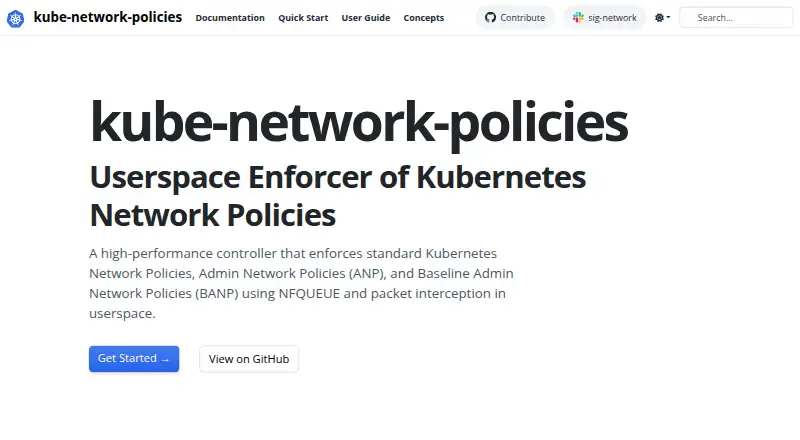
kube-network-policies is a Linux userspace implementation of Kubernetes network policies. It uses NFQUEUE and nftables to intercept and evaluate traffic, and supports standard Kubernetes NetworkPolicy, AdminNetworkPolicy (ANP), and BaselineAdminNetworkPolicy (BANP). When policies target pods, it can identify and capture their packets without intercepting all traffic. Enabling ANP or BANP disables that optimization and sends all node traffic to userspace for evaluation.
The documented evaluation sequence checks logging, Admin Network Policy, standard NetworkPolicy, Baseline Admin Network Policy, then allows traffic by default. ANP and CNP can match external domain names using cached DNS A and AAAA answers. Structured JSON logs support troubleshooting, and a PolicyEvaluator plugin pipeline can add custom validation logic. Installation is available through raw Kubernetes manifests or Helm. The local development quick start requires Docker, KIND, and kubectl; ANP or BANP also require the experimental Network Policy API CRDs. The project is open source under Apache-2.0 and is not an officially supported Google product.
Who it suits
This project suits Kubernetes operators who need policy evaluation in userspace on Linux. Its local development instructions are aimed at people with Docker, KIND, and kubectl available.
What it does well
- Supports standard NetworkPolicy, ANP, and BANP.
- Install with raw manifests or Helm.
- Structured JSON logs aid policy troubleshooting.
- Custom validation can be added through its plugin pipeline.
- Can match external domains using cached DNS answers.
What to know first
- ANP or BANP disables selective packet capture optimization.
- ANP and BANP require experimental API CRDs.
- Local development requires Docker, KIND, and kubectl.
- Not an officially supported Google product.
Limits
When ANP or BANP is enabled, selective capture is disabled and all node traffic is diverted to userspace for evaluation. Those policies also require the experimental Network Policy API CRDs.
Plans
| Plan | Billed and limits | Price |
|---|---|---|
| Open-source project | Kubernetes network policy implementation · install with raw manifests or Helm | Free |
As kube-network-policies.sigs.k8s.io lists them, read 9 Oct 2026. The maker's own page has the final word.
Getting started
- Use Linux with a Kubernetes environment or KIND.
- For the local development quick start, prepare Docker, KIND, and kubectl.
- Install the project using raw Kubernetes manifests or Helm.
- For ANP or BANP, install the experimental Network Policy API CRDs before deploying the configured daemonset.
kube-network-policies is a Linux userspace policy engine for Kubernetes operators who need both ordinary pod rules and cluster-wide administrative policy formats. It is strongest when selective capture can limit evaluation to affected pods; teams enabling ANP or BANP must accept all-node userspace processing and additional CRD setup.
Overview
The project intercepts traffic with Linux NFQUEUE and nftables, then evaluates it in userspace. It handles standard Kubernetes NetworkPolicy as well as AdminNetworkPolicy (ANP) and BaselineAdminNetworkPolicy (BANP), including egress control. That combination suits clusters seeking policy enforcement without adopting a full networking stack, but it places packet processing in a userspace daemon rather than a dedicated CNI plugin.
Deployment can use raw Kubernetes manifests or Helm. The documented local-development route uses KIND and requires Docker, KIND, and kubectl. ANP and BANP add a firm prerequisite: install the experimental Network Policy API CRDs before deploying the corresponding daemonset.
Key features
Selective packet capture
With active policies targeting particular pods, the implementation identifies those pods and captures their packets instead of intercepting every packet. For standard NetworkPolicy workloads, that can avoid unnecessary userspace evaluation and makes the design more attractive where only a subset of workloads needs enforcement.
The optimization disappears when ANP or BANP is enabled. In that mode, all traffic on every node is diverted to userspace for evaluation. Administrative policy support is therefore a capability gain with a substantial traffic-handling trade-off, especially for operators concerned about broad interception overhead.
Policy pipeline and matching
The evaluation order is explicit: logging, Admin Network Policy, standard NetworkPolicy, Baseline Admin Network Policy, and finally an allow decision. That ordering helps teams reason about which rule wins, while the default allow behavior makes an incomplete policy set permissive rather than implicitly restrictive.
ANP and CNP can match external domain names through an in-memory DNS cache containing DNS A and AAAA answers. Domain-based decisions depend on that cache, so this is best for environments prepared to account for DNS-derived matching rather than relying only on pod and IP selectors.
Diagnostics and extensibility
Structured JSON logs expose policy decisions in a form suited to centralized log analysis and troubleshooting. The PolicyEvaluator plugin pipeline can accept custom validation logic, giving teams a route to enforce organization-specific checks beyond the built-in formats. The project is licensed under Apache-2.0.
Pricing
| Plan | Price | Includes |
|---|---|---|
| Open-source project | free | Kubernetes network policy implementation; installation with raw manifests or Helm |
There is no paid tier, subscription, seat quota, or trial period. The free plan is a practical fit for teams able to operate Kubernetes policy infrastructure themselves; it does not come with a commercial support entitlement. Maintainer contact is through the Kubernetes #sig-network Slack channel and mailing list.
Platforms
kube-network-policies runs on Linux in self-hosted Kubernetes environments, with Kubernetes and KIND supported in the documented platform set. Docker, KIND, and kubectl are required for the local development setup. It is not a general desktop networking utility and is not presented as a CNI plugin.
Who it's for
Choose it when your cluster needs standard NetworkPolicy plus ANP or BANP, structured decision logs, or an extensible policy-evaluation pipeline. It also fits operators who value selective capture for standard policies and are comfortable managing manifests, Helm releases, and experimental policy CRDs.
Look elsewhere if you need a broader CNI and networking platform, a managed service, or a design that keeps interception selective while administrative policies are active. The all-node userspace path for ANP and BANP is the central operational constraint.
Pros and cons
Pros
- Three Kubernetes policy formats: standard NetworkPolicy, ANP, and BANP cover both workload-level and administrative rules.
- Selective capture for standard policies: packets from unrelated pods avoid interception when they are outside active policy targets.
- Operationally useful diagnostics: structured JSON logs support automated troubleshooting.
- Custom validation: the evaluator plugin pipeline can be extended with organization-specific logic.
- No license cost: the Apache-2.0 project is free to deploy.
Cons
- Administrative policies disable optimization: ANP or BANP sends all node traffic through userspace.
- Extra CRD dependency: ANP and BANP require the experimental Network Policy API CRDs before deployment.
- Linux and self-hosted scope: it does not target managed, cross-platform, or desktop use.
- No commercial plan: support is community-oriented through Kubernetes channels rather than a paid support tier.
Alternatives
Antrea is a better fit when you want a broader Kubernetes networking project and can provide an Open vSwitch kernel module on every node.
Calico Open Source suits teams seeking community-maintained networking with in-memory data retention and unlimited clusters.
Cilium is the alternative when an eBPF-oriented open-source platform for Linux, with kernel 5.10 or equivalent, matches your cluster.
Canal is worth choosing for a free Apache-2.0 option spanning API, Linux, macOS, and self-hosted environments.
Flannel is a straightforward free Apache 2.0 Kubernetes networking project when you need a general networking layer instead of this focused policy engine.
CNI Plugins is the reference collection to pick when you need example and reference CNI network plugins under Apache-2.0.
Cello CNI fits Volcengine ECS deployments that can meet its Kubernetes and Helm 3.0 requirements.
VMware Workstation Pro is a free Windows or Linux host virtualization choice, not a Kubernetes policy implementation.
See the Container Networking Software list for more options.
Verdict
kube-network-policies is a focused, free choice for Linux Kubernetes operators who need three Kubernetes policy formats, selective capture for standard rules, and extensible, structured evaluation. Choose it when you can operate userspace enforcement and, for ANP or BANP, accept experimental CRDs and all-node traffic diversion; choose a broader CNI project when those trade-offs or the self-hosted scope do not fit.
Verdict
kube-network-policies supports several Kubernetes policy formats and offers selective capture when its optimization applies. Operators enabling ANP or BANP should account for the required CRDs and all-node userspace evaluation.
Questions
What does kube-network-policies cost?
The Open-source project plan is free.
Is it open source?
Yes. The repository lists the Apache-2.0 license.
Which policy types does it support?
It supports standard Kubernetes NetworkPolicy, AdminNetworkPolicy (ANP), and BaselineAdminNetworkPolicy (BANP).
How can I install it?
The quick start documents installation with raw Kubernetes manifests or Helm.
What is required for the local development quick start?
It uses KIND and lists Docker, KIND, and kubectl as prerequisites.
Where can I reach the maintainers?
The repository points users to the Kubernetes #sig-network Slack channel and mailing list.
Facts from kube-network-policies's own pages
- Admin policy behavior
- When ANP or BANP is enabled, the optimization is disabled and all node traffic is diverted to userspace for evaluation. · kube-network-policies.sigs.k8s.io, 9 Oct 2026
- ANP/BANP requirement
- Using ANP or BANP requires installing the experimental Network Policy API CRDs before deploying the ANP-configured daemonset. · kube-network-policies.sigs.k8s.io, 8 Oct 2026
- Domain matching
- ANP and CNP can match external domain names using an in-memory DNS cache that records DNS A and AAAA answers. · kube-network-policies.sigs.k8s.io, 9 Oct 2026
- Extensibility
- The policy pipeline uses PolicyEvaluator plugins to support additional validation logic. · kube-network-policies.sigs.k8s.io, 9 Oct 2026
- Installation
- The quick start documents installation using raw Kubernetes manifests or Helm in the kube-system namespace. · kube-network-policies.sigs.k8s.io, 9 Oct 2026
- Integrations
- ANP and BANP support integrates with the Kubernetes Network Policy API custom resource definitions. · kube-network-policies.sigs.k8s.io, 9 Oct 2026
- License
- The repository lists the Apache-2.0 license. · github.com, 8 Oct 2026
- Logging
- Structured JSON logging can provide machine-readable diagnostics for packet policy decisions. · github.com, 9 Oct 2026
- Packet handling
- It uses Linux NFQUEUE and nftables to intercept and evaluate network traffic in userspace. · kube-network-policies.sigs.k8s.io, 8 Oct 2026
- Policy formats
- It supports standard Kubernetes NetworkPolicy, AdminNetworkPolicy (ANP), and BaselineAdminNetworkPolicy (BANP). · kube-network-policies.sigs.k8s.io, 8 Oct 2026
- Policy ordering
- The documented evaluation pipeline checks logging, Admin Network Policy, standard NetworkPolicy, Baseline Admin Network Policy, then defaults to allowing traffic. · kube-network-policies.sigs.k8s.io, 9 Oct 2026
- Policy support
- It supports standard Kubernetes NetworkPolicy, AdminNetworkPolicy (ANP), and BaselineAdminNetworkPolicy (BANP). · kube-network-policies.sigs.k8s.io, 9 Oct 2026
- Prerequisites
- The local development quick start uses KIND and lists Docker, KIND, and kubectl as prerequisites. · kube-network-policies.sigs.k8s.io, 8 Oct 2026
- Project status
- The documentation says this is not an officially supported Google product and is not eligible for Google's Open Source Software Vulnerability Rewards Program. · kube-network-policies.sigs.k8s.io, 9 Oct 2026
- Purpose
- A userspace implementation that enforces Kubernetes network policies by intercepting packets with Linux NFQUEUE. · kube-network-policies.sigs.k8s.io, 9 Oct 2026
- Requirements
- The quick start prerequisites are Docker, KIND, and kubectl for its local development cluster instructions. · kube-network-policies.sigs.k8s.io, 9 Oct 2026
- Security disclaimer
- The project says it is not an officially supported Google product and is not eligible for the Google Open Source Software Vulnerability Rewards Program. · kube-network-policies.sigs.k8s.io, 8 Oct 2026
- Security reporting
- The project directs users to the Kubernetes Security and Disclosure Information page to report vulnerabilities. · github.com, 9 Oct 2026
- Selective capture
- In standard mode, it selectively captures packets for pods targeted by active standard NetworkPolicies. · kube-network-policies.sigs.k8s.io, 9 Oct 2026
- Support
- The repository README lists the Kubernetes Slack #sig-network channel and the sig-network mailing list for maintainers and community support. · github.com, 9 Oct 2026
Where kube-network-policies stands on Freedom251
- Container Networking Software#10 of 28