Freedom251 › Container Networking Software
Flannel
What Flannel is
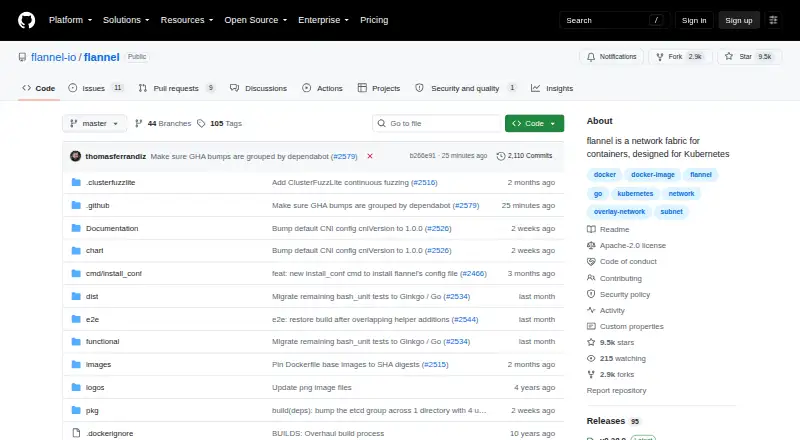
Flannel is a free network fabric for connecting containers, designed for Kubernetes. A small flanneld agent on each host receives a subnet lease from a configured address space, and Flannel forwards packets between hosts through a selected backend. Documented choices include VXLAN, host-gw, WireGuard and UDP, with VXLAN recommended; backend documentation says the choice should not be changed at runtime. WireGuard encapsulates and encrypts packets using the in-kernel WireGuard implementation. Network configuration and subnet allocations can be stored in the Kubernetes API or directly in etcd. The project documents Kubernetes and Docker deployments, with Linux and Windows build instructions. It does not enforce network policies natively, though its Helm chart can deploy a Kubernetes SIGs network policy controller alongside it. Listed integrations include kube-network-policies, Canal, K3s and RKE2. Flannel runs as a privileged daemonset with host-network access, so its security policy advises least privilege and keeping it updated. Security fixes are maintained for the latest release only; older releases are not actively patched.
Who it suits
Flannel suits teams connecting containers in Kubernetes environments that can manage host-level networking and select a backend. It can also be used with documented Docker deployments.
What it does well
- Free project under the Apache 2.0 license.
- Documented Kubernetes and Docker deployments.
- Offers VXLAN, host-gw, WireGuard and UDP backends.
- WireGuard backend encrypts packets.
- Network configuration can use Kubernetes API or etcd.
What to know first
- Network policies are not enforced natively.
- Only the latest release receives security fixes.
- Runs as a privileged daemonset with host-network access.
- Backend selection should not change at runtime.
Limits
Flannel is free, and no trial is offered. It does not natively enforce network policies, its backend should not be changed at runtime, and security fixes are maintained for the latest release only.
Plans
| Plan | Billed and limits | Price |
|---|---|---|
| Flannel | Open-source Kubernetes networking project · Apache 2.0 license | Free |
As github.com lists them, read 4 Oct 2026. The maker's own page has the final word.
Getting started
- Open the Flannel project website on GitHub.
- Choose a documented Kubernetes or Docker deployment.
- Use the build instructions for Linux or Windows, as applicable.
- Select a backend; VXLAN is the recommended choice.
- Choose Kubernetes API or etcd for network configuration and subnet allocations.
Flannel is a free, open-source container network fabric built primarily for Kubernetes. It is best for operators who need straightforward host-to-host connectivity and can run a privileged networking component. Its backend flexibility is useful, but teams needing built-in policy enforcement or long-term patching of older releases should look elsewhere.
Overview
Flannel runs a small flanneld agent on every host and allocates each host a subnet lease from a configured address space. It then forwards traffic between hosts, creating the layer 3 connectivity containers need across a cluster. Network configuration and subnet allocations can be stored in the Kubernetes API or directly in etcd, so existing control-plane choices can determine the most natural setup.
The project documents Kubernetes and Docker environments, with build instructions for Linux and Windows. It also identifies integrations with kube-network-policies, Canal, K3s and RKE2. That makes Flannel a focused networking layer that can be combined with other cluster components rather than a complete policy and security suite by itself.
Key features
- Several forwarding backends: VXLAN is the recommended backend, while host-gw, UDP, WireGuard and cloud integrations are documented alternatives. This gives infrastructure teams room to match their environment, but the backend is an architectural choice: documentation says it should not be changed at runtime, so select it before deployment.
- WireGuard encryption: The WireGuard backend encapsulates and encrypts packets using the in-kernel WireGuard implementation. Choose it when encrypted transport is a requirement; the other listed backends are not described as providing that encryption.
- Kubernetes CNI integration: Flannel functions as a CNI plugin and supplies the underlying pod-network connectivity. Its scope is deliberately narrow, which keeps the job clear but leaves policy controls to another component.
- Policy add-on path: Flannel does not enforce network policies natively. Its Helm chart can deploy a Kubernetes SIGs network policy controller alongside it, and the project points to integrations such as kube-network-policies and Canal. This can fill the policy gap, but it adds another component to operate and secure.
- Datastore choices: Operators can place network state in the Kubernetes API or etcd. The choice accommodates different cluster architectures, although it also ties deployment decisions to how those stores are administered.
- Privileged deployment: Flannel runs as a privileged daemonset with host-network access. That is consistent with its role in configuring node networking, but it raises the impact of a misconfiguration; the security policy advises least privilege and keeping the software updated.
- Security maintenance: Maintainers direct vulnerability reports through GitHub private vulnerability reporting and say reports are acknowledged within seven days. Security fixes are maintained for the latest release only, so staying current is essential for teams that cannot accept unpatched older versions.
- Operational support: Users are directed to the #k3s channel in Rancher Users Slack, #flannel-users in Calico Users Slack and GitHub issues for bugs. Those channels are useful for community troubleshooting rather than a paid support commitment.
Pricing
| Plan | Price | Includes | Best for |
|---|---|---|---|
| Flannel | free | Open-source Kubernetes networking project under the Apache 2.0 license | Teams building and operating their own Kubernetes or Docker networking |
There is no free trial because the software is free, and no subscription, seat quota or usage allowance is published for this plan. The trade-off is operational responsibility: deployment, updates, privileged access and any policy controller are managed by the operator.
Platforms
Flannel supports Kubernetes, Docker, Linux and Windows, with documented Kubernetes and Docker deployments and Linux and Windows build instructions. It is self-hosted software, so teams must provide and maintain the cluster or hosts where the daemonset and related components run.
Who it's for
Flannel suits Kubernetes operators who want a no-license-cost CNI focused on reliable inter-host pod connectivity, need a choice of forwarding backends, and are comfortable administering etcd or the Kubernetes API. It is also a sensible fit for environments already using K3s, RKE2, Canal or related integrations.
It is a weaker fit for organizations that require network-policy enforcement in the primary plugin, cannot run privileged host-network workloads, or need security fixes on maintained older releases. Those teams should budget for an additional policy controller or choose a networking project whose security and policy model better matches their requirements.
Pros and cons
Pros
- Free and Apache 2.0 licensed: There is no license charge for deploying the networking project.
- Backend flexibility: VXLAN, host-gw, UDP, WireGuard and cloud integrations cover multiple forwarding approaches.
- Optional encrypted transport: WireGuard uses the kernel implementation to encrypt packets in transit.
- Broad documented environment support: Kubernetes and Docker deployments span Linux and Windows build paths.
- Flexible state storage: Network configuration and subnet leases can use the Kubernetes API or etcd.
Cons
- No native network-policy enforcement: Policy requires the bundled controller option or another integrated project.
- Privileged host access: The daemonset runs with host-network access, increasing the consequences of weak hardening.
- Latest-release-only security fixes: Older releases are not actively patched, making update discipline important.
- Backend changes are not runtime-safe: The selected backend must be treated as a deployment-time decision.
Alternatives
Canal is a free Apache-2.0 project to consider when you want a Flannel-related deployment paired with additional networking components.
Antrea is free and requires a Kubernetes cluster plus the Open vSwitch kernel module on every node; choose it when that dependency fits your infrastructure.
Calico Open Source is a free, community-maintained option with in-memory data retention and unlimited clusters.
CNI Plugins is a free Apache-2.0 collection of reference and example CNI network plugins, better suited when you need building blocks rather than a complete Flannel deployment.
kube-network-policies is a free Kubernetes network-policy implementation installable with raw manifests or Helm, useful as the policy layer Flannel lacks.
Cello CNI is a free Apache-2.0 CNI requiring Volcengine ECS, Kubernetes and Helm 3.0.
Cilium is a free open-source option for Linux and self-hosted deployments, requiring Linux kernel 5.10 or equivalent on AMD64 or AArch64.
Browse container networking software for more options.
Verdict
Choose Flannel when you want a free, focused Kubernetes CNI with selectable forwarding backends and an optional WireGuard path, and your team can manage privileged node networking. Look elsewhere if native policy enforcement, non-privileged operation or support for older release branches is a hard requirement.
Verdict
Flannel provides container networking with several backend choices and documented Kubernetes and Docker environments. Teams should account for its privileged host access, lack of native network-policy enforcement and latest-release-only security fixes.
Questions
How much does Flannel cost?
Flannel is listed as free, with a plan price of $0.
Which platforms does Flannel support?
The listed platforms are Linux, self-hosted and Windows. The project documents Kubernetes and Docker deployments.
Is Flannel open source?
Yes. The project is licensed under Apache 2.0.
Does Flannel enforce network policies?
It does not enforce them natively. Its Helm chart can deploy a Kubernetes SIGs network policy controller alongside it.
Does Flannel encrypt network traffic?
Its WireGuard backend encapsulates and encrypts packets using the in-kernel WireGuard implementation.
Where can Flannel store network configuration?
It can store configuration and subnet allocations in the Kubernetes API or directly in etcd.
Facts from Flannel's own pages
- Backends
- Documented backends include VXLAN, host-gw, WireGuard, and UDP; VXLAN is the recommended choice. · github.com, 4 Oct 2026
- Compatibility constraint
- The backend documentation says a selected backend should not be changed at runtime. · github.com, 4 Oct 2026
- Datastores
- Flannel can store network configuration and subnet allocations in the Kubernetes API or directly in etcd. · github.com, 4 Oct 2026
- Deployment security
- Flannel runs as a privileged daemonset with access to the host network, and its security policy advises following least privilege and keeping it updated. · github.com, 4 Oct 2026
- Encryption
- The WireGuard backend encapsulates and encrypts packets using the in-kernel WireGuard implementation. · github.com, 4 Oct 2026
- How it works
- A small flanneld agent on each host allocates that host a subnet lease from a configured address space. · github.com, 4 Oct 2026
- Integrations
- The project lists kube-network-policies, Canal, K3s, and RKE2 as projects that integrate with Flannel. · github.com, 4 Oct 2026
- Network policy
- Flannel does not natively enforce network policies, but its Helm chart can deploy a Kubernetes SIGs network policy controller alongside it. · github.com, 4 Oct 2026
- Notable limitation
- The project maintains security fixes for the latest release only; older releases are not actively patched. · github.com, 4 Oct 2026
- Purpose
- Flannel provides a layer 3 network fabric for containers designed for Kubernetes. · github.com, 4 Oct 2026
- Security reporting
- The security policy directs vulnerability reports to GitHub private vulnerability reporting and says maintainers acknowledge reports within seven days. · github.com, 4 Oct 2026
- Support
- The project points users to the #k3s channel in Rancher Users Slack, the #flannel-users channel in Calico Users Slack, and GitHub issues for bugs. · github.com, 4 Oct 2026
- Supported environments
- The project documents Kubernetes and Docker deployments, with Linux and Windows build instructions. · github.com, 4 Oct 2026
- Traffic forwarding
- Flannel forwards packets between hosts using backends including VXLAN and cloud integrations. · github.com, 4 Oct 2026
Where Flannel stands on Freedom251
- Container Networking Software#4 of 28