Freedom251 › Container Networking Software
CNI Plugins
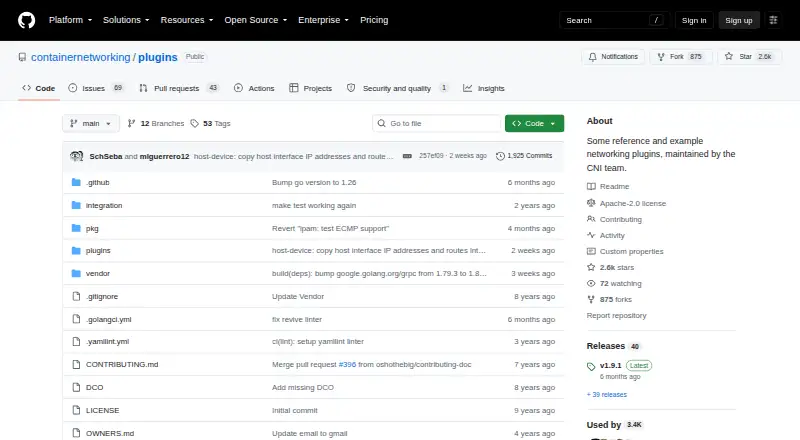
What CNI Plugins is
CNI Plugins is a free collection of reference and example networking plugins for containers on Linux and Windows. The CNI project provides a specification and libraries for configuring container network interfaces, along with plugins that perform those configurations. Interface choices include bridge, ipvlan, loopback, macvlan, point-to-point, VLAN, host-device, and dummy; Windows-specific options include win-bridge and win-overlay. IP address management plugins cover DHCP, host-local allocation tracking, and static IPv4 or IPv6 allocation. Meta plugins add interface tuning, port mapping, bandwidth limits, source-based routing, and firewall rules. A sample plugin serves as an example for creating a custom one. The project also provides a Go library for integrating CNI into applications and a command-line tool for running plugins. CNI focuses on container connectivity and removing allocated resources when a container is deleted. It is distributed under the Apache License, Version 2.0, and is a Cloud Native Computing Foundation project. The latest release page lists Linux archives for amd64, arm, and arm64.
Who it suits
It suits developers and platform teams configuring network interfaces and connectivity for Linux or Windows containers. The sample plugin and Go library may help teams building custom integrations.
What it does well
- Free under the Apache License, Version 2.0.
- Includes Linux and Windows networking plugins.
- IPAM options include DHCP and static IPv4 or IPv6.
- Provides a Go library and command-line tool.
What to know first
- Latest release downloads listed are Linux archives.
- No free trial is offered.
Plans
| Plan | Billed and limits | Price |
|---|---|---|
| Free | Reference and example CNI network plugins · Apache-2.0 license | Free |
As github.com lists them, read 4 Oct 2026. The maker's own page has the final word.
Getting started
- Open the CNI Plugins GitHub repository
- Choose a Linux release archive for amd64, arm, or arm64, if applicable
- Use the CNI specification and libraries to configure container interfaces
- Run plugins with the CNI command-line tool or integrate CNI with the Go library
CNI Plugins suits teams that need configurable building blocks for Linux and Windows container networking, or developers integrating CNI into an application. Its breadth and free Apache 2.0 license make it a strong foundation; teams wanting a complete, ready-made networking system should look elsewhere.
Overview
CNI provides a specification and libraries for configuring network interfaces in containers, with plugins that carry out that work. The project also supplies a Go library for application integration and a command-line tool for executing plugins. Together, these pieces suit operators assembling a network setup and developers embedding CNI, but they leave component selection and composition to the team.
The scope is focused: connect containers to networks and remove allocated resources when a container is deleted. As a Cloud Native Computing Foundation project distributed under the Apache License, Version 2.0, CNI Plugins is a practical choice for teams that value open, adaptable components over a single product with a prescribed workflow.
Key features
Interface plugins cover bridge, ipvlan, loopback, macvlan, point-to-point, VLAN, host-device and dummy networking. This gives teams several ways to configure container interfaces, though the range is most useful when someone can choose the right components for the environment.
IPAM options include DHCP, host-local allocation tracking and static IPv4 or IPv6 allocation. That variety supports different address-management needs, while still requiring operators to settle on an allocation approach and fit it into their setup.
Meta plugins add interface tuning, port mapping, bandwidth limiting, source-based routing and firewall rules. These extend the collection beyond basic interface creation, but do not turn it into a complete network-management product. A sample plugin also gives developers an example to work from when building a custom plugin.
Windows-specific win-bridge and win-overlay plugins extend the project to Windows containers. The latest release page provides downloadable Linux archives, including amd64, arm and arm64 builds; Windows users therefore have platform-specific components, while the named downloadable archives are Linux builds.
The project asks security reporters to contact the email addresses in its OWNERS file privately. Questions go to the cni-dev mailing group or the #cni channel on CNCF Slack.
Pricing
Free — free. The plan includes reference and example CNI network plugins under the Apache-2.0 license. There is no free trial, because the software is offered as a free plan. With no paid tier described, the central trade-off is not feature gating by price but the effort of selecting and integrating the components.
Platforms
CNI Plugins supports Linux and Windows. Linux release archives are available for amd64, arm and arm64; Windows support is represented by win-bridge and win-overlay plugins.
Who it's for
CNI Plugins is best for platform teams choosing networking and IPAM components for containers, and developers who want a Go library and command-line tool to integrate or run CNI. Its interface, IPAM and meta-plugin options reward teams that need flexibility and can make integration decisions. It is a weaker fit for buyers who want one packaged networking system with a turnkey operational model.
Pros and cons
- Pros: A broad choice of interface plugins and IPAM methods lets teams build around their container networking needs.
- Pros: The Go library, execution tool and sample plugin support both application integration and custom development.
- Pros: Free availability under Apache 2.0 keeps the components open to use and adapt.
- Cons: Teams must choose and combine plugins themselves, so the breadth brings configuration and integration responsibility.
- Cons: Linux release downloads are specified for Linux architectures; Windows users must work with the Windows-specific plugins.
Alternatives
For other options, browse Container Networking Software.
- Canal is another free Apache-2.0 project, with API, Linux, macOS and self-hosted platforms; consider it if those platforms better match your requirements.
- VMware Workstation Pro is free for Windows or Linux hosts on 64-bit Intel or AMD PCs, with no subscription or license key required; choose it when that host-software scope fits instead of CNI components.
- Antrea is a free Apache License 2.0 option for Linux, Windows and self-hosted use, but requires a Kubernetes cluster and Open vSwitch kernel module on every Kubernetes node.
- Calico Open Source offers community-driven support and maintenance, in-memory data retention and unlimited clusters; consider it when those stated characteristics are a better fit.
- Flannel is a free, Apache 2.0 open-source Kubernetes networking project; choose it if that project scope suits your needs.
- kube-network-policies is a free Kubernetes network policy implementation installable with raw manifests or Helm; pick it when network policy is the requirement.
- Cello CNI is a free Apache 2.0 option that requires Volcengine ECS, Kubernetes and Helm 3.0; choose it only if those requirements fit.
- Cilium is a free open-source Linux option requiring kernel 5.10 or equivalent and AMD64 or AArch64; consider it if that platform and requirement set works for you.
Verdict
Choose CNI Plugins if you need open, adaptable components to configure container interfaces, manage IP allocation or integrate CNI into software. Its range and free Apache 2.0 license are the main reasons to choose it; look elsewhere if you want a ready-made networking product rather than a collection you must assemble.
Verdict
CNI Plugins offers a broad set of container network and IPAM components, plus integration tools for applications. Its stated scope includes cleaning up allocated resources when a container is deleted.
Questions
How much does CNI Plugins cost?
CNI Plugins is free, with a listed price of $0.
Which platforms does it support?
Linux and Windows are listed as supported platforms.
Is CNI Plugins open source?
The repository is distributed under the Apache License, Version 2.0.
What networking functions are available?
Plugins cover interface configuration, IP address allocation, interface tuning, port mapping, bandwidth limits, source-based routing, and firewall rules.
Who maintains the project?
CNI is a Cloud Native Computing Foundation project, and the plugin collection is maintained by the containernetworking team.
Facts from CNI Plugins's own pages
- Additional plugins
- Meta plugins provide interface tuning, port mapping, bandwidth limiting, source-based routing, and firewall rules. · github.com, 4 Oct 2026
- CNI integration
- The CNI project includes a Go library for integrating CNI into applications and a command-line tool for executing plugins. · cni.dev, 4 Oct 2026
- CNI role
- CNI provides a specification and libraries for configuring network interfaces in Linux and Windows containers, along with supported plugins. · cni.dev, 4 Oct 2026
- Container networking scope
- CNI focuses on container network connectivity and removing allocated resources when a container is deleted. · cni.dev, 4 Oct 2026
- Downloads
- The latest release page lists downloadable Linux plugin archives, including amd64, arm, and arm64 builds. · github.com, 4 Oct 2026
- IP address allocation
- IPAM plugins include DHCP, host-local allocation tracking, and static IPv4 or IPv6 allocation. · github.com, 4 Oct 2026
- License
- The repository is distributed under the Apache License, Version 2.0. · github.com, 4 Oct 2026
- Maintainer organization
- CNI is a Cloud Native Computing Foundation project. · cni.dev, 4 Oct 2026
- Networking features
- Interface plugins include bridge, ipvlan, loopback, macvlan, point-to-point, VLAN, host-device, and dummy. · github.com, 4 Oct 2026
- Purpose
- CNI Plugins is a collection of reference and example network plugins maintained by the containernetworking team. · github.com, 4 Oct 2026
- Sample plugin
- A sample plugin provides an example for building a custom plugin. · github.com, 4 Oct 2026
- Security reporting
- The project asks that security issues be reported privately to the email addresses listed in its OWNERS file. · github.com, 4 Oct 2026
- Support
- The project directs questions to the cni-dev mailing group or the #cni channel on CNCF Slack. · github.com, 4 Oct 2026
- Windows plugins
- The project includes Windows-specific win-bridge and win-overlay plugins. · github.com, 4 Oct 2026
Where CNI Plugins stands on Freedom251
- Container Networking Software#7 of 28