Freedom251 › Software-Defined Networking Software

Cilium
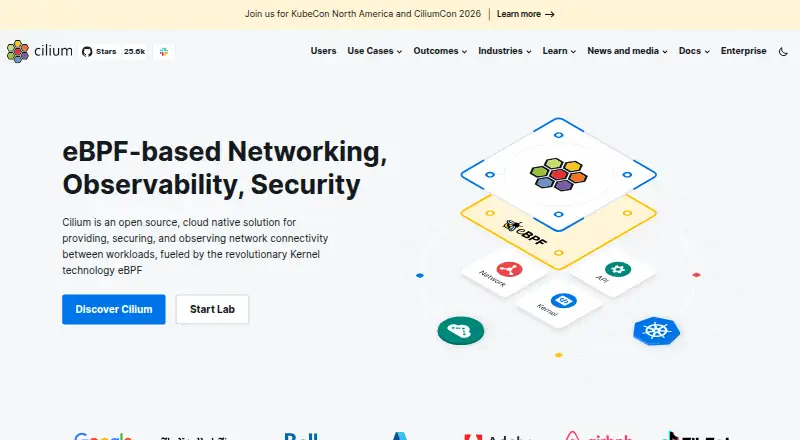
What Cilium is
Cilium is open-source software for providing, securing, and observing network connectivity between workloads, powered by eBPF. Its networking use cases include CNI, Layer 4 load balancing, Cluster Mesh, kube-proxy replacement, BGP, service mesh, Gateway API, IPv6, host firewall, and ingress. Identity-aware network policies can enforce rules across L3–L7, including DNS- and HTTP-aware filtering; listed security features also include runtime security and transparent encryption. Encryption options for managed host and endpoint traffic include IPsec, WireGuard, and ztunnel, which is marked beta. Hubble, built on Cilium and eBPF, provides visibility into service communication and behavior. Other observability features include service maps, metrics and tracing export, network flow logs, and protocol visibility. Documentation describes Prometheus and Grafana integrations and Kubernetes support for services including GKE, AKS, EKS, OpenShift, RKE, k3s, and Alibaba ACK. The container image requires AMD64 or AArch64 hosts with Linux kernel 5.10 or later, or an equivalent kernel such as 4.18 on RHEL 8.10. For environments above 500 nodes, the quick installation guide points to separate large-environment guidance.
Who it suits
Cilium suits teams managing Linux-based workload networking that need policy enforcement, security, and observability. It is relevant to Kubernetes environments and supports multiple listed distributions and services.
What it does well
- Open-source software for workload networking.
- Identity-aware policies cover L3–L7.
- Hubble provides service communication visibility.
- Integrates with Prometheus and Grafana.
What to know first
- Requires AMD64 or AArch64 hosts.
- Requires Linux kernel 5.10 or later, or equivalent.
- Environments above 500 nodes need separate guidance.
- ztunnel encryption support is marked beta.
Limits
Cilium requires AMD64 or AArch64 Linux hosts with kernel 5.10 or later, or an equivalent kernel. Its installation guide directs environments above 500 nodes to additional guidance for large environments or specific datapath modes.
Plans
| Plan | Billed and limits | Price |
|---|---|---|
| Cilium | Open source · Linux kernel >= 5.10 or equivalent · AMD64 and AArch64 | Free |
As cilium.io lists them, read 3 Oct 2026. The maker's own page has the final word.
Getting started
- Open https://cilium.io/.
- Use Linux hosts with AMD64 or AArch64 and kernel 5.10 or later, or an equivalent kernel.
- Follow the installation guide for a supported Kubernetes distribution or service.
- For metrics and dashboards, use the documented Prometheus and Grafana integrations.
- For environments above 500 nodes, refer to the guide's large-environment or datapath-mode guidance.
Cilium is open-source software for connecting, securing, and observing network traffic between workloads. It is best suited to teams operating Linux-based environments, particularly Kubernetes clusters, that need granular policy and visibility alongside networking. Its broad capabilities are compelling, but kernel compatibility and deployment scale deserve attention before adoption.
Overview
Powered by eBPF, Cilium brings workload networking, security controls, and observability into one platform. That breadth can help teams manage these concerns together, but it is more than a minimal networking component; organizations wanting only a narrow connectivity tool may not need its full scope.
Its networking use cases include CNI, Layer 4 load balancing, Cluster Mesh, kube-proxy replacement, BGP, service mesh, Gateway API, IPv6, host firewall, and ingress. The hybrid deployment and control-plane models, policy segmentation, and northbound API make it relevant to organizations managing network policy across workloads.
Key features
Policy and security
Cilium can enforce identity-aware network rules from L3 through L7, including DNS- and HTTP-aware filtering. This is useful when teams need controls that account for workload identity and application traffic, rather than relying only on broad network boundaries. Its security capabilities also include runtime security and transparent encryption.
Encryption for managed host and endpoint traffic can use IPsec, WireGuard, or ztunnel. Because ztunnel support is beta, teams considering that option should account for its status rather than treating it as a mature default.
Observability
Hubble, Cilium’s distributed observability platform built on eBPF, provides visibility into service communication and behavior. Service maps, metrics and tracing export, identity-aware L3/L4/DNS flow logs, and protocol visibility give operators several ways to examine network activity. Prometheus and Grafana integrations support metrics and dashboards, making the observability capabilities useful for teams already using those tools.
Pricing
Cilium is open source and its Cilium plan costs nothing. There are no paid tiers to weigh against reduced capabilities, so the decision is less about subscription cost than whether the environment and operating model fit. The plan requires Linux kernel 5.10 or equivalent and AMD64 or AArch64 hosts.
Platforms
Cilium is Linux and self-hosted software. Its container image requires AMD64 or AArch64 hosts running Linux kernel 5.10 or later, with 4.18 on RHEL 8.10 cited as an equivalent kernel. The quick installation guide covers Kubernetes distributions and services including GKE, AKS, EKS, OpenShift, RKE, k3s, and Alibaba ACK. Environments above 500 nodes should follow the guidance for large environments or specific datapath modes; that is an important deployment consideration for larger clusters.
Who it's for
Cilium is a strong fit for platform and security teams running Linux workloads that need networking, identity-aware policy, and traffic visibility in the same system. Kubernetes operators with varied networking requirements may benefit from its wide use-case coverage. It is a weaker fit for teams seeking a hosted service, working outside its Linux and architecture requirements, or looking for a narrowly scoped network plugin.
Cilium identifies as a CNCF graduated project. Its documentation points users to an FAQ, Slack channels, and GitHub issue tracker for help and bug reports. Documentation also links to 2022 security and fuzzing audits; the security audit summary reported no critical or high severity vulnerabilities in that audit.
Pros and cons
- Broad workload networking: CNI, load balancing, Cluster Mesh, BGP, service mesh, Gateway API, IPv6, host firewall, and ingress address diverse cluster needs.
- Fine-grained policy: Identity-aware L3–L7 rules, including DNS- and HTTP-aware filtering, suit teams that need application-level network controls.
- Useful traffic visibility: Hubble combines service communication views with flow logs, metrics, tracing export, and protocol visibility.
- Infrastructure constraints: Linux kernel and host architecture requirements can rule out otherwise suitable environments.
- Scale needs planning: Deployments above 500 nodes require guidance for large environments or specific datapath modes.
- Beta encryption option: ztunnel is marked beta, so teams should be cautious about making it a required production dependency.
Alternatives
Choose Cloudflare Access instead if a freemium access product with broad desktop, mobile, web, and API platforms is a better match; its free plan is capped at under 50 users. Tailscale is another freemium option for teams looking for a product spanning desktop, mobile, and web platforms, with a free Personal plan for up to six users and unlimited user devices. Consider ZeroTier if its freemium networking model and support for self-hosted and multiple client platforms better suit your environment.
Infoblox Cloud Network Automation is a paid alternative for organizations considering token-based cloud network automation. EfficientIP SOLIDserver DDI is a paid option for teams looking at DDI software with hardware and virtual appliances. F5 BIG-IP APM is a paid alternative with a perpetual license option. NetBox offers a freemium choice for teams considering network documentation and management. OpenStack Neutron is another free networking option.
Browse Cloud Network Management Software, Microsegmentation Software, Software-Defined Networking Software, or Container Networking Software for more options by category.
Verdict
Choose Cilium if your team runs compatible Linux workloads and wants networking, fine-grained policy, and observability under one open-source platform. Its breadth and Hubble visibility are the main reasons to choose it; teams that cannot meet the kernel and architecture requirements, or that need a more narrowly scoped or hosted service, should look elsewhere.
Verdict
Cilium brings networking, policy, security, and observability features together for Linux workload environments. Check kernel and scale requirements before choosing an installation path.
Questions
How much does Cilium cost?
Cilium is free and open source.
What operating systems and processors does it require?
Its container image requires Linux hosts with AMD64 or AArch64 processors and kernel 5.10 or later, or an equivalent kernel such as 4.18 on RHEL 8.10.
Which Kubernetes services are supported?
The installation guide lists GKE, AKS, EKS, OpenShift, RKE, k3s, and Alibaba ACK.
Does Cilium support encryption?
Yes. It supports transparent encryption of managed host and endpoint traffic using IPsec, WireGuard, or ztunnel. ztunnel support is marked beta.
What integrations are described?
Cilium documentation describes integrations with Prometheus and Grafana for metrics and dashboards.
What should deployments above 500 nodes do?
The quick installation guide points larger environments to the Getting Started guide for large environments or specific datapath modes.
Facts from Cilium's own pages
- Community support
- Cilium documentation directs users to its FAQ, Slack channels, and GitHub issue tracker for help and bug reports. · docs.cilium.io, 3 Oct 2026
- Encryption
- Cilium supports transparent encryption of managed host and endpoint traffic using IPsec, WireGuard, or ztunnel; ztunnel support is marked beta. · docs.cilium.io, 3 Oct 2026
- Hubble
- Hubble is a distributed networking and security observability platform built on Cilium and eBPF that provides visibility into service communication and behavior. · docs.cilium.io, 3 Oct 2026
- Integrations
- Cilium documentation describes integrations with Prometheus and Grafana for metrics and dashboards. · docs.cilium.io, 3 Oct 2026
- Kubernetes support
- The quick installation guide lists Kubernetes distributions and services including GKE, AKS, EKS, OpenShift, RKE, k3s, and Alibaba ACK. · docs.cilium.io, 3 Oct 2026
- Networking
- Its listed networking use cases include CNI, Layer 4 load balancing, Cluster Mesh, kube-proxy replacement, BGP, service mesh, Gateway API, IPv6, host firewall, and ingress. · cilium.io, 3 Oct 2026
- Observability
- Cilium lists service maps, metrics and tracing export, identity-aware L3/L4/DNS network flow logs, and advanced network protocol visibility. · cilium.io, 3 Oct 2026
- Policy
- Cilium network policies can enforce identity-aware rules at L3–L7, including DNS- and HTTP-aware filtering. · docs.cilium.io, 3 Oct 2026
- Project status
- Cilium identifies itself as a CNCF graduated project. · cilium.io, 3 Oct 2026
- Purpose
- Cilium is an open source, cloud native solution for providing, securing, and observing network connectivity between workloads, powered by eBPF. · cilium.io, 3 Oct 2026
- Scale limitation
- The quick installation guide says environments larger than 500 nodes should refer to the Getting Started guide for large environments or specific datapath modes. · docs.cilium.io, 3 Oct 2026
- Security features
- Listed security capabilities include transparent encryption, network policy, and runtime security. · cilium.io, 3 Oct 2026
- Security review
- Cilium documentation links to 2022 security and fuzzing audits; the security audit summary reports no critical or high severity vulnerabilities found in that audit. · docs.cilium.io, 3 Oct 2026
- System requirements
- The container image requires AMD64 or AArch64 hosts running Linux kernel 5.10 or later, or an equivalent kernel such as 4.18 on RHEL 8.10. · docs.cilium.io, 3 Oct 2026
Where Cilium stands on Freedom251
- Software-Defined Networking Software#2 of 26
- Microsegmentation Software#3 of 31
- Cloud Network Management Software#3 of 24
- Container Networking Software#6 of 28
- Distributed Systems#16 of 30