Freedom251 › Cloud Network Management Software
OpenStack Neutron
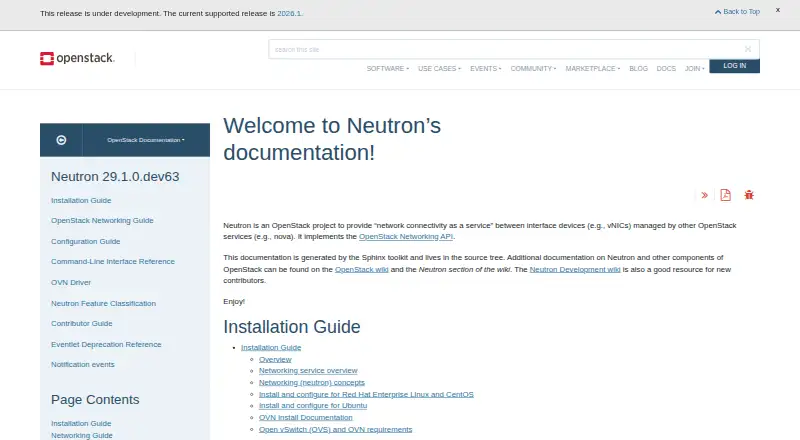
What OpenStack Neutron is
OpenStack Neutron provides network connectivity for interface devices managed by other OpenStack services. Its API lets operators define cloud connectivity and addressing, and manage networks, subnets, and ports. It supports provider, routed provider, and self-service networks, with network options including VLAN, VXLAN, and GRE. Neutron can configure L3 forwarding, NAT, perimeter firewalls, and virtual private networks, and works mainly with OpenStack Compute to connect instances. Plug-ins and agents support Open vSwitch, OVN, SR-IOV, and Macvtap, though only one networking plug-in can be active at a time. Security groups apply ingress and egress firewall rules at the port level, with default-deny and anti-spoofing rules. Quality-of-service rules cover bandwidth and packet-rate limits, DSCP marking, and minimum rates, depending on the backend. Neutron is free, open source under Apache 2.0, and available for Linux and self-hosted deployments. The installation guide's example requires at least two hosts and is presented as a learning proof of concept, not a production setup.
Who it suits
Neutron suits OpenStack administrators with sufficient Linux experience who need to deploy and manage cloud networking. The example installation is intended for learning rather than production use.
What it does well
- Manages networks, subnets, ports, and addressing through an API.
- Supports provider, routed provider, and self-service networks.
- Offers L3 forwarding, NAT, firewalls, and VPN configuration.
- Security groups include default-deny and anti-spoofing rules.
- Free, open source under Apache 2.0.
What to know first
- Only one networking plug-in can be used at a time.
- Example deployment requires at least two hosts.
- Installation example is not intended for production.
- QoS rule availability depends on the networking backend.
Getting started
- Visit the OpenStack Neutron documentation.
- Use the installation guide for provider or self-service networks.
- Prepare at least two hosts for the documented example architecture.
- Select one networking plug-in for the deployment.
- Use the Networking Guide to deploy and manage Neutron.
Verdict
Neutron provides a broad set of network management and connectivity functions for OpenStack environments. Its documented learning setup has specific infrastructure and experience requirements, and is not a production installation guide.
Questions
What does Neutron cost?
Neutron is listed as free and open source under the Apache 2.0 license.
Which network types and protocols does it support?
It supports provider, routed provider, and self-service networks, with options including VLAN, VXLAN, and GRE. Supported protocols also include Geneve.
Which backends are available?
The documentation lists plug-ins and agents for Open vSwitch, OVN, SR-IOV, and Macvtap. Only one networking plug-in can be used at a time.
Does Neutron work with OpenStack Compute?
Yes. It mainly works with OpenStack Compute to provide networks and connectivity for instances.
What does the installation example require?
The example architecture requires at least two hosts to launch a basic virtual machine or instance. It is described as a learning proof of concept, not a production installation.
What QoS rules can it apply?
Rule types include bandwidth limits, packet-rate limits, DSCP marking, minimum bandwidth, and minimum packet rate. Support depends on the backend.
Facts from OpenStack Neutron's own pages
- Access control
- Default API policies support PROJECT_READER, PROJECT_MEMBER, PROJECT_MANAGER, ADMIN, and SERVICE roles; the documented policies accept project-scoped tokens only. · docs.openstack.org, 7 Oct 2026
- API
- Neutron implements the OpenStack Networking API, including extensions. · docs.openstack.org, 7 Oct 2026
- Compute integration
- Neutron mainly interacts with OpenStack Compute to provide networks and connectivity for instances. · docs.openstack.org, 7 Oct 2026
- Deployment
- The installation guide covers provider networks and self-service networks. · docs.openstack.org, 7 Oct 2026
- Deployment requirement
- The installation guide's example architecture requires at least two hosts to launch a basic virtual machine or instance. · docs.openstack.org, 8 Oct 2026
- DNS
- DNS integration lets users control DNS-related attributes on ports, networks, and floating IPs, with external DNS service required for floating IPs. · docs.openstack.org, 7 Oct 2026
- Drivers
- The documentation lists plug-ins and agents for Open vSwitch, OVN, SR-IOV, and Macvtap. · docs.openstack.org, 8 Oct 2026
- Foundation headquarters
- The Open Infrastructure Foundation lists its principal office in Austin, Texas. · openinfra.dev, 7 Oct 2026
- License
- The OpenStack project is provided under the Apache 2.0 license. · docs.openstack.org, 8 Oct 2026
- Maintainer organization
- The OpenInfra Foundation supports the OpenStack project and describes itself as a home for open source infrastructure projects. · openstack.org, 7 Oct 2026
- Networking backends
- Neutron ships plug-ins and agents for Open vSwitch, OVN, SR-IOV, and Macvtap. · docs.openstack.org, 7 Oct 2026
- Network management
- Its API lets operators define cloud network connectivity and addressing and manage networks, subnets, and ports. · docs.openstack.org, 8 Oct 2026
- Network resources
- Neutron lets users create and attach interface devices to networks and supports plug-ins for different networking equipment and software. · docs.openstack.org, 7 Oct 2026
- Network types
- It supports provider, routed provider, and self-service networks, with options including VLAN, VXLAN, and GRE. · docs.openstack.org, 8 Oct 2026
- Notable limit
- Only one networking plug-in can be used at a time. · docs.openstack.org, 8 Oct 2026
- OpenStack integration
- Neutron mainly works with OpenStack Compute to provide networks and connectivity for instances. · docs.openstack.org, 8 Oct 2026
- Purpose
- Neutron provides network connectivity as a service between interface devices managed by other OpenStack services. · docs.openstack.org, 8 Oct 2026
- Quality of service
- QoS rule types include bandwidth limits, packet rate limits, DSCP marking, minimum bandwidth, and minimum packet rate, with support dependent on backend. · docs.openstack.org, 7 Oct 2026
- Release security
- OpenStack release artifacts, including Git tags and Python package files, are signed by release automation. · security.openstack.org, 7 Oct 2026
- Routing and services
- The service can configure L3 forwarding, NAT, perimeter firewalls, and virtual private networks. · docs.openstack.org, 8 Oct 2026
- Security
- Security groups provide port-level ingress and egress firewall rules, use a default-deny policy, and include anti-spoofing rules by default. · docs.openstack.org, 8 Oct 2026
- Security guidance
- OpenStack security resources include advisories, security notes, and a deployer guide covering topics such as hardening, rate limiting, compliance, and cryptography. · security.openstack.org, 7 Oct 2026
- Target users
- The Networking Guide is aimed at OpenStack administrators deploying and managing Neutron. · docs.openstack.org, 7 Oct 2026
- Who it is for
- The installation guide describes its example as a learning proof of concept for users with sufficient Linux experience and says it is not intended for production installations. · docs.openstack.org, 8 Oct 2026