Freedom251 › Chaos Engineering Platforms
Krkn
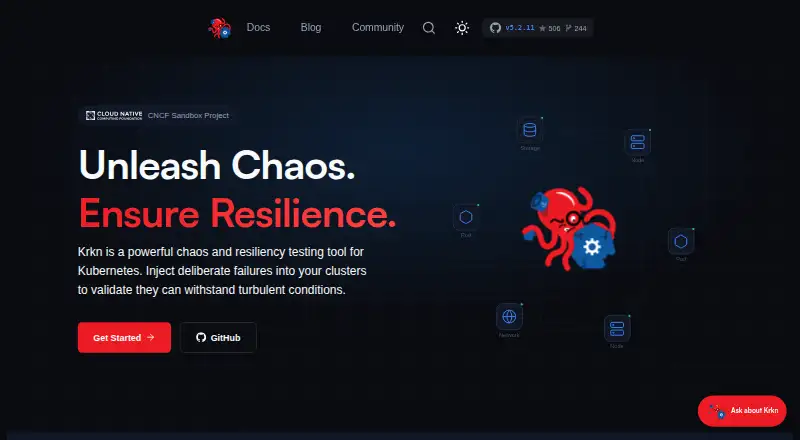
What Krkn is
Krkn injects deliberate failures into Kubernetes clusters so teams can assess how applications and clusters respond to disruption. Its more than 20 scenarios cover pods, containers, nodes, networks, applications, resources, storage, and time. The recommended krknctl tool discovers, runs, and orchestrates scenarios; other options include pre-built containers, a browser dashboard, and a standalone Python program. Krkn can evaluate Prometheus metrics against SLO pass/fail criteria and review metrics during and after chaos runs. The dashboard supports Elasticsearch and Grafana, and telemetry can be sent to S3 or Elasticsearch. Cerberus monitors Kubernetes and OpenShift health and provides a go/no-go signal, reports, and a metrics API; it can also report failures in Slack. Krkn-AI uses evolutionary algorithms with user-defined objectives to identify impactful experiments. The project says it saves recovery state and can restore a cluster automatically, but warns some disruptive scenarios may leave a target unrecoverable. Requirements include Kubernetes or OpenShift 1.21+, cluster-admin kubeconfig access, and Docker 20.10+ or Podman 4.0+. Krkn is for resilience testing, not security provision, and does not currently adhere to compliance standards.
Who it suits
Krkn suits first-time chaos engineers as well as teams building resilience-testing workflows for Kubernetes or OpenShift clusters. It is intended to measure application or cluster resilience, not provide security assurance.
What it does well
- More than 20 chaos scenarios
- Validates SLO criteria with Prometheus metrics
- Offers CLI, containers, dashboard, and Python options
- Can monitor cluster health through Cerberus
What to know first
- Requires cluster-admin kubeconfig access
- Requires Kubernetes or OpenShift 1.21+
- Some scenarios may leave a system unrecoverable
- Does not currently adhere to compliance standards
Limits
The free plan is listed without pricing or usage limits on the opened pages. krkn-hub runs one scenario type per execution; multiple scenario types in one execution require standalone Krkn. Standalone Python installation requires Python 3.9 and manual dependency management.
Plans
| Plan | Billed and limits | Price |
|---|---|---|
| Krkn | No pricing or usage limits stated on the opened pages | Free |
As krkn-chaos.dev lists them, read 7 Oct 2026. The maker's own page has the final word.
Getting started
- Visit https://krkn-chaos.dev/ and choose a deployment option: CLI, pre-built container, browser dashboard, or standalone Python.
- Prepare Kubernetes or OpenShift 1.21+ and cluster-admin kubeconfig access.
- For container use, have Docker 20.10+ or Podman 4.0+ available.
- Run Krkn outside the cluster against the Kubernetes or OpenShift API, as the installation guide recommends.
- Use krknctl to discover, run, and orchestrate chaos scenarios.
Overview
Krkn is a free tool for introducing controlled failures into Kubernetes clusters and assessing resilience. It is best suited to platform teams and chaos engineers who need cluster-level experiments tied to service objectives. Its scenario range and SLO checks are compelling; the risk of disruptions that cannot be reversed calls for deliberate targeting and operational safeguards.
Key features
Krkn offers more than 20 scenarios across pods, containers, nodes, networks, applications, resources, storage, and time. That breadth helps teams probe different failure points within a Kubernetes environment rather than relying on one kind of disruption. The recommended krknctl CLI discovers, runs, and orchestrates scenarios. Pre-built container images, a browser-based dashboard, and a standalone Python program provide other ways to run it.
For teams with defined reliability targets, Krkn can evaluate Prometheus PromQL queries and pass or fail a run against SLO criteria. It can also review metrics during and after experiments. The dashboard supports Elasticsearch and Grafana integration, while telemetry can be sent to S3 or Elasticsearch.
Cerberus monitors Kubernetes and OpenShift cluster health, providing a go/no-go signal, reports, and a metrics API; it can report failures in Slack. Krkn-AI uses evolutionary algorithms and user-defined goals, including SLOs and application health checks, to identify impactful experiments. These features support a more structured resilience workflow, though they do not remove the need to assess risk before a run.
Krkn saves recovery state before changes and can automatically restore a cluster if an experiment goes wrong. That is a useful safeguard, not a guarantee: some disruptive scenarios can leave the target system in a non-recoverable condition. The project identifies as a CNCF Sandbox project. Its security self-assessment says it is not a security provider and does not currently adhere to compliance standards; it lists software bills of materials for Krkn, krkn-lib, and krknctl, and accepts vulnerability reports through GitHub.
Pricing
Krkn is free: its published plan is free. No pricing or usage limits are stated for the plan, so it is an option for teams that want to run self-hosted chaos experiments without a software charge. The cost advantage does not change the infrastructure and access requirements or the operational risk of disruptive scenarios.
Platforms
Krkn supports API, Linux, self-hosted, and web use. The getting-started guide requires Kubernetes or OpenShift 1.21+, cluster-admin kubeconfig access, and Docker 20.10+ or Podman 4.0+. The installation guide recommends running Krkn outside the cluster against the Kubernetes or OpenShift API. This setup suits teams able to provide administrative cluster access; it is not a lightweight test environment for users without that access.
Teams choosing the standalone Python installation need a Python 3.9 environment and must manage dependencies manually. Also, krkn-hub runs only one scenario type per execution; running multiple types together requires the standalone Krkn installation. That distinction matters for teams building multi-scenario workflows.
Who it's for
Krkn fits first-time chaos engineers as well as teams developing resilience-testing workflows, particularly when Kubernetes or OpenShift and Prometheus-based SLO checks are central to the work. Its varied run options accommodate different operating preferences, while the prerequisites make it a poor fit for teams unable to provide cluster-admin access or manage the required runtime. Use it with careful blast-radius planning, especially where automatic recovery cannot be assumed.
Pros and cons
- Pros: More than 20 scenarios across several cluster and application layers give teams broad disruption coverage.
- Pros: PromQL-based SLO pass/fail checks connect experiments to explicit reliability objectives.
- Pros: CLI, containers, dashboard, and standalone Python installation offer several execution paths.
- Cons: Cluster-admin kubeconfig access and compatible Kubernetes or OpenShift, Docker, or Podman versions are required.
- Cons: Some disruptions may not be recoverable, despite the saved recovery state and automatic restoration capability.
- Cons: krkn-hub limits each execution to one scenario type, and standalone Python use requires manual dependency management.
- Cons: Krkn is not a security provider and does not currently adhere to compliance standards.
Alternatives
Chaos Engineering Platforms is a category guide for comparing options.
- Chaos Toolkit is a free, open-source CLI under Apache License 2.0, with API, Linux, macOS, self-hosted, web, and Windows platforms. Choose it if those platform options and the CLI are a closer fit.
- ChaosBlade is a free open-source tool with 200+ experiment scenarios and support for three system platforms and four programming-language applications. Choose it if that stated scenario and application coverage better suits your experiments.
- Reliably is freemium and open source, with a free plan for one team member; it says its approach avoids lock-in. Choose it if that open-source approach or its stated team-member allowance is a priority.
- Toxiproxy is a free, open-source TCP proxy under the MIT license. Choose it if a TCP-proxy tool is what your work calls for.
- Chaos Mesh is a free, open-source, cloud-native chaos engineering platform that runs on Kubernetes. Choose it if that Kubernetes-native platform is a better match.
- chaosd is a free Apache-2.0-licensed Linux binary that requires glibc v2.17 or later. Choose it if a Linux binary is the right deployment form for your environment.
- FaultMesh has a free Starter plan for up to three services, core fault types, basic resilience scoring, and community support, alongside a paid Growth plan. Choose it if those stated service limits and scoring fit your needs.
- Krkn-AI is free under Apache License 2.0 and runs on Linux and self-hosted environments. Choose it if you want that narrower platform footprint.
Verdict
Choose Krkn if your team needs broad Kubernetes disruption scenarios, Prometheus-based SLO validation, and flexible self-hosted execution without a software charge. Its main advantage is the ability to connect varied experiments to explicit reliability criteria; its main drawback is that cluster-admin access and careful recovery planning are essential, since some disruptions may not be recoverable. Look elsewhere if those operational risks or prerequisites are not acceptable.
Verdict
Krkn offers several ways to run a wide range of cluster disruption scenarios and evaluate their impact against SLOs. Check its access and runtime requirements, and account for the possibility that some disruptions cannot be automatically recovered.
Questions
Is Krkn free?
Yes. It is listed as free, with no pricing or usage limits stated on the opened pages.
What does Krkn test?
It injects deliberate failures into Kubernetes clusters. Its listed scenarios cover pods, containers, nodes, networks, applications, resources, storage, and time.
What are the deployment options?
Krkn offers a CLI, pre-built container images, a browser-based dashboard, and a standalone Python program. krknctl is the recommended way to run it.
What does Krkn require?
The getting-started guide lists Kubernetes or OpenShift 1.21+, cluster-admin kubeconfig access, and Docker 20.10+ or Podman 4.0+. Standalone Python installation requires Python 3.9 and manual dependency management.
Does Krkn integrate with monitoring tools?
The dashboard supports Elasticsearch and Grafana, and Krkn can send telemetry to S3 or Elasticsearch. It can evaluate Prometheus PromQL queries against SLO pass/fail criteria.
Is Krkn a security product?
No. Krkn says it is designed to measure application or cluster resilience through controlled disruptions, not to provide security. It says it does not currently adhere to compliance standards.
Facts from Krkn's own pages
- CLI
- krknctl discovers, runs, and orchestrates chaos scenarios, and is the recommended way to run Krkn. · krkn-chaos.dev, 5 Oct 2026
- Deployment options
- Krkn offers a CLI, pre-built container images, a browser-based dashboard, and a standalone Python program. · krkn-chaos.dev, 5 Oct 2026
- Install options
- Installation options include a CLI, pre-built containers, a browser-based dashboard, and a standalone Python program. · krkn-chaos.dev, 7 Oct 2026
- Integrations
- The documentation describes integrations with Prometheus, Elasticsearch, Grafana, Slack, S3, and CI/CD systems such as Jenkins and GitHub Actions. · krkn-chaos.dev, 7 Oct 2026
- Krkn AI
- Krkn-AI uses evolutionary algorithms and user-defined objectives such as SLOs and application health checks to identify impactful chaos experiments. · krkn-chaos.dev, 5 Oct 2026
- Metrics and SLOs
- Krkn can validate SLO pass/fail criteria with Prometheus PromQL queries and review metrics during and after chaos scenarios. · krkn-chaos.dev, 5 Oct 2026
- Monitoring
- Cerberus monitors Kubernetes and OpenShift health and exposes a go/no-go signal, reports, and a metrics API. · krkn-chaos.dev, 7 Oct 2026
- Notable limits
- krkn-hub runs one scenario type per execution; running multiple scenario types in one execution requires the standalone Krkn installation. · krkn-chaos.dev, 5 Oct 2026
- Operating guidance
- The installation guide recommends running Krkn outside the cluster against the Kubernetes or OpenShift API. · krkn-chaos.dev, 7 Oct 2026
- Project status
- The site identifies Krkn as a Cloud Native Computing Foundation Sandbox project. · krkn-chaos.dev, 7 Oct 2026
- Purpose
- Krkn injects deliberate failures into Kubernetes clusters to test their resilience. · krkn-chaos.dev, 7 Oct 2026
- Requirements
- The getting-started guide lists Kubernetes or OpenShift 1.21+, cluster-admin kubeconfig access, and Docker 20.10+ or Podman 4.0+ as requirements. · krkn-chaos.dev, 7 Oct 2026
- Rollback
- Krkn’s rollback system persists changes to the filesystem before a scenario so it can restore targeted Kubernetes objects or subsystems. · krkn-chaos.dev, 7 Oct 2026
- Rollback limitation
- The security self-assessment says some disruptive scenarios may leave the target system in a non-recoverable condition. · krkn-chaos.dev, 7 Oct 2026
- Runtime requirement
- The standalone Python installation requires a Python 3.9 environment and manual dependency management. · krkn-chaos.dev, 5 Oct 2026
- Scenario coverage
- The site lists 20+ chaos scenarios spanning pods, nodes, networks, applications, storage, and time. · krkn-chaos.dev, 7 Oct 2026
- Scenarios
- The site lists more than 20 chaos scenarios covering pods, containers, nodes, networks, applications, resources, storage, and time. · krkn-chaos.dev, 5 Oct 2026
- Security documentation
- The security self-assessment lists a software bill of materials for Krkn, krkn-lib, and krknctl, and says a security-insights.yml should be added to the roadmap. · krkn-chaos.dev, 5 Oct 2026
- Security posture
- Krkn says it is not a security provider and does not currently adhere to compliance standards. · krkn-chaos.dev, 7 Oct 2026
- Security reporting
- The project accepts vulnerability reports through GitHub’s vulnerability reporting tool. · krkn-chaos.dev, 7 Oct 2026
- Security scope
- Krkn's security self-assessment says Krkn is not a security provider; it is designed to measure application or cluster resilience through controlled disruptions. · krkn-chaos.dev, 5 Oct 2026
- Slack integration
- Cerberus supports reporting failures in Slack. · krkn-chaos.dev, 5 Oct 2026
- SLO validation
- Krkn can evaluate Prometheus metrics to automatically pass or fail a chaos run. · krkn-chaos.dev, 7 Oct 2026
- Who it is for
- The docs describe krknctl as suitable for users from first-time chaos engineers to teams building resilience testing workflows. · krkn-chaos.dev, 7 Oct 2026
Where Krkn stands on Freedom251
- Chaos Engineering Platforms#6 of 25