Freedom251 › Chaos Engineering Platforms
Krkn-AI
What Krkn-AI is
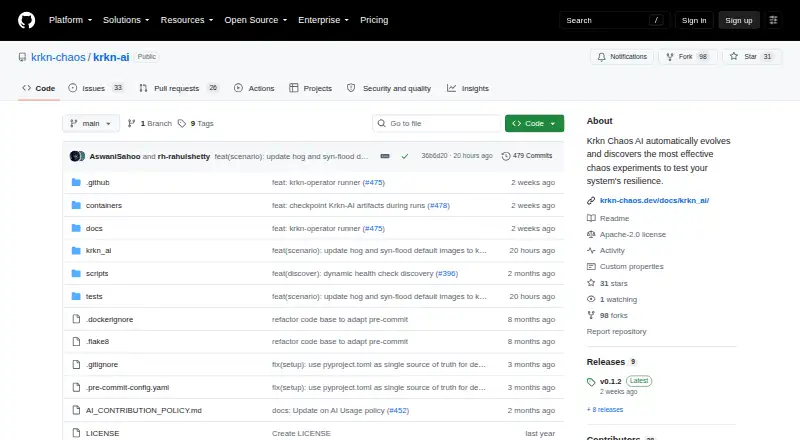
Krkn-AI is a free, open-source tool that runs chaos scenarios and discovers experiments to assess application resilience. It uses evolutionary algorithms to generate experiments from Krkn scenarios, guided by objectives such as SLOs and application health checks. Its discover command creates a YAML configuration with cluster component information and basic setup. Results report scenario effects on application liveness and include fitness scores; Prometheus metrics can measure system response. An interactive dashboard can monitor experiment results. The project describes testing Kubernetes and OpenShift applications and requires a cluster kubeconfig. Krkn-AI can be installed as a Python CLI or run from a pre-built container image, including on Kubernetes. Listed prerequisites include Python 3.11 or later, krknctl, oc or kubectl, Podman, Helm 3.x, and a Kubernetes or OpenShift cluster kubeconfig. The repository lists an Apache-2.0 license. Its README says the tool is under active development and advises users to use it at their own risk.
Who it suits
Krkn-AI is intended for teams testing the resilience of Kubernetes or OpenShift applications. It suits users able to meet its cluster and command-line prerequisites and operate a self-hosted tool.
What it does well
- Free and open source under Apache-2.0.
- Generates experiments from Krkn scenarios.
- Uses user-defined objectives such as SLOs and health checks.
- Reports liveness impact and fitness scores.
- Offers CLI and pre-built container deployment.
What to know first
- Requires a Kubernetes or OpenShift cluster kubeconfig.
- Requires Python 3.11 or later and several tools.
- The project is under active development and advises caution.
Plans
| Plan | Billed and limits | Price |
|---|---|---|
| Apache License 2.0 | Open-source software · No commercial pricing or plan limits stated | Free |
As github.com lists them, read 10 Oct 2026. The maker's own page has the final word.
Getting started
- Prepare a Kubernetes or OpenShift cluster kubeconfig.
- Install Python 3.11 or later, krknctl, oc or kubectl, Podman, and Helm 3.x as needed.
- Install the Python CLI from source or the GitHub repository using uv, or use the pre-built Quay.io container.
- Use the discover command to generate a YAML configuration populated with cluster component information.
- Run experiments from the CLI or container and monitor results in the interactive dashboard.
Verdict
Krkn-AI provides a way to automate resilience experiments and monitor their results in Kubernetes and OpenShift environments. Review its prerequisites and development-status warning before adopting it.
Questions
How much does Krkn-AI cost?
The listed Apache License 2.0 plan is free. The project is open source.
What platforms and environments does it support?
It is listed for Linux and self-hosted deployment. The project describes testing Kubernetes and OpenShift applications and requires a cluster kubeconfig.
How can I deploy Krkn-AI?
It can be installed as a Python CLI or run from a pre-built container image, including on Kubernetes.
What does it use to evaluate experiments?
User-defined objectives such as SLOs and application health checks guide the algorithm. Fitness evaluation can measure system response with Prometheus metrics.
What license does it use?
The repository lists the Apache-2.0 license.
What should I know about the container run options?
The documented standard example uses host networking and privileged mode. The container guide also describes a FUSE-based option without the privileged flag.
Facts from Krkn-AI's own pages
- Algorithm
- It uses evolutionary algorithms to generate experiments from Krkn scenarios and guide testing with user-defined objectives such as SLOs and application health checks. · krkn-chaos.dev, 10 Oct 2026
- Audience
- The project is intended for testing the resilience of Kubernetes and OpenShift applications. · github.com, 10 Oct 2026
- Cluster discovery
- The discover command can populate configuration with cluster components, runnable scenarios, health check URLs, and Prometheus-validated fitness queries. · krkn-chaos.dev, 10 Oct 2026
- Container
- A pre-built container image is available on Quay.io, and the container guide documents discovery and run modes. · github.com, 9 Oct 2026
- Container permissions
- The documented standard run example uses host networking and privileged mode; the guide also describes a FUSE-based option without the privileged flag. · github.com, 9 Oct 2026
- Deployment
- Krkn-AI can be installed as a Python CLI or run from a pre-built container image, including on Kubernetes. · github.com, 10 Oct 2026
- Development status
- The repository cautions that the tool is under active development and should be used at the user's own risk. · github.com, 10 Oct 2026
- Evaluation
- User-defined objectives such as SLOs and application health checks guide the algorithm. · krkn-chaos.dev, 9 Oct 2026
- Installation
- The README provides installation from source or directly from the GitHub repository using uv and Python 3.11 or later. · github.com, 9 Oct 2026
- Integrations
- The documented setup uses Krkn scenarios, krknctl, Kubernetes or OpenShift, and Prometheus metrics. · github.com, 10 Oct 2026
- License
- The public repository is licensed under Apache-2.0. · github.com, 10 Oct 2026
- Metrics
- Fitness evaluation can measure system response using Prometheus metrics. · github.com, 10 Oct 2026
- Monitoring
- An interactive dashboard can monitor Krkn-AI experiment results. · krkn-chaos.dev, 9 Oct 2026
- Project affiliation
- The Krkn documentation identifies Krkn as a Cloud Native Computing Foundation Sandbox project. · krkn-chaos.dev, 9 Oct 2026
- Purpose
- Krkn-AI automatically runs chaos scenarios and discovers experiments to evaluate system resilience. · krkn-chaos.dev, 10 Oct 2026
- Requirements
- The project lists Python 3.11+, krknctl, oc or kubectl, Podman, Helm 3.x, and a Kubernetes or OpenShift cluster kubeconfig as prerequisites. · github.com, 10 Oct 2026
- Results
- Users can analyze scenario impact on application liveness and fitness scores, with an interactive dashboard for monitoring experiment results. · krkn-chaos.dev, 10 Oct 2026
- Security
- The project documentation links to a security self-assessment; the repository page does not state a compliance certification. · krkn-chaos.dev, 10 Oct 2026
- Support
- The project documentation links to a community Slack, GitHub issues, and contribution guidelines. · krkn-chaos.dev, 9 Oct 2026
- Supported environments
- The project describes testing Kubernetes and OpenShift applications and requires a cluster kubeconfig. · github.com, 9 Oct 2026
Where Krkn-AI stands on Freedom251
- Chaos Engineering Platforms#11 of 25