
KrakenD API Gateway
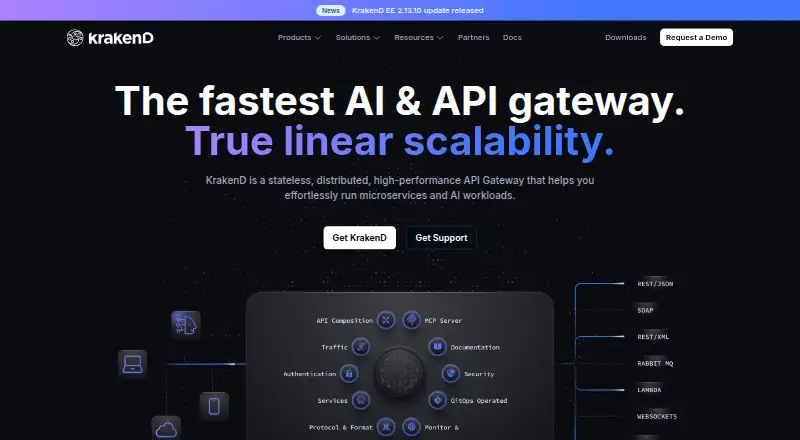
What KrakenD API Gateway is
KrakenD API Gateway is a self-hosted, stateless gateway for connecting, securing, combining, and transforming APIs and AI workloads. It can gather data from multiple services into one response shaped for a client. Traffic controls include rate limiting, circuit breaking, IP filtering, bot detection, and load balancing. It connects with services and protocols including REST, RabbitMQ, SNS, SQS, Kafka, GraphQL, gRPC, SOAP, and Lambda. Authentication options include JWT, OAuth2, OpenID Connect, client credentials, API keys, Basic Authentication, and mTLS. Deployment options include Docker, Kubernetes, cloud marketplace virtual machines, and Linux packages or generic binaries. The maker says its development Docker image can be used on Windows, Mac, or Linux, and KrakenD runs natively on Linux and Mac OS. Community Edition is free and includes unlimited requests, APIs, and AI workloads. Enterprise adds commercial support and SLAs; AI Gateway and AI security capabilities are listed for Enterprise, not Community. Community support includes Google Groups, GitHub issue reporting, and Gophers Slack.
Who it suits
KrakenD suits teams that want a self-hosted gateway to compose and manage API traffic. Community Edition offers a free option; organizations needing commercial support and SLAs can consider Enterprise.
What it does well
- Free Community Edition
- Unlimited requests, APIs, and AI workloads
- Supports API composition across multiple services
- Offers Docker and Kubernetes deployment
What to know first
- AI Gateway and AI security are Enterprise features
- Community does not include direct vendor support and SLAs
- KrakenD is self-hosted
Plans
| Plan | Billed and limits | Price |
|---|---|---|
| Community Edition | Free to use; no license cost · Unlimited requests · unlimited APIs and AI workloads · self-hosted | Free |
| Enterprise Edition | Contact sales · Unlimited requests · unlimited APIs and AI workloads · commercial support and SLAs | On request |
As krakend.io lists them, read 30 Sept 2026. The maker's own page has the final word.
KrakenD is a self-hosted, stateless API gateway for teams bringing data and services together across multiple protocols. It is strongest when clients need tailored responses from several APIs and teams want traffic controls at the gateway; Community Edition’s unlimited requests make it a practical starting point, while enterprise controls and vendor support require an upgrade.
Overview
KrakenD combines, secures, and transforms APIs and AI workloads in a distributed gateway. Its composition feature can gather results from several services into one response shaped for a client, reducing the need for that client to coordinate multiple calls. That is a useful fit for service architectures with varied upstreams, though it adds a gateway layer that is unnecessary for teams with simpler integration needs.
Traffic management includes rate limiting, circuit breaking, IP filtering, bot detection, and load balancing. Together, these controls give teams ways to manage traffic and apply protections at a shared point, rather than relying only on individual services. KrakenD supports REST, HTTP, WebSockets, SOAP, gRPC, GraphQL, AMQP, Kafka, and NATS; its connectivity also covers RabbitMQ, SNS, SQS, and Lambda services.
Key features
Authentication and security
Authentication options include JWT, OAuth2, OpenID Connect, client credentials, API keys, Basic Authentication, and mTLS. KrakenD describes its design as zero-trust, with token validation, API key authentication, IP filtering, rate limiting, and protection against common web attack vectors. The breadth is useful for teams with different client and service requirements, but Enterprise is needed for features such as SSO/SAML and audit logging.
Deployment and support
KrakenD is self-hosted and can be deployed through Docker and Kubernetes, cloud marketplace virtual machines, Linux packages, or generic Linux binaries. The maker says its development Docker image can be used on Windows, Mac, or Linux, while native operation is supported on Linux and Mac OS. Community users can turn to Google Groups, GitHub issue reporting, and Gophers Slack; Enterprise adds direct vendor support and SLAs.
The company states that it is SOC 2 Type II certified, and Enterprise advertises FIPS compliance. Enterprise also includes AI Gateway and AI security capabilities that are absent from Community Edition, so teams with those requirements should account for the edition boundary before adopting it.
Pricing
Both editions have unlimited requests, APIs, and AI workloads, so KrakenD does not impose a published usage cap on those measures. The main trade-off is feature access and support, not a stated request quota.
- Community Edition: free. It has no license cost, is self-hosted, and includes unlimited requests, APIs, and AI workloads. Its community support model and exclusions such as SSO/SAML, audit logging, and direct SLA support make it better suited to teams able to operate the gateway themselves.
- Enterprise Edition: custom pricing, billed by contacting sales. It retains unlimited requests, APIs, and AI workloads and adds commercial support and SLAs. It fits organizations that need vendor-backed help, Enterprise-only controls, AI Gateway, or AI security capabilities.
Platforms
KrakenD supports Linux, macOS, Windows, and self-hosted use. The maker describes native running on Linux and Mac OS, with the development Docker image usable on Windows, Mac, or Linux; deployment options also include Docker and Kubernetes. Its hybrid deployment model gives teams room to place the gateway in their own environments while supporting a range of integrations.
Who it's for
KrakenD suits teams building APIs over multiple services, especially when they need to aggregate upstream data, transform requests, or apply traffic controls and authentication in one place. Community Edition is a fit for technically capable teams comfortable with self-hosting and community channels. Organizations requiring direct SLAs, SSO/SAML, audit logging, or Enterprise AI capabilities should evaluate Enterprise. It is less compelling for a team that needs only a simple single-service route and has no need for composition or gateway-level controls.
Pros and cons
- Pro: Unlimited requests, APIs, and AI workloads in both editions avoid a stated usage ceiling as deployments grow.
- Pro: API composition and support for a broad range of protocols and service types suit architectures with diverse upstreams.
- Pro: Rate limiting, circuit breaking, authentication options, and IP filtering centralize useful traffic and security controls.
- Con: Community Edition lacks SSO/SAML, audit logging, and direct SLA support, which can make it insufficient for organizations with those requirements.
- Con: Enterprise pricing requires contacting sales, so teams cannot compare its cost from a published price.
- Con: Self-hosting leaves deployment and day-to-day operation with the customer, making it a poorer fit for teams seeking a fully managed gateway.
Alternatives
For a broader comparison, see API Gateway Software.
- Gravitee API Gateway is another freemium option with a free Apache 2.0 Community Edition and a paid Planet plan at $2,500 a month; consider it if that pricing structure better suits your choice.
- Amazon API Gateway is a paid service with a free tier; consider it if you prefer an API gateway from Amazon Web Services.
- Google Cloud Endpoints has a free usage tier of 1,999,999 API calls and a Standard usage tier at $3 a month; consider it if a metered usage tier fits your expected call volume.
- Kong Gateway offers a 30-day free trial with no Gateway limits and 30 days of analytics retention; consider it if a time-limited trial is useful before choosing a plan.
- Tyk Gateway offers a free open-source API gateway and a usage-based Core plan with custom pricing; consider it if those plan terms suit your needs.
- Higress has a free self-hosted Community Edition with community support and documentation, while the user handles stability and performance; consider it if that operating model is acceptable.
- NGINX Gateway Fabric is a free open-source project for Kubernetes deployment with Gateway API support varying by resource; consider it if those constraints match your environment.
- Tencent Cloud API Gateway makes the first 1 million API calls per month free during the first year on its Shared instance; consider it if that introductory allowance fits your usage.
Verdict
Choose KrakenD when you need a self-hosted gateway to aggregate APIs, manage traffic, and connect services across varied protocols without a request cap in either edition. Community Edition is the clear starting point for teams that can run it themselves; choose Enterprise when direct support, SLAs, SSO/SAML, audit logging, or Enterprise AI features matter. Look elsewhere if you want a fully managed option or cannot justify custom-priced Enterprise for the controls you need.
Verdict
KrakenD brings API composition, traffic controls, and multiple authentication options into a self-hosted gateway. Community Edition is free, while Enterprise is the option for commercial support and SLAs.
Facts from KrakenD API Gateway's own pages
- API composition
- It can combine data from multiple APIs or services into a single response tailored to client needs. · krakend.io, 30 Sept 2026
- Authentication
- Listed authentication options include JWT, OAuth2, OpenID Connect, client credentials, and mTLS. · krakend.io, 30 Sept 2026
- Compliance
- KrakenD states that the company is SOC 2 Type II certified; Enterprise also advertises FIPS compliance. · krakend.io, 30 Sept 2026
- Connectivity
- The gateway connects to REST, RabbitMQ, SNS, SQS, Kafka, GraphQL, gRPC, SOAP, and Lambda services. · krakend.io, 30 Sept 2026
- Deployment
- KrakenD is self-hosted and available through Docker and Kubernetes, cloud marketplace virtual machines, Linux packages, and Linux generic binaries. · krakend.io, 30 Sept 2026
- Enterprise AI features
- The feature comparison lists AI Gateway and AI security capabilities as Enterprise features not included in Community. · krakend.io, 30 Sept 2026
- Founded
- 2016 · krakend.io, 28 Sept 2026
- Headquarters
- Barcelona, Spain · krakend.io, 28 Sept 2026
- Limits
- The maker says plans have unlimited requests, APIs, and AI workloads, while Community feature availability differs from Enterprise in areas including SSO/SAML, audit logging, and direct SLA support. · krakend.io, 30 Sept 2026
- Platform support
- The maker says the development Docker image can be used on Windows, Mac, or Linux, and that KrakenD runs natively on Linux and Mac OS. · krakend.io, 30 Sept 2026
- Purpose
- KrakenD is a stateless, distributed API gateway for connecting, securing, aggregating, and transforming APIs and AI workloads. · krakend.io, 30 Sept 2026
- Security
- KrakenD describes a zero-trust design with token validation, API key authentication, IP filtering, rate limiting, and protections against common web attack vectors. · krakend.io, 30 Sept 2026
- Support
- Community support resources include Google Groups, GitHub issue reporting, and Gophers Slack; Enterprise offers direct vendor support and SLAs. · krakend.io, 30 Sept 2026
- Traffic management
- Traffic controls include rate limiting, circuit breaking, IP filtering, bot detection, and load balancing. · krakend.io, 30 Sept 2026
Where KrakenD API Gateway stands on Freedom251
- Rest Apis#6 of 28
- Api 1#8 of 25
- API Gateway Software#10 of 29
- Apis#10 of 26