Freedom251 › API Developer Portal Software

Apiman
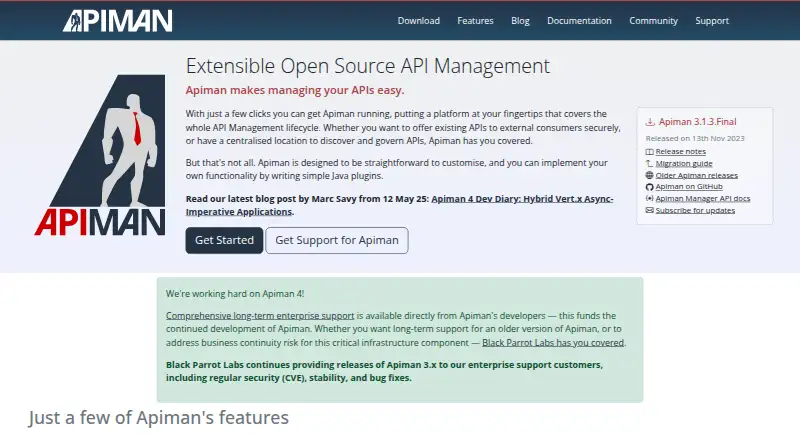
What Apiman is
Apiman is open-source API management software for handling API access, discovery and governance across the API lifecycle. It applies policies at runtime and can offer different service levels for the same API. Its management layer includes a REST API, Manager UI and standalone Developer Portal, plus multi-tenancy, events, notifications, permissions and approvals. Teams can build custom policies and components with Java plugins, which can be loaded while the system is running without a restart. Gateways scale independently from the Manager and can continue running if the Manager goes down. Supported gateway platforms include Vert.x, WildFly and Tomcat. Standard policies include authorization, BASIC authentication, IP allowlisting and blocklisting, OAuth2/JWT authentication through the Keycloak plugin, and HTTP security headers. Apiman is primarily an HTTP API gateway: WebSockets lack explicit testing or support, while raw TCP, raw UDP and messaging protocols are unsupported. The project uses Apache License 2.0, with no features behind paywalls. Version 3.x is community-supported; versions 2.x and 1.x are unsupported.
Who it suits
Apiman may suit teams that need self-hosted API management, policy controls and a developer portal. It is oriented primarily toward HTTP APIs and supports gateways on Vert.x, WildFly and Tomcat.
What it does well
- Open-source Apache License 2.0 software.
- No features are hidden behind paywalls.
- Gateways can continue if the Manager goes down.
- Custom Java plugins can load without restarting.
- Includes a standalone Developer Portal.
What to know first
- Raw TCP, raw UDP and messaging protocols are unsupported.
- WebSockets lack explicit testing or support.
- Versions 2.x and 1.x are unsupported.
- Up-front billing and payment capture are not provided.
Limits
Apiman is primarily an HTTP gateway. WebSockets lack explicit testing or support, and raw TCP, raw UDP and messaging protocols are unsupported. It supports post-hoc billing through metrics but not up-front billing or payment capture.
Plans
| Plan | Billed and limits | Price |
|---|---|---|
| Apiman Community Edition | Apache-2.0 licensed · no features hidden behind paywalls · self-hosted | Free |
| Standard | 16 cores · 24/7 support · 5 days professional services · 20 days feature development · unlimited CVE patching and alerts | On request |
| Essentials | 4 cores · 24/7 support · 1 day professional services · 5 days feature development · unlimited CVE patching and alerts | On request |
| Advanced | 32 cores · 24/7 support · 10 days professional services · 41 days feature development · unlimited CVE patching and alerts | On request |
As apiman.io lists them, read 9 Oct 2026. The maker's own page has the final word.
Getting started
- Visit the Apiman website.
- Choose the free, self-hosted Community Edition or review commercial support packages.
- Select a supported gateway platform: Vert.x, WildFly or Tomcat.
- Configure API access and governance through the management layer.
- Add integrations such as Keycloak or a supported gateway metrics emitter if needed.
Apiman is open-source software for managing APIs and governing access through a self-hosted gateway. It is best suited to teams that want policy control and Java extensibility; its HTTP focus and support boundaries make it a less natural fit for broader protocol needs or unsupported releases.
Overview
Apiman covers API lifecycle management, from secure access to discovery and governance. Its management layer combines a REST API, Manager UI, and standalone Developer Portal with multi-tenancy, permissions, approvals, events, and notifications. That breadth suits organizations coordinating APIs across teams, rather than those looking only for a gateway.
The Apache License 2.0 Community Edition has no feature paywalls. The tradeoff is self-hosting: teams operate the software themselves unless they arrange commercial support. Apiman also offers access policies, API analytics, an API catalog, and lifecycle management.
Key features
Governance and security
Runtime policies let teams govern API use, while multiple plans can provide different service levels for the same API. Standard policies include authorization, BASIC authentication, IP allowlisting and blocklisting, HTTP security headers, and OAuth2/JWT authentication through the Keycloak plugin. This gives teams a practical baseline for access control without requiring every rule to be custom-built.
Extensibility and gateway deployment
Developers can create policies and components as Java plugins, which can be loaded dynamically without restarting. That is useful when an organization needs bespoke behavior, though it assumes Java development capacity. Gateways scale independently from the Manager and can keep running if it goes down, reducing the operational dependence of live traffic on the management layer.
Supported gateway platforms are Vert.x, WildFly, and Tomcat; the project identifies Vert.x as the best-performing option. Keycloak supports identity management, while gateway metrics can be emitted to Elasticsearch, Prometheus, InfluxDB, and JDBC.
Protocol and monetization limits
Apiman is primarily an HTTP API gateway. WebSockets lack explicit testing or support, and raw TCP, raw UDP, and messaging protocols are unsupported, so teams with those requirements should choose another approach. Metrics can support post-hoc billing or monetization, but Apiman does not provide explicit up-front billing or payment capture.
Pricing
The Community Edition costs nothing and is self-hosted under Apache-2.0, with no features behind paywalls. It suits teams prepared to operate the platform and manage support themselves. The paid support packages are custom pricing; they add 24/7 support, CVE patching and alerts, plus differing capacity and service allowances:
| Plan | Included | Best fit |
|---|---|---|
| Essentials | 4 cores, 24/7 support, 1 day of professional services, 5 days of feature development, unlimited CVE patching and alerts | Teams needing a smaller supported deployment |
| Standard | 16 cores, 24/7 support, 5 days of professional services, 20 days of feature development, unlimited CVE patching and alerts | Teams needing more implementation and development assistance |
| Advanced | 32 cores, 24/7 support, 10 days of professional services, 41 days of feature development, unlimited CVE patching and alerts | Organizations with greater capacity and development needs |
Essentials gives up capacity and service days compared with the larger packages; Advanced provides the most cores and development time. No seat or API quotas are specified in these plans.
Platforms
Apiman is available for API use on Linux and the web, with a self-hosted deployment model. Its gateway can run on Vert.x, WildFly, or Tomcat. This is a fit for teams that want deployment control, not buyers looking for a hosted service.
Who it's for
Choose Apiman if you need self-hosted API lifecycle management, policy-based governance, a developer portal, and the option to extend behavior with Java. Its independently scaling gateways are also valuable when live API traffic should continue during a Manager outage. Look elsewhere if your gateway must handle raw TCP, UDP, messaging, or depend on explicitly supported WebSockets, or if you need built-in up-front payment capture.
For support, version 3.x is community-supported; versions 2.x and 1.x are unsupported. Teams relying on community help should use a supported release, while organizations needing 24/7 assistance and CVE patching can consider Black Parrot Labs' commercial packages.
Pros and cons
- Pros: Apache-2.0 licensing with no feature gates avoids a paid-feature ceiling for self-hosters.
- Pros: Independent gateway scaling and continued operation during Manager outages help separate API traffic from management availability.
- Pros: Dynamic Java plugins and multiple governance plans allow tailored policies and service levels.
- Cons: Support for community releases is limited to version 3.x; versions 1.x and 2.x are unsupported.
- Cons: The HTTP focus excludes raw TCP, raw UDP, and messaging, while WebSockets lack explicit support.
- Cons: Metrics enable post-hoc monetization, not up-front billing or payment capture.
Alternatives
Consider Gravitee API Gateway if you want another Apache 2.0 community edition or need its broader listed platform range, including Windows; its Community Edition has no numerical limits published here. For a managed search-oriented use case rather than API governance, Algolia offers a free tier with 10K search requests per month, 50K records, 5K recommendation requests per month, and 5K crawls per month.
Amazon API Gateway is another API gateway option. Google Cloud Endpoints has a free usage tier covering 1,999,999 API calls, while its Standard usage tier is priced at $3 a month. Hasura offers a free plan with up to 3M API requests per month and two databases per project. Kong Gateway offers a 30-day free trial with no Gateway limits and 30 days of analytics retention. Apigee API hub is available at no additional cost to eligible Apigee organizations in supported regions. DreamFactory offers an open-source plan with a PostgreSQL connector.
Browse more options in API Management Software or API Developer Portal Software.
Verdict
Apiman is a strong choice for teams that want open-source, self-hosted API management with flexible governance and gateways that can run independently of the Manager. Its main reasons to look elsewhere are equally concrete: limited protocol coverage, no built-in up-front billing, and community support restricted to version 3.x.
Verdict
Apiman offers API governance and independently scaling gateways, with an open-source license and no paid feature gates. Check the protocol limits and use a community-supported version if relying on project community support.
Questions
Is Apiman free?
The Community Edition is listed as free, is Apache-2.0 licensed and self-hosted, and has no features hidden behind paywalls.
Which gateway platforms does Apiman support?
The listed platforms are Vert.x, WildFly and Tomcat. The project says Vert.x provides the best performance.
Does Apiman include a developer portal?
Yes. Its management layer includes a standalone Developer Portal, as well as a REST API and Manager UI.
Can teams extend Apiman?
Developers can create custom policies and components with Java plugins. Plugins can load dynamically at runtime without restarting.
Which integrations are named?
Keycloak is named for identity management. Elasticsearch, Prometheus, InfluxDB and JDBC are listed as gateway metrics emitters.
Which Apiman versions are community-supported?
Version 3.x is community-supported. Versions 2.x and 1.x are unsupported.
Facts from Apiman's own pages
- API governance
- Apiman supports policy-based runtime governance and multiple plans that can offer different service levels for the same API. · apiman.io, 9 Oct 2026
- Extensibility
- Developers can create custom policies and components with Java plugins, and plugins can be loaded dynamically at runtime without restarting. · apiman.io, 9 Oct 2026
- Gateway deployment
- The gateways scale independently of the Manager and can continue running if the Manager goes down. · apiman.io, 9 Oct 2026
- Integrations
- The feature page names Keycloak for identity management and Elasticsearch, Prometheus, InfluxDB, and JDBC as gateway metrics emitters. · apiman.io, 9 Oct 2026
- License
- The project says Apiman is licensed under Apache License 2.0, with no features hidden behind paywalls. · apiman.io, 9 Oct 2026
- Management
- The management layer includes a REST API, Manager UI, and standalone Developer Portal, as well as multi-tenancy, events, notifications, permissions, and approvals. · apiman.io, 9 Oct 2026
- Monetization limit
- Apiman supports post-hoc billing or monetization through metrics but does not currently provide explicit up-front billing or payment capture. · apiman.io, 9 Oct 2026
- Protocol limits
- Apiman is primarily an HTTP API gateway; the feature page says WebSockets lack explicit testing or support and raw TCP, raw UDP, and messaging protocols are unsupported. · apiman.io, 9 Oct 2026
- Purpose
- Apiman is open-source API management software covering the API management lifecycle, including secure API access and API discovery and governance. · apiman.io, 9 Oct 2026
- Security policies
- Standard policies include authorization, BASIC authentication, IP allowlisting and blocklisting, OAuth2/JWT authentication via the Keycloak plugin, and HTTP security headers. · apiman.io, 9 Oct 2026
- Security support
- The project security policy lists version 3.x as community-supported and versions 2.x and 1.x as unsupported. · github.com, 9 Oct 2026
- Support
- Black Parrot Labs offers commercial Apiman support, development, and expertise, with support packages described as including 24/7 support and CVE patching and alerts. · blackparrotlabs.io, 9 Oct 2026
- Supported gateway platforms
- The site lists Vert.x, WildFly, and Tomcat as supported gateway platforms and says Vert.x provides the best performance. · apiman.io, 9 Oct 2026
Where Apiman stands on Freedom251
- API Developer Portal Software#2 of 36
- Rest Apis#2 of 28
- API Management Software#3 of 38