Freedom251 › API Gateway Software
Google Cloud Endpoints
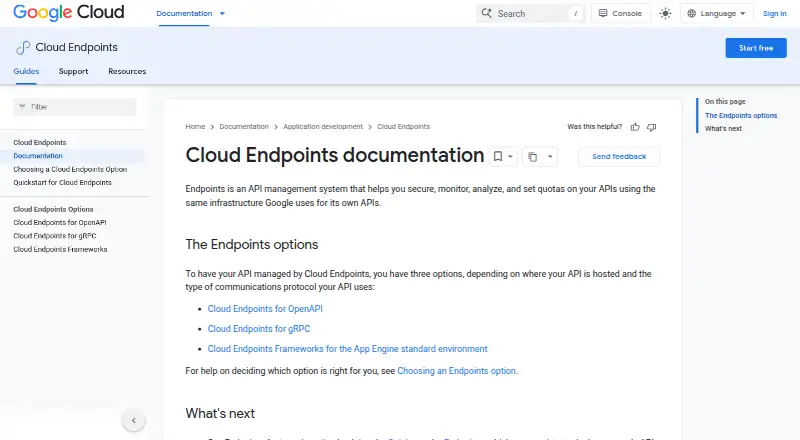
What Google Cloud Endpoints is
Google Cloud Endpoints is an API management service with a hybrid deployment model and support for Linux and macOS. It includes lifecycle management, access policies, and API analytics, covering API changes, access, and usage. Pricing is organized around API-call volume, with the listed prices expressed per million API calls. The Free usage tier costs nothing and covers 1,999,999 API calls. The Standard usage tier is $3 a month for 2,000,000 to 1,000,000,000 API calls. The High-volume usage tier is $1.50 a month for 1,000,000,000 API calls and above. The listed tiers define their volumes alongside their billing terms, so readers can consider those thresholds when selecting an option. The product is suited to API management across a hybrid environment, with its lifecycle, access, and analytics capabilities grouped alongside usage-based tier details.
Who it suits
It suits teams managing APIs across Linux or macOS environments that need lifecycle management, access policies, and API analytics. The listed tiers may help teams compare options by API-call volume.
What it does well
- Includes API lifecycle management.
- Provides access policies.
- Offers API analytics.
- Supports hybrid deployment.
- Includes a free usage tier.
What to know first
- Free tier covers 1,999,999 API calls.
- Standard tier is $3 a month.
- High-volume tier is $1.50 a month.
Limits
The Free usage tier covers 1,999,999 API calls. The Standard usage tier covers 2,000,000 to 1,000,000,000 API calls at $3 a month; the High-volume usage tier covers 1,000,000,000 API calls and above at $1.50 a month.
Plans
| Plan | Billed and limits | Price |
|---|---|---|
| Free usage tier | Price per million API calls (USD) · 1,999,999 API calls | Free |
| Standard usage tier | Price per million API calls (USD) · 2,000,000 to 1,000,000,000 API calls | $3 a month |
| High-volume usage tier | Price per million API calls (USD) · 1,000,000,000 API calls and above | $1.50 a month |
| Usage-based | 1,000,000,000 API calls and above: $1.50 per million | Free |
As cloud.google.com lists them, read 21 Sept 2026. The maker's own page has the final word.
Getting started
- Open the Google Cloud Endpoints website.
- Use a Linux or macOS environment.
- Choose the Free usage tier for up to 1,999,999 API calls, or select a paid tier based on call volume.
- Use lifecycle management, access policies, and API analytics.
Google Cloud Endpoints is an API management system for teams that need to secure, monitor, and set quotas on APIs across cloud and Docker environments. It suits teams already using Google Cloud services, as well as those deploying Docker workloads elsewhere. Its broad deployment choices are a strength; quota controls are marked Beta, and using them requires API keys on every request.
Overview
Endpoints manages API lifecycle and access through Google Cloud Service Infrastructure, which also reports logs and metrics to the Google Cloud console. It accepts API descriptions in OpenAPI 2.0, OpenAPI 3.x, or gRPC, and uses the Extensible Service Proxy (ESP) or ESPv2 to manage APIs.
The hybrid deployment model gives teams a choice of runtime. Documented backends include Google Kubernetes Engine, Compute Engine, Kubernetes, App Engine, Cloud Run, Cloud Run functions, and Knative serving, though proxy availability varies by backend. Docker support also lets teams host an API wherever Docker runs, as long as the host can reach Google Cloud over the internet.
Key features
- API keys and quotas: Endpoints can require and validate API keys. A key identifies the caller’s Google Cloud project for quota, billing, and monitoring, so quotas depend on callers supplying a key with each request. Quotas can limit call rates and help protect an API from excess traffic, but the feature is Beta and may have limited support.
- User authentication: Firebase Authentication and Auth0 are documented options. ESP validates their JWTs, giving teams a defined path to authenticate users alongside API key controls.
- Logs and metrics: Service Infrastructure reports API activity to the Google Cloud console. This brings monitoring and analytics into the same console used to manage the API.
The combination of lifecycle management, access policies, and analytics makes Endpoints a fit for teams that want API controls alongside flexible deployment. Its dependence on Google Cloud for Service Infrastructure and internet access is a practical constraint for environments that cannot connect to Google Cloud.
Pricing
Pricing is based on API calls to Service Control, with the published usage tiers measured per million calls. There are no seat counts or trial terms attached to these tiers.
| Plan | Price | Call range | Best fit |
|---|---|---|---|
| Free usage tier | free | Up to 1,999,999 API calls | Evaluation and lower call volumes |
| Standard usage tier | $3 a month | 2,000,000 to 1,000,000,000 API calls | Services operating within the standard range |
| High-volume usage tier | $1.50 a month | 1,000,000,000 API calls and above | Very high call volumes |
The free tier covers calls only through 1,999,999, so teams above that threshold move to a paid tier. The high-volume rate is lower than the standard rate, making it the stated fit for very large workloads. A separate usage-based option is priced at $0, with 1,000,000,000 API calls and above priced at $1.50 per million.
Platforms
Endpoints is listed for API, Linux, macOS, self-hosted, and web environments. Its Docker optimization and hybrid deployment model are useful when teams need to run APIs across more than one supported backend.
Who it's for
Endpoints is best suited to teams building APIs that need project-level caller attribution, monitoring, and access controls while retaining a choice of Google Cloud and Docker-capable deployment environments. It is less suitable when quota enforcement must rely on a mature, non-Beta feature or when requests cannot include API keys.
Pros and cons
- Pro: OpenAPI 2.0, OpenAPI 3.x, and gRPC support accommodate multiple API description formats.
- Pro: Documented backends span managed Google Cloud services, Kubernetes, and Docker-capable hosts, offering deployment flexibility.
- Pro: API keys connect caller identity with quota, billing, and monitoring at the Google Cloud project level.
- Con: Quotas are Beta and may have limited support, making them a less certain choice for teams that depend on them.
- Con: Quota use requires an API key on every request, which may not suit APIs that cannot identify callers this way.
- Con: Hosts outside Google Cloud still need internet access to Google Cloud for Endpoints to work.
Alternatives
Consider Gravitee API Gateway if you want a free Apache 2.0 community edition or a freemium option across API, Linux, self-hosted, web, and Windows platforms. Its listed Planet plan costs $2,500 a month.
Amazon API Gateway is another paid option with a free plan and support for Android, API, iOS, and web platforms.
Choose Kong Gateway if a 30-day free trial with no Gateway limits and 30 days of analytics retention fits your evaluation. Its Plus plan has custom pricing.
KrakenD API Gateway offers a free, self-hosted Community Edition with unlimited requests, APIs, and AI workloads across Linux and macOS.
Tyk Gateway has a free open-source API gateway and a usage-based Core plan with custom pricing.
Higress is a free, self-hosted community edition with community support and documentation; users handle stability and performance.
NGINX Gateway Fabric is a free open-source project for Kubernetes deployment, with Gateway API support varying by resource.
Tencent Cloud API Gateway offers a shared instance with the first 1 million API calls per month free during the first year; excess calls and public network outbound traffic are pay-as-you-go.
For more options, browse API Gateway Software or API Management Software.
Verdict
Google Cloud Endpoints is a strong choice for teams that want API lifecycle controls, analytics, and flexible deployment tied to Google Cloud’s service infrastructure. Its call-based tiers include a free range and a lower listed rate for very high volume. Look elsewhere if Beta quota support is not dependable enough for your needs, or if API-key identification and Google Cloud connectivity do not fit your API architecture.
Verdict
Google Cloud Endpoints combines API lifecycle management, access policies, and analytics in a hybrid deployment. Consider the listed API-call ranges and prices when choosing a tier.
Questions
Does Google Cloud Endpoints have a free plan?
Yes. The Free usage tier costs nothing and covers 1,999,999 API calls.
How much do the paid tiers cost?
The Standard usage tier is $3 a month for 2,000,000 to 1,000,000,000 API calls. The High-volume usage tier is $1.50 a month for 1,000,000,000 API calls and above.
Which platforms are listed?
Linux and macOS.
What deployment model does it use?
Its listed deployment model is hybrid.
What API management features does it include?
It includes lifecycle management, access policies, and API analytics.
Who makes Google Cloud Endpoints?
The facts do not specify its maker.
Facts from Google Cloud Endpoints's own pages
- API access
- Endpoints can require and validate API keys, and API keys identify a Google Cloud project for quota, billing, and monitoring. · docs.cloud.google.com, 9 Oct 2026
- API formats
- Endpoints supports APIs described with OpenAPI 2.0 and OpenAPI 3.x, as well as a gRPC option. · docs.cloud.google.com, 9 Oct 2026
- Authentication
- Documented user authentication options include Firebase Authentication and Auth0, which use JWT validation by ESP. · docs.cloud.google.com, 9 Oct 2026
- Deployment options
- Documented backends include Google Kubernetes Engine, Compute Engine, Kubernetes, App Engine, Cloud Run, Cloud Run functions, and Knative serving, with proxy availability varying by backend. · docs.cloud.google.com, 9 Oct 2026
- Hosting
- Endpoints is optimized for Docker and can host an API anywhere Docker is supported if it has internet access to Google Cloud. · docs.cloud.google.com, 9 Oct 2026
- Logs and metrics
- Endpoints uses Service Infrastructure to manage APIs and report logs and metrics viewable in the Google Cloud console. · docs.cloud.google.com, 9 Oct 2026
- Maker founding
- Google Inc. was officially born in August 1998. · about.google, 9 Oct 2026
- Maker headquarters
- Google's company story identifies its current headquarters, the Googleplex, as being in Mountain View, California. · about.google, 9 Oct 2026
- Pricing basis
- Endpoints pricing depends on the number of API calls, and Endpoints charges by calls to Service Control. · cloud.google.com, 9 Oct 2026
- Proxy
- Endpoints provides API management through the Extensible Service Proxy (ESP) or ESPv2. · docs.cloud.google.com, 9 Oct 2026
- Purpose
- Cloud Endpoints is an API management system for securing, monitoring, analyzing, and setting quotas on APIs. · docs.cloud.google.com, 9 Oct 2026
- Quota identification
- To use features such as quotas, each request must pass an API key so Endpoints can identify the caller's Google Cloud project. · docs.cloud.google.com, 9 Oct 2026
- Quotas
- Quotas control the rate of application calls and help protect APIs from excessive requests, but the documented quota feature is Beta and may have limited support. · docs.cloud.google.com, 9 Oct 2026
Where Google Cloud Endpoints stands on Freedom251
- API Gateway Software#4 of 29
- API Management Software#6 of 38
- Apis#5 of 26