Freedom251 › API Gateway Software
Tyk Gateway
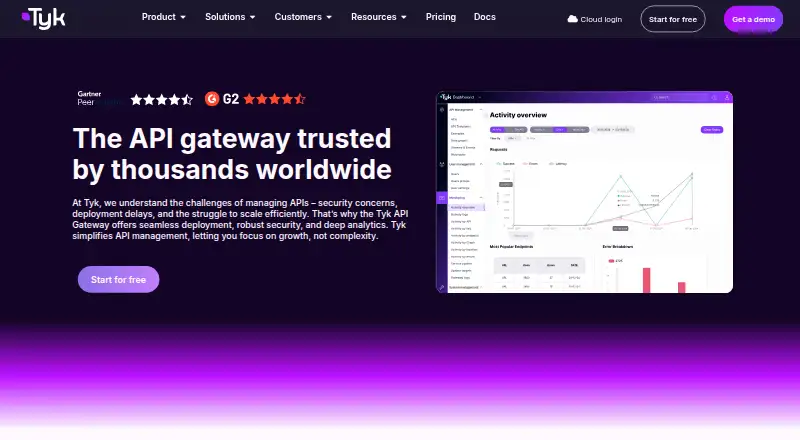
What Tyk Gateway is
Tyk Gateway manages API traffic and provides security, governance, auditing, and analytics. It supports REST, gRPC, SOAP, GraphQL, event-driven APIs, and AI APIs, with traffic controls for authentication, authorization, rate limits, quotas, caching, load balancing, logging, tracing, and versioning. Deployments can run in cloud, on-premises, or hybrid environments. Users can extend the gateway with plugins, extensions, and custom pluggable middleware. Tyk Dashboard monitors API performance, while Tyk Pump exports analytics data to business intelligence tools. Listed integrations include Kubernetes, legacy systems, CI/CD pipelines, OpenAPI, OAuth, Open Policy Agent, and OpenTelemetry. Tyk also lists security policies, role-based access control, and single sign-on, and states that it has SOC 2 compliance covering security, availability, processing integrity, confidentiality, and privacy. The Open Source API Gateway plan is free. Core pricing is usage-based and requires contacting Tyk; Professional and Enterprise pricing also requires an inquiry. Professional includes unlimited gateways, APIs, and monthly API requests.
Who it suits
Tyk positions Core for startups and scale-ups, Professional for high-growth teams, and Enterprise for regulated industries and global enterprises. It suits teams that need API traffic controls and cloud, on-premises, or hybrid deployment options.
What it does well
- Supports REST, gRPC, SOAP, and GraphQL.
- Can deploy in cloud, on-premises, or hybrid environments.
- Open Source API Gateway plan is free.
- Professional includes unlimited gateways, APIs, and monthly requests.
- Supports plugins and custom middleware.
What to know first
- Core, Professional, and Enterprise pricing requires an inquiry.
- Free plan is the open-source API gateway.
- Professional and Enterprise features require paid plans.
Limits
The free Open Source API Gateway is described as an open-source gateway. Core pricing is usage-based. Professional includes unlimited gateways, APIs, and monthly API requests; Enterprise pricing is customized.
Plans
| Plan | Billed and limits | Price |
|---|---|---|
| Open Source API Gateway | Free · Open-source API gateway | Free |
| Tyk Cloud free trial | 48 hours · full feature access · no installation · no credit card | Free |
| Professional | flat rate · Cloud, Hybrid, or Self-managed · unlimited API gateways · unlimited APIs · unlimited requests/month · developer portal · enhanced success plan | On request |
| Core | usage-based · Cloud, Hybrid, or Self-managed · unlimited API gateways · developer portal included · enhanced success plan | On request |
| Enterprise | custom pricing · advanced governance and security · premium support and custom SLAs · multi-region · multi-cloud · named CSM · guided PoC | On request |
As tyk.io lists them, read 2 Oct 2026. The maker's own page has the final word.
Getting started
- Visit the Tyk API Gateway website.
- Choose the free Open Source API Gateway or contact Tyk about a paid plan.
- Select a cloud, on-premises, or hybrid deployment.
- Configure APIs and traffic controls such as authentication, quotas, and rate limits.
- Use Tyk Dashboard to monitor API performance and Tyk Pump to export analytics.
Overview
Tyk Gateway is software for governing and routing API traffic across cloud, on-premises, and hybrid deployments. It is a strong fit for teams operating several API styles or requiring explicit security and policy controls. The trade-off is that paid plans require a conversation with Tyk, so budgeting takes more work than with products that publish complete prices.
Founded in 2014 and headquartered in London, Tyk combines an open-source gateway with commercial offerings aimed at startups, growing engineering organizations, and regulated enterprises. The free gateway is useful for self-managed deployments, while the paid tiers add managed options and progressively broader governance and support.
Key features
Protocol coverage is unusually broad. Tyk supports REST, gRPC, SOAP, GraphQL, event-driven APIs, and AI APIs, along with TCP, HTTP/HTTPS, WebSockets, and Server-Sent Events. That makes it practical when one platform must front legacy SOAP services, modern APIs, streaming connections, and newer AI workloads. A team serving only conventional REST endpoints may find this range unnecessary.
Its traffic-management toolkit includes authentication and authorization, rate limits, quotas, caching, load balancing, logging, tracing, versioning, and request transformation. Authentication can use API keys, bearer tokens, JWT, OIDC, Basic Auth, client certificates, mTLS, or custom plugins. These options support differentiated policies for public, partner, and internal APIs, although teams will need to decide which controls belong in the gateway and maintain them over time.
Plugins, extensions, and custom pluggable middleware provide an escape hatch for requirements that built-in policies do not cover. That extensibility is valuable for organizations with specialized workflows, but it also creates more components to review and govern.
Tyk Dashboard monitors API performance, while Tyk Pump exports analytics to business-intelligence tools. Integrations span Kubernetes, legacy systems, CI/CD pipelines, OpenAPI, OAuth, Open Policy Agent, OpenTelemetry, REST, SOAP, and GraphQL. Security and governance features include security policies, role-based access control, single sign-on, auditing, and the listed authentication and quota controls. Tyk states that it has SOC 2 compliance, covering security, availability, processing integrity, confidentiality, and privacy criteria.
Pricing
The Open Source API Gateway costs nothing, billed Free. It is the clearest option for teams comfortable running an open-source gateway themselves and willing to manage deployment and operations without the commercial plan entitlements.
Core uses usage-based billing with custom pricing. It includes unlimited API gateways, a developer portal, and cloud, hybrid, or self-managed deployment. Tyk positions it for startups and scale-ups; usage-based terms can suit changing demand, but the final cost depends on a quote. Core and Professional include an enhanced success plan.
Professional also requires contacting Tyk and uses flat-rate billing. It includes unlimited API gateways, unlimited APIs, and unlimited monthly API requests, with cloud, hybrid, or self-managed deployment. This is the most straightforward fit for high-growth teams whose request volume makes per-usage pricing harder to predict, provided a custom quote is acceptable.
Enterprise has customized pricing and includes everything in Professional, plus advanced governance and security, premium support with custom SLAs, and multi-region and multi-cloud deployments. It targets regulated industries and global enterprises that need formal service commitments and broader operating geography.
Tyk also advertises a free plan and a 2-day trial. The trial window is short, so it is better for a focused evaluation than an extended proof of concept.
Platforms
Tyk is available for API, Linux, self-hosted, and web use. Its deployment model is hybrid, with cloud, on-premises, and hybrid choices across the commercial plans; self-managed operation is also explicitly included in Core and Professional.
Who it's for
Choose Tyk when a platform must handle multiple protocols, enforce detailed identity and traffic policies, and fit an organization’s cloud, on-premises, or hybrid topology. Core is aimed at startups and scale-ups, Professional at high-growth teams, and Enterprise at regulated or multinational organizations needing advanced governance, premium support, and custom SLAs.
It is less compelling for a small project with a single API style and simple routing needs, where Tyk’s breadth, extensibility, and custom-plan sales process may add overhead.
Pros and cons
Pros
- Broad protocol support: REST, gRPC, SOAP, GraphQL, event-driven, AI, WebSockets, and SSE coverage reduces the need for separate gateways.
- Deep policy controls: authentication choices, quotas, rate limits, transformation, tracing, and versioning support finely managed traffic.
- Flexible deployment: cloud, on-premises, hybrid, and self-managed models accommodate varied infrastructure constraints.
- Extensible architecture: plugins and custom middleware can address requirements beyond standard policies.
- Analytics and governance: Dashboard, Pump, RBAC, SSO, auditing, and stated SOC 2 compliance support operational oversight.
Cons
- Limited price transparency: Core, Professional, and Enterprise all require contacting Tyk, complicating upfront comparison.
- Short trial: the 2-day trial leaves little time for a broad evaluation.
- Potential operational complexity: extensive protocols, plugins, and policy options demand stronger administration than a narrowly focused gateway.
Alternatives
Gravitee API Gateway is worth considering when you want a freemium gateway with a free Apache 2.0 Community Edition and a published Planet plan at $2,500 per month.
Amazon API Gateway fits teams seeking a paid AWS service with a free tier and API, Android, iOS, and web availability.
Google Cloud Endpoints suits buyers who prefer a freemium service with a free allowance of 1,999,999 API calls and a published standard tier at $3 per month.
Kong Gateway is an alternative with a 30-day no-credit-card trial, no gateway limits during that trial, and 30 days of analytics retention.
KrakenD API Gateway is a self-hosted option whose free Community Edition allows unlimited requests, APIs, and AI workloads.
Higress offers a free self-hosted community edition with community support and documentation.
NGINX Gateway Fabric is a free open-source Kubernetes project with Gateway API support that varies by resource.
Tencent Cloud API Gateway may suit buyers wanting a paid cloud gateway with a first-year allowance of one million API calls per month.
Browse the broader API Gateway Software category for more options.
Verdict
Tyk Gateway is a strong choice for organizations that need one extensible gateway across diverse protocols, environments, and governance requirements. Its open-source edition lowers the entry cost, while Professional and Enterprise add predictable request handling or enterprise-grade support capabilities. Look elsewhere if published pricing, a longer evaluation period, or a simpler gateway for a narrow API estate matters more than Tyk’s breadth.
Verdict
Tyk Gateway offers broad protocol support, traffic controls, analytics, and deployment flexibility. The open-source gateway is free, but pricing for the named paid plans requires contacting Tyk.
Questions
Does Tyk Gateway have a free plan?
Yes. The Open Source API Gateway is free.
How much do the paid plans cost?
Core uses usage-based pricing, while Professional and Enterprise prices require contacting Tyk. Enterprise pricing is customized.
Which API protocols does Tyk Gateway support?
Listed protocols include REST, SOAP, GraphQL, gRPC, TCP, HTTP/HTTPS, WebSockets, and Server-Sent Events. Tyk also describes support for event-driven APIs and AI APIs.
Can Tyk Gateway run in a hybrid environment?
Yes. Tyk lists cloud, on-premises, and hybrid deployment options.
What is included with Professional?
Professional includes unlimited API gateways, APIs, and monthly API requests. It is a flat-rate plan, with pricing available by contacting Tyk.
What does Enterprise add?
Enterprise adds advanced governance and security, premium support with custom SLAs, and multi-region and multi-cloud deployments.
Facts from Tyk Gateway's own pages
- Analytics
- Tyk Dashboard and Tyk Pump collect and export traffic analytics for monitoring API usage and performance. · tyk.io, 15 Oct 2026
- API lifecycle
- Tyk includes API versioning, deprecation controls, OpenAPI import and API design and testing through the Dashboard. · tyk.io, 15 Oct 2026
- Authentication
- Authentication options include OIDC, JWT, bearer tokens, basic authentication and client certificates. · hub.docker.com, 15 Oct 2026
- Cloud regions
- Tyk Cloud lists regions in Oregon, North Virginia, London, Frankfurt, Singapore and Australia. · tyk.io, 15 Oct 2026
- Cloud SLA
- Tyk Cloud advertises a 99.9% availability SLA and managed autoscaling. · tyk.io, 15 Oct 2026
- Company facts
- LinkedIn lists Tyk as privately held, founded in 2015, headquartered in London and employing 51 to 200 people. · linkedin.com, 15 Oct 2026
- Company legal name
- Crunchbase lists the legal name as Tyk Technologies Ltd and founders as James Hirst and Martin Buhr. · crunchbase.com, 15 Oct 2026
- Compliance
- Tyk states that it has SOC 2 compliance and describes its audit criteria as security, availability, processing integrity, confidentiality, and privacy. · tyk.io, 2 Oct 2026
- Container distribution
- Docker Hub shows the tykio/tyk-gateway image with more than 10 million pulls and a current image size of about 208 MB. · hub.docker.com, 15 Oct 2026
- Deployment
- Tyk can be deployed in cloud, on-premises, or hybrid environments. · tyk.io, 2 Oct 2026
- Deployment options
- Tyk can run as managed cloud, hybrid, self-managed or on-premises infrastructure. · tyk.io, 15 Oct 2026
- Documentation and support
- Documentation covers installation, advanced configuration, plugins and APIs, with community support and paid 24/7 support links. · tyk.io, 15 Oct 2026
- Extensibility
- Custom middleware plugins can be written in Python, JavaScript, Go or another language that supports gRPC. · hub.docker.com, 15 Oct 2026
- Founded
- 2014 · tyk.io, 28 Sept 2026
- Funding and investors
- Crunchbase lists Scottish Equity Partners and MMC Ventures as investors and two funding rounds, while the total amount is obscured. · crunchbase.com, 15 Oct 2026
- Governance
- The platform offers RBAC, SSO, auditing, Open Policy Agent integration and centralized policy enforcement. · tyk.io, 15 Oct 2026
- Headquarters
- London, United Kingdom · tyk.io, 28 Sept 2026
- Installation methods
- Documented installation paths include Docker, Kubernetes, Helm, Ansible, Red Hat, Ubuntu, CentOS and source compilation. · hub.docker.com, 15 Oct 2026
- Integrations
- OpenAPI, OAuth, Open Policy Agent, OpenTelemetry, Kubernetes, Tyk Operator, Tyk Pump, Tyk Sync and Tyk Identity Broker are documented integrations or companion tools. · tyk.io, 15 Oct 2026
- Intended users
- Tyk positions Core for startups and scale-ups, Professional for high-growth teams, and Enterprise for regulated industries and global enterprises. · tyk.io, 2 Oct 2026
- License
- The Tyk Gateway is open source under the Mozilla Public License 2.0. · hub.docker.com, 15 Oct 2026
- Limit: documentation and complexity
- G2 reviewers report that advanced plugins and authentication edge cases require searching GitHub or community discussions, and that the learning curve is steep. · g2.com, 15 Oct 2026
- Limit: plugins and deployment
- Gartner reviewers report problematic plugin management and deployment processes that may require separate builds for operating systems. · gartner.com, 15 Oct 2026
- Limit: pricing for smaller teams
- A G2 reviewer says pricing can feel steep for smaller teams even though larger deployments justify the value more easily. · g2.com, 15 Oct 2026
Where Tyk Gateway stands on Freedom251
- API Gateway Software#2 of 29