Freedom251 › API Developer Portal Software
APIMatic
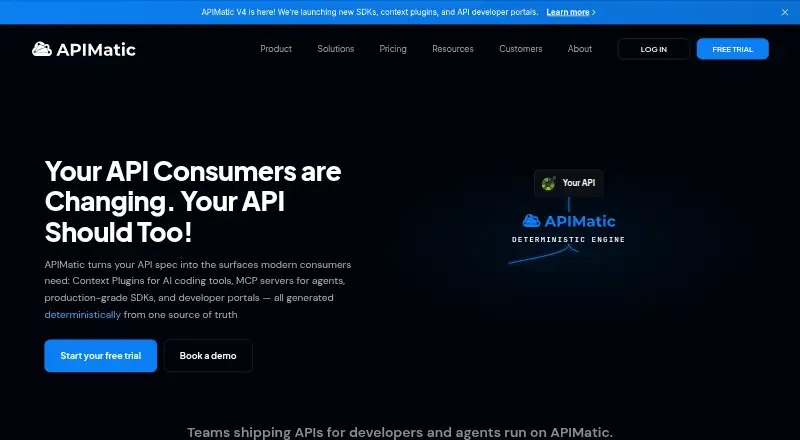
What APIMatic is
APIMatic turns API contracts into SDKs, documentation, developer portals, code samples, Context Plugins, and MCP servers. Its specification-driven platform validates and transforms API definitions before generating interfaces for developers and AI systems. The API editor and VS Code extension allow users to create or edit definitions; the extension includes validation and linting, with more than 1,200 built-in rules. The API Transformer supports formats including OpenAPI, RAML, Postman, API Blueprint, WSDL, Insomnia, and GraphQL Schema. Generated typed SDKs cover PHP, Ruby, Python, C#, Go, Java, and JavaScript/TypeScript. Developer portals can include API references, a console, live code samples, and custom guides. Context Plugins provide API context to tools such as Cursor, GitHub Copilot, Claude Code, and Windsurf. The CLI and Cloud APIs can automate SDK and portal generation in CI/CD workflows. A free plan is available, paid plans start at $10/mo, and the product advertises a 14-day free trial. Plan endpoint limits matter: APIs over an allowance cannot generate SDKs or documentation.
Who it suits
APIMatic suits API providers that want to help developers and AI agents integrate with their APIs. Its free plan has limits of one API, 10 endpoints, two programming languages, and one team member.
What it does well
- Generates SDKs in seven language groupings.
- Supports multiple API specification formats.
- Includes an editor and VS Code extension.
- CLI and Cloud APIs support CI/CD automation.
- Free plan is available.
What to know first
- Free plan allows one API and 10 endpoints.
- Exceeding endpoint limits blocks SDK and documentation generation.
- Enterprise pricing is custom.
Limits
The Free plan allows one API, 10 endpoints, any two programming languages, and one team member. APIs that exceed a plan’s endpoint allowance cannot generate SDKs or documentation. The Lite plan lists one API, 20 endpoints, any two programming languages, and one team member.
Plans
| Plan | Billed and limits | Price |
|---|---|---|
| Free | FREE FOREVER · HTTP + any 2 programming languages · 1 API · 10 endpoints · 1 team member | Free |
| Business | Starts from $1,000 /month · All languages · Up to 5 APIs · Up to 50 endpoints · Up to 5 team members | $1,000 a month |
| Lite | $99/m billed annually or $115/m billed monthly · HTTP + any 2 programming languages · 1 API · 20 endpoints · 1 team member | $99 a month |
| Enterprise | Custom · All languages · Up to ∞ APIs · Up to ∞ endpoints · Custom team size | On request |
As apimatic.io lists them, read 8 Oct 2026. The maker's own page has the final word.
Getting started
- Visit the APIMatic website.
- Start with the free plan or use the advertised 14-day free trial.
- Create or edit an API definition in the API editor or VS Code extension.
- Choose a supported specification format and programming languages for generation.
- Use the CLI or Cloud APIs to automate generation in a CI/CD workflow, if needed.
- For the Enterprise offering, consider the self-hosted pipeline option.
APIMatic is a specification-driven platform for API providers, best suited to teams publishing developer integrations across languages and coding tools. Its broad generation workflow is useful, but endpoint and team caps can make the lower tiers a poor fit for larger API portfolios.
Overview
APIMatic validates and transforms API definitions, then generates SDKs, documentation, developer portals, code samples, and context for AI coding agents. It addresses the work of helping others integrate with an organization’s APIs, rather than general application-to-application integration.
The central advantage is that these developer-facing outputs can share one API contract as their starting point. That is a good match for providers who maintain specifications as part of their API workflow. Teams without usable API definitions may have less to gain, since the product’s generation approach depends on those contracts.
Key features
Specification editing and validation
The API editor and VS Code extension support creating or editing definitions, with validation and linting in the extension. APIMatic says its definition checks include more than 1,200 built-in rules. That gives teams a substantial rule set for checking contracts before generation, although the value depends on whether their specifications are kept current.
The API Transformer supports OpenAPI, RAML, Postman, API Blueprint, WSDL, Insomnia, and GraphQL Schema. This range is useful for organizations working across multiple formats. Generated typed SDKs cover PHP, Ruby, Python, C#, Go, Java, and JavaScript/TypeScript, giving developers language-specific interfaces without requiring every consumer to work directly from the raw API definition.
Portals, automation, and AI context
Developer portals can combine API references, an advanced API console, live code samples, and custom guides. Context Plugins bring API context into Cursor, GitHub Copilot, Claude Code, and Windsurf, extending the same specification-driven approach to AI coding tools. These capabilities make APIMatic relevant where both human developers and AI agents need help integrating with an API.
CLI and Cloud APIs support automating SDK and portal generation in CI/CD workflows. APIMatic also documents integrations with GitHub, GitHub Actions, Jenkins, Microsoft Azure API Management, MuleSoft Anypoint, and Red Hat OpenShift. Organizations using MuleSoft or Red Hat can connect it to those API management environments; the integrations do not make APIMatic a replacement API gateway.
Pricing
The Free plan costs nothing forever and includes HTTP plus any two programming languages, one API, 10 endpoints, and one team member. It is a useful way for an individual to work with a small API, but the endpoint cap is restrictive for broader coverage.
Lite costs $99/m billed annually or $115/m billed monthly. It includes HTTP plus any two programming languages, one API, 20 endpoints, and one team member. The monthly option avoids an annual commitment at a higher rate, while either version remains limited to a single API and seat. The pricing note also advertises a 14-day free trial.
Business starts from $1,000 /month and includes all languages, up to five APIs, 50 endpoints, and five team members. This is the more relevant tier for a small team publishing several APIs, but the endpoint allowance still requires checking against the actual definitions. Enterprise has custom pricing, all languages, up to unlimited APIs and endpoints, and custom team size. It adds SAML and OIDC SSO, self-hosting the full pipeline inside the customer’s network, concierge onboarding, and priority support with SLAs—features aimed at organizations with security and support requirements beyond the standard tiers.
All paid plans include direct email support; Business and Enterprise also provide dedicated specialists through Slack, phone, and email. A key operational limit applies across plans: APIs exceeding their endpoint allowance cannot generate SDKs or documentation. Check endpoint counts before committing, since a cap can block the core output rather than merely reduce usage.
Platforms
APIMatic is offered for API, extension, Linux, self-hosted, and web environments. Its on-premises option can generate documentation and SDKs on customer infrastructure, with no data shared with APIMatic or third parties. That makes it a relevant choice for organizations that require generation to stay within their own network.
Who it's for
APIMatic suits API providers that want a consistent, automated route from contracts to SDKs, portals, and AI coding context. It is particularly compelling for teams publishing integrations in several languages or maintaining CI/CD generation workflows. A solo user with one small API can start on Free; larger teams should weigh the endpoint caps, seat allowances, and Enterprise security options. It is less suitable for buyers seeking an API gateway or a tool for connecting unrelated business applications.
Pros and cons
- Broad contract support: The transformer handles formats from OpenAPI and RAML to WSDL and GraphQL Schema, helping teams with varied API-definition sources.
- Multiple developer outputs: SDKs, references, portals, samples, and AI context come from the specification workflow, reducing the need to assemble each interface separately.
- Automation options: CLI and Cloud APIs can bring generation into CI/CD, useful for teams that want outputs to track contract changes.
- Hard endpoint ceilings: Exceeding a plan’s allowance prevents SDK and documentation generation, so modest quotas can become a blocker.
- Constrained lower tiers: Free and Lite allow one API and one team member; Business costs from $1,000 /month for a larger allowance, making expansion costly for teams with several APIs.
Alternatives
Choose Amazon API Gateway if you want an API gateway with a free plan and mobile, web, and API platforms. Apinizer is an option for a self-managed gateway, with its free Community plan covering up to three API proxies. Gravitee API Gateway offers a free Apache 2.0 community edition for gateway needs. Kong Gateway may suit buyers who want a 30-day trial with no Gateway limits. Apiman is a free, self-hosted Apache-2.0 community edition with no features hidden behind paywalls, while Fusio is a free, Apache 2.0 open-source API management platform. Zuplo offers a free plan capped at 100K requests per month, with two account members and five environments. Apigee API hub is available at no additional cost to eligible Apigee organizations in supported regions. For category browsing, see API Developer Portal Software or Code Generators.
Verdict
Choose APIMatic if your organization publishes APIs and wants specifications to drive SDKs, portals, and coding-agent context from a shared workflow. Its range of formats, outputs, and automation options is the main reason to pick it. Look elsewhere if you need a gateway, have no specification-led process, or cannot fit your API portfolio within the endpoint and seat limits of the available plans.
Verdict
APIMatic combines specification validation with generation for SDKs, portals, and AI coding context. Its free and paid plans have defined limits, so endpoint allowances should be checked against the APIs in scope.
Questions
Does APIMatic have a free plan?
Yes. Its Free plan is billed FREE FOREVER and includes one API, 10 endpoints, any two programming languages, and one team member.
How much do APIMatic’s paid plans cost?
The listed Lite plan is $99 a month, billed at $99/m annually or $115/m monthly. Business starts from $1,000 /month, while Enterprise is custom priced; the product also advertises paid plans from $10/mo.
Is there a free trial?
Yes. APIMatic advertises a 14-day free trial.
Which programming languages can APIMatic generate SDKs for?
It lists PHP, Ruby, Python, C#, Go, Java, and JavaScript/TypeScript.
Can APIMatic be self-hosted?
The Enterprise offering describes an on-premises option for generating API documentation and SDKs on a customer’s own infrastructure, with no data shared with APIMatic or third parties.
Which coding tools work with Context Plugins?
APIMatic lists Cursor, GitHub Copilot, Claude Code, and Windsurf.
Facts from APIMatic's own pages
- AI coding integrations
- Context Plugins work with Cursor, Claude Code, and GitHub Copilot, according to APIMatic’s site. · apimatic.io, 8 Oct 2026
- AI tools
- Context Plugins provide API context to coding tools including Cursor, Copilot, Claude Code, and Windsurf. · apimatic.io, 8 Oct 2026
- API integration platform
- APIMatic turns API contracts into SDKs, documentation, developer portals, code samples, Context Plugins, and MCP servers. · apimatic.io, 8 Oct 2026
- API management integrations
- APIMatic says its platform works in harmony with Mulesoft and RedHat API Management Platforms. · apimatic.io, 8 Oct 2026
- API specifications
- The platform validates and transforms API specifications before generating interfaces for developers and AI systems. · apimatic.io, 8 Oct 2026
- Audience
- APIMatic describes its platform as serving organizations that provide APIs and want to support developers integrating them. · apimatic.io, 8 Oct 2026
- Automation
- Its CLI and Cloud APIs can be used to automate SDK and API portal generation in CI/CD workflows. · apimatic.io, 8 Oct 2026
- Enterprise support
- The enterprise offering lists concierge onboarding and priority support with SLAs. · apimatic.io, 8 Oct 2026
- Generation
- Its specification-driven engine validates and transforms API specifications, then generates integration interfaces from them. · apimatic.io, 8 Oct 2026
- Integrations
- APIMatic documents integrations with GitHub, GitHub Actions, Jenkins, Microsoft Azure API Management, MuleSoft Anypoint, and Red Hat OpenShift. · apimatic.io, 8 Oct 2026
- Intended users
- APIMatic describes its platform as helping API providers support developers and AI agents integrating with their APIs. · apimatic.io, 8 Oct 2026
- Plan limits
- The pricing page says APIs that exceed a plan’s endpoint allowance cannot generate SDKs or documentation. · apimatic.io, 8 Oct 2026
- Portals
- Developer portals can include API references, an advanced API console, live code samples, and custom guides. · apimatic.io, 8 Oct 2026
- Privacy
- APIMatic’s privacy policy says sensitive information submitted to its website is encrypted using SSL and describes user data deletion requests and retention of no more than five years. · apimatic.io, 8 Oct 2026
- Purpose
- APIMatic turns API contracts into SDKs, documentation, developer portals, and context for AI coding agents. · apimatic.io, 8 Oct 2026
- SDK languages
- APIMatic lists SDKs for TypeScript, Python, Go, Java, C#, PHP, and Ruby. · apimatic.io, 8 Oct 2026
- SDKs
- The platform generates typed SDKs for PHP, Ruby, Python, C#, Go, Java, and JavaScript/TypeScript. · docs.apimatic.io, 8 Oct 2026
- Security option
- The enterprise offering describes self-hosting the full pipeline inside the customer’s own network. · apimatic.io, 8 Oct 2026
- Self hosting
- APIMatic describes an on-premises option for generating API documentation and SDKs on the customer’s own infrastructure, with no data shared with APIMatic or third parties. · apimatic.io, 8 Oct 2026
- Specification editor
- The API editor and VS Code extension let users create or edit API definitions, with validation and linting checks in the extension. · apimatic.io, 8 Oct 2026
- Specification formats
- The API Transformer supports formats including OpenAPI, RAML, Postman, API Blueprint, WSDL, Insomnia, and GraphQL Schema. · apimatic.io, 8 Oct 2026
- SSO
- Enterprise SSO supports SAML and OIDC, and is available to Enterprise customers. · docs.apimatic.io, 8 Oct 2026
- Support
- All paid plans have direct email support, while Business and Enterprise plans have dedicated specialists available through Slack, phone, and email. · apimatic.io, 8 Oct 2026
- Trial
- The product page advertises a 14-day free trial. · apimatic.io, 8 Oct 2026
Where APIMatic stands on Freedom251
- API Developer Portal Software#3 of 36
- Code Generators#6 of 33
- Api Docs#4 of 19