Freedom251 › API Management Software
Fusio
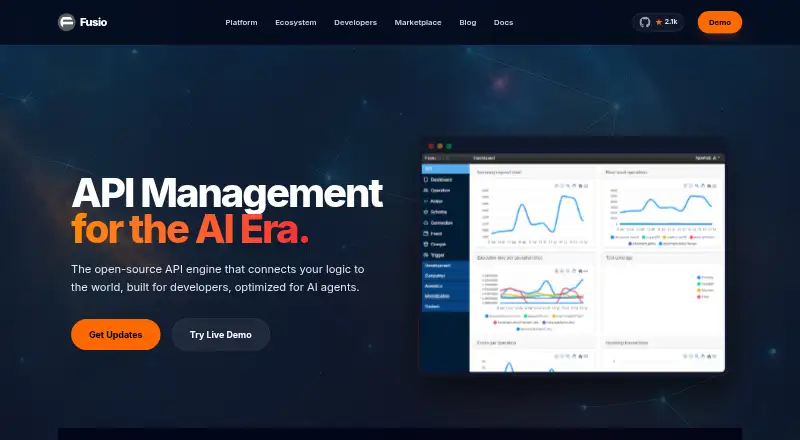
What Fusio is
Fusio is a free, open-source API management platform for connecting business logic and infrastructure to APIs. It is self-hosted, with a unified gateway that links databases, microservices, and custom scripts while handling routing, authentication, and request validation. TypeSchema models provide validation and can generate OpenAPI specifications and client SDKs in multiple languages. A developer portal offers documentation, testing tools, and API keys. API monetization features can manage plans, quotas, subscriptions, and billing. The project also describes optional AI-assisted development and AI/MCP integration. Official adapters connect with technologies and services such as AWS, Google Cloud, GraphQL, HTTP, LDAP, MongoDB, Redis, SQL, Stripe, and SOAP. Worker runtimes are available for PHP, JavaScript, and Python, while SDKs are listed for C#, Go, Java, JavaScript, PHP, and Python. Built-in API management capabilities include authentication, granular rate limiting, and request validation. Fusio can be installed from a release archive, through Composer, or with Docker. Its code is licensed under Apache 2.0.
Who it suits
Fusio suits teams that want to self-host API management and connect services, infrastructure, and custom logic. It may also suit developers building API portals or managing plans, quotas, and subscriptions.
What it does well
- Self-hosted gateway connects databases, microservices, and scripts.
- TypeSchema can generate OpenAPI specifications and SDKs.
- Developer portal includes documentation, testing, and API keys.
- Offers worker runtimes in PHP, JavaScript, and Python.
- Free and licensed under Apache 2.0.
What to know first
- The platform is self-hosted.
- AI features are optional.
Plans
| Plan | Billed and limits | Price |
|---|---|---|
| Fusio | Open-source API management platform · Apache 2.0 code license | Free |
As fusio-project.org lists them, read 9 Oct 2026. The maker's own page has the final word.
Getting started
- Visit the Fusio website.
- Choose an installation route: release archive, Composer, or Docker.
- Deploy Fusio in a self-hosted environment.
- Configure API connections and gateway controls.
- Use the developer portal for documentation, testing, and API keys.
Fusio is an open-source API management system for teams building APIs around their own services and business logic. It is best suited to developers willing to operate infrastructure rather than buy a managed gateway. The broad feature set is compelling when one self-hosted platform must cover API delivery, documentation, access control and monetization.
Overview
Fusio combines a unified gateway with lifecycle management, access policies, analytics and API product management. The gateway can connect databases, microservices and custom scripts while applying routing, authentication and request validation. That scope can replace several narrowly focused components, but the deployment model matters: your team is responsible for running the system.
The software is free under the Apache 2.0 license. Installation is offered through a release archive, Composer or Docker, giving infrastructure teams several ways to fit it into an existing environment. Fusio is headquartered in Heiligenhaus, Germany.
Key features
Gateway and security
Routing, authentication, granular rate limiting and request validation are built into the API-management layer. These controls are useful for teams that want policy enforcement close to the APIs rather than assembling separate gateway and security products. They also make Fusio more suitable for production API programs than a simple routing proxy, provided the team can operate the host environment.
Schema-driven development
TypeSchema models provide validation, generate OpenAPI specifications and produce client SDKs in multiple languages. This reduces repetitive contract work and can keep documentation and generated clients aligned with the API model. The developer hub lists SDKs for C#, Go, Java, JavaScript, PHP and Python.
Portal, products and monetization
The included developer portal combines documentation, testing tools and API keys, giving consumers a place to discover and try services. Fusio also supports plans, quotas, subscriptions and billing through its API monetization features. That combination is a strong reason to consider it for teams turning internal APIs into governed products, not just exposing endpoints.
Adapters, runtimes and optional AI
Official adapters cover AWS, Google Cloud, GraphQL, HTTP, LDAP, MongoDB, Redis, SQL, Stripe and SOAP. Worker runtimes are available for PHP, JavaScript and Python, which broadens the kinds of business logic the platform can execute. AI-assisted development and AI/MCP integration are offered as optional capabilities, so teams can use the core platform without making AI part of their architecture.
Pricing
| Plan | Price | Includes |
|---|---|---|
| Fusio | free | Open-source API management platform; Apache 2.0 code license |
There is no paid software tier, seat charge or published usage quota for the Fusio plan. The economic trade-off is operational rather than subscription-based: hosting, upgrades and administration remain with the self-hosting team. This plan fits organizations that can provide that capability and want to inspect, adapt or extend Apache-licensed code.
Platforms
Fusio is available for API, Linux, self-hosted and web use. Docker, Composer and release-archive installation support different deployment workflows, while the PHP, JavaScript and Python worker runtimes let teams choose among those execution languages.
Who it's for
Fusio fits engineering teams building a portfolio of APIs from multiple back ends and needing gateway policy, schemas, a consumer portal and commercial plans in one system. It is particularly relevant when self-hosting, API lifecycle control and open-source licensing are requirements. Teams without the capacity or desire to maintain infrastructure should favor a managed alternative instead.
Pros and cons
Pros
- Broad lifecycle coverage: gateway, access policies, analytics and product management sit in one platform.
- Useful automation: TypeSchema validation, OpenAPI generation and multi-language SDKs reduce contract-maintenance work.
- Commercial API tooling: plans, quotas, subscriptions and billing support API monetization without a separate product layer.
- Open integration surface: adapters span cloud services, databases, protocols and Stripe, with PHP, JavaScript and Python workers.
- Open-source economics: the Apache 2.0 license and free plan remove software subscription costs.
Cons
- Self-hosting burden: the team must operate the deployment, so it is not a fit for organizations seeking a fully managed service.
- Operational choice is mandatory: installation and runtime options provide flexibility but require infrastructure decisions and maintenance ownership.
- AI is optional: teams specifically seeking an AI-first API platform may need capabilities beyond Fusio's optional AI/MCP layer.
Alternatives
Choose Amazon API Gateway when a paid AWS service and web, Android or iOS reach matter more than an Apache-licensed self-hosted stack; it has a free plan but no free trial. APIMatic is the better choice when hosted SDK and API documentation workflows with a defined free tier are the priority; its Free plan covers one API, 10 endpoints, one team member and HTTP plus any two programming languages.
Apinizer suits teams wanting a self-managed community gateway capped at three API proxies. Gravitee API Gateway offers a free Apache 2.0 Community Edition, while its paid Planet plan costs $2,500 a month. Kong Gateway is worth considering for a 30-day free trial with no gateway limits and 30 days of analytics retention.
Apiman is another Apache-2.0 self-hosted option with no features hidden behind paywalls. Zuplo is preferable when a hosted-style free tier capped at 100K requests per month, two account members and five environments matches your scale. Apigee API hub fits eligible Apigee organizations wanting API-hub access at no additional cost in supported regions.
Verdict
Choose Fusio if you want an Apache-licensed, self-hosted platform that spans gateway security, schema automation, developer access and API monetization. Look elsewhere if avoiding infrastructure ownership is more important than consolidating those capabilities in open-source software.
Verdict
Fusio combines a self-hosted gateway with schema tools, a developer portal, and API monetization features. Its self-hosted deployment and broad language and adapter options are central considerations for teams evaluating it.
Questions
Is Fusio free?
Yes. Fusio is free and open source, with its code licensed under Apache 2.0.
Which platforms does Fusio support?
Fusio is available for API use, Linux, self-hosted deployment, and the web.
How can Fusio be installed?
The project offers installation from a release archive, through Composer, or with Docker.
Does Fusio include AI features?
The site describes AI-assisted development and AI/MCP integration, and says those features are optional.
Which languages are available for workers and SDKs?
Worker runtimes are available for PHP, JavaScript, and Python. SDKs are listed for C#, Go, Java, JavaScript, PHP, and Python.
What integrations does Fusio list?
Official adapters include AWS, Google Cloud, GraphQL, HTTP, LDAP, MongoDB, Redis, SQL, Stripe, and SOAP.
Facts from Fusio's own pages
- AI and MCP
- The site describes AI-assisted development and AI/MCP integration, and says AI features are optional. · fusio-project.org, 9 Oct 2026
- Developer portal
- The platform includes a developer portal with documentation, testing tools, and API keys. · fusio-project.org, 9 Oct 2026
- Execution languages
- Fusio offers worker runtimes for PHP, JavaScript, and Python. · fusio-project.org, 9 Oct 2026
- Gateway
- Its unified API gateway connects databases, microservices, and custom scripts while handling routing, authentication, and request validation. · docs.fusio-project.org, 9 Oct 2026
- Headquarters
- Heiligenhaus, Germany · fusio-project.org, 28 Sept 2026
- Installation options
- Fusio can be installed from a release archive, through Composer, or with Docker. · fusio-project.org, 9 Oct 2026
- Integrations
- Official adapters connect with services and technologies including AWS, Google Cloud, GraphQL, HTTP, LDAP, MongoDB, Redis, SQL, Stripe, and SOAP. · fusio-project.org, 9 Oct 2026
- License
- The Fusio site states that its code is licensed under Apache 2.0. · fusio-project.org, 9 Oct 2026
- Monetization
- Fusio can manage plans, quotas, subscriptions, and billing through its API monetization features. · fusio-project.org, 9 Oct 2026
- Purpose
- Fusio is an open-source API management platform for connecting business logic and infrastructure to APIs. · fusio-project.org, 9 Oct 2026
- Schema automation
- TypeSchema models provide validation and automatic OpenAPI specifications and multi-language client SDK generation. · docs.fusio-project.org, 9 Oct 2026
- SDKs
- The developer hub lists SDKs for C#, Go, Java, JavaScript, PHP, and Python. · fusio-project.org, 9 Oct 2026
- Security controls
- The platform documentation describes authentication, granular rate limiting, and request validation as built-in API management capabilities. · docs.fusio-project.org, 9 Oct 2026
- Self-hosted
- Fusio describes itself as self-hosted API management for builders. · docs.fusio-project.org, 9 Oct 2026
- Support
- The project offers real-time Discord support and architectural discussions, plus an issue tracker for bugs and feature requests. · fusio-project.org, 9 Oct 2026
Where Fusio stands on Freedom251
- API Management Software#4 of 38
- Rest Apis#3 of 28
- API Developer Portal Software#5 of 36
- API Marketplace Software#5 of 36
- Api 1#6 of 25