Freedom251 › Accounts Payable Software

Kotlin/JS
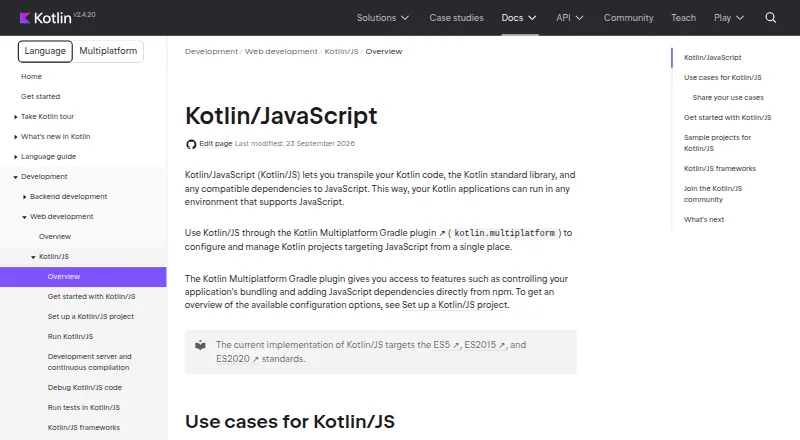
What Kotlin/JS is
Kotlin/JS is a Kotlin compiler target that converts Kotlin code, the Kotlin standard library and compatible dependencies into JavaScript. Projects can target browsers or Node.js, including server-side and serverless applications. The current implementation targets ES5, ES2015 and ES2020, and supports ESM, CommonJS, UMD and AMD module systems. Configuration uses the Kotlin Multiplatform Gradle plugin, which supports bundling setup and JavaScript dependencies from npm. JetBrains provides Kotlin wrappers for React and other JavaScript frameworks, including React Redux, React Router and styled-components. Kotlin/JS can share logic between web frontends and JVM backends, or among Android, iOS and web clients. Node.js projects can use kotlinx-nodejs for type-safe access to the Node.js API. Browser testing can use Karma or an experimental browser testing DSL, while Node.js projects use Mocha; the documentation notes Karma is deprecated and is not expected to receive new features or bug fixes. The Gradle plugin generates JavaScript source maps for builds. Kotlin/JS is open source and free, with Linux, macOS, web and Windows listed as platforms.
Who it suits
It suits Kotlin developers building web frontends or sharing business logic with JavaScript or TypeScript codebases. It may also fit teams targeting Node.js or sharing code between web clients and JVM backends.
What it does well
- Compiles Kotlin and compatible dependencies to JavaScript.
- Targets browsers and Node.js.
- Supports four JavaScript module systems.
- Can share logic across web, JVM, Android and iOS.
- Gradle plugin generates JavaScript source maps.
What to know first
- Karma is deprecated and will not receive expected updates.
- Browser testing DSL is experimental.
Plans
| Plan | Billed and limits | Price |
|---|---|---|
| Kotlin/JS | Kotlin compiler target for JavaScript; configured with the Kotlin Multiplatform Gradle plugin | Free |
As kotlinlang.org lists them, read 29 Sept 2026. The maker's own page has the final word.
Getting started
- Open the Kotlin/JS documentation website.
- Configure the project with the Kotlin Multiplatform Gradle plugin.
- Set the project target to a browser or Node.js environment.
- Choose the required JavaScript module system and ECMAScript target.
Overview
Kotlin/JS is a way to build JavaScript applications using Kotlin across browser and Node.js environments. It makes the strongest case for teams already invested in Kotlin that want to share application logic across clients; JavaScript-first projects may find its Gradle-based setup an extra layer.
Its appeal is broader than compiling a frontend: Kotlin code, its standard library, and compatible dependencies become JavaScript, while common logic can be shared with JVM backends and Android or iOS clients. That can reduce duplication when Kotlin is already part of the architecture, but offers less reason to switch when a project has no need for cross-platform code sharing.
Key features
JavaScript output and project integration
The current implementation targets ES5, ES2015, and ES2020, with output available in ESM, CommonJS, UMD, and AMD module formats. This gives teams options for integrating generated code with different JavaScript module conventions. Projects are configured through the Kotlin Multiplatform Gradle plugin, which supports bundling and npm dependencies. That is useful for Kotlin and Gradle teams, but means JavaScript projects take on a Kotlin-specific build setup.
Frameworks and shared logic
JetBrains provides Kotlin wrappers for React and other JavaScript frameworks, including React Redux, React Router, and styled-components. Those wrappers give Kotlin developers a route into established frontend frameworks, though they do not remove the need to work within the JavaScript ecosystem. Sharing business logic with JavaScript or TypeScript codebases—and across web, JVM, Android, and iOS clients—is the more distinctive reason to choose Kotlin/JS.
Node.js and debugging
The Node.js target supports server-side and serverless applications, and kotlinx-nodejs provides type-safe access to Node.js APIs. The Gradle plugin also generates JavaScript source maps automatically, which can help connect generated output to project sources during debugging.
Testing
Node.js projects use Mocha. Browser testing can use Karma or a new experimental browser-testing DSL, but Karma is deprecated and is not expected to receive new features or bug fixes. Teams choosing Kotlin/JS for browser work should account for that uneven testing picture rather than assume both paths are equally established.
Pricing
Kotlin/JS is free and open source. Its Kotlin/JS plan costs nothing and provides a Kotlin compiler target for JavaScript, configured with the Kotlin Multiplatform Gradle plugin. There are no paid tiers or seat quotas described, so the price is straightforward; the main trade-off is adopting the Kotlin build and testing workflow rather than paying for a separate service.
Platforms
Kotlin/JS is available across Linux, macOS, and Windows development environments, and targets web browsers and Node.js. This covers common desktop development systems as well as browser and server-side JavaScript projects.
Who it's for
Kotlin/JS suits Kotlin developers building web frontends, and teams that want to share business logic between Kotlin-based clients or with JavaScript and TypeScript codebases. It is also an option for Kotlin teams building Node.js services or serverless applications. A JavaScript-first team with no Kotlin code to share has less reason to accept the additional Kotlin Multiplatform Gradle configuration.
Pros and cons
Pros
- Cross-platform code sharing: Common logic can serve web frontends alongside JVM backends and Android or iOS clients.
- Flexible JavaScript integration: Support for four module systems and npm dependencies gives projects several integration paths.
- Browser and server targets: Teams can use the same Kotlin-based approach for browser frontends and Node.js applications.
- Free and open source: The compiler target has no plan charge.
Cons
- Kotlin-specific build setup: Projects use the Kotlin Multiplatform Gradle plugin, adding a distinct toolchain layer to JavaScript work.
- Browser testing caveat: Karma is deprecated, while the alternative browser-testing DSL is experimental.
- Limited reason to switch for JavaScript-only teams: Its clearest advantage is sharing Kotlin logic, so teams without that goal may not benefit from the extra integration.
Alternatives
For API and code documentation rather than a Kotlin-to-JavaScript compiler target, consider Asciidoctor, a free, open-source tool whose core converters include HTML 5, DocBook 5, and man pages. Scalar is a freemium API documentation option; its free plan covers up to 3 APIs, 1 SDK of up to 25 endpoints, 1 editor seat, and 50 Agent Scalar credits, while Pro is $150 a month (billed $125/). Choose Sphinx for free open-source documentation software that can be installed locally or self-hosted.
DocFX is a free open-source static site generator that requires .NET SDK 8.0 or higher. Doxygen is free open-source software with Windows, Linux, and macOS downloads; mdBook is a free open-source option under MPL-2.0, and Natural Docs is open source under AGPL version 3. For package management rather than documentation or transpilation, Swift Package Manager is a free open-source tool.
Browse Code Transpilers for related tools, or compare options in Documentation Generators and Accounts Payable Software.
Verdict
Choose Kotlin/JS if your team already uses Kotlin and wants to carry shared business logic into browser or Node.js projects without abandoning Kotlin. Its free, multi-target compiler and JavaScript integration make that a credible path. Look elsewhere if your project is JavaScript-only or depends on a mature, settled browser-testing workflow: the Gradle layer and deprecated Karma path weaken the case for switching.
Verdict
Kotlin/JS lets developers use Kotlin in browser and Node.js projects, with framework wrappers and multiple module formats. Note that Karma is deprecated and the alternative browser-testing DSL is experimental.
Questions
What does Kotlin/JS do?
It transpiles Kotlin code, the Kotlin standard library, and compatible dependencies to JavaScript.
Does Kotlin/JS cost anything?
Kotlin/JS is free and open source.
Which platforms can projects target?
Projects can target browsers or Node.js. Linux, macOS, web, and Windows are listed as platforms.
Which JavaScript module systems are supported?
Kotlin/JS supports ESM, CommonJS, UMD, and AMD.
What testing options does it support?
Browser tests can use Karma or an experimental browser testing DSL, and Node.js projects use Mocha. The documentation says Karma is deprecated.
Can Kotlin/JS work with JavaScript frameworks?
JetBrains provides Kotlin wrappers for React and other JavaScript frameworks, including React Redux, React Router, and styled-components.
Facts from Kotlin/JS's own pages
- Code sharing
- Kotlin/JS can share common logic between web frontends and JVM backends, and between Android, iOS, and web clients. · kotlinlang.org, 29 Sept 2026
- Debugging
- The Kotlin Multiplatform Gradle plugin automatically generates JavaScript source maps for project builds. · kotlinlang.org, 29 Sept 2026
- ECMAScript targets
- The current Kotlin/JS implementation targets ES5, ES2015, and ES2020. · kotlinlang.org, 29 Sept 2026
- Environments
- Kotlin/JS projects can target browsers or Node.js. · kotlinlang.org, 29 Sept 2026
- Founded
- 2000 · kotlinlang.org, 28 Sept 2026
- Gradle setup
- Kotlin/JS is configured through the Kotlin Multiplatform Gradle plugin, which supports bundling configuration and JavaScript dependencies from npm. · kotlinlang.org, 29 Sept 2026
- Integrations
- JetBrains provides Kotlin wrappers for React and other JavaScript frameworks, including support for React Redux, React Router, and styled-components. · kotlinlang.org, 29 Sept 2026
- Intended users
- The documentation describes Kotlin/JS use cases including web developers sharing business logic with JavaScript or TypeScript codebases and developers building web frontends in Kotlin. · kotlinlang.org, 29 Sept 2026
- JavaScript modules
- Kotlin/JS supports ESM, CommonJS, UMD, and AMD module systems. · kotlinlang.org, 29 Sept 2026
- Purpose
- Kotlin/JS transpiles Kotlin code, the Kotlin standard library, and compatible dependencies to JavaScript. · kotlinlang.org, 29 Sept 2026
- Server-side use
- The Node.js target supports server-side or serverless applications, and kotlinx-nodejs provides type-safe access to the Node.js API. · kotlinlang.org, 29 Sept 2026
- Support
- The Kotlin documentation directs users to the #javascript channel in Kotlin Slack to discuss Kotlin/JS with the community and team. · kotlinlang.org, 29 Sept 2026
- Testing
- Kotlin/JS supports browser tests through Karma or a new experimental browser testing DSL, and uses Mocha for Node.js projects. · kotlinlang.org, 29 Sept 2026
- Testing limitation
- The Kotlin documentation says Karma is deprecated and is not expected to receive new features or bug fixes. · kotlinlang.org, 29 Sept 2026
Where Kotlin/JS stands on Freedom251
- Accounts Payable Software#15 of 97
- Code Transpilers#10 of 28