
Keyword Tool
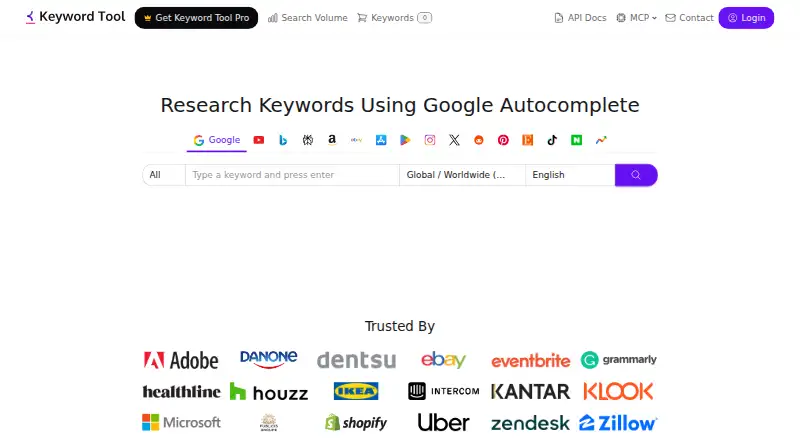
What Keyword Tool is
Keyword Tool turns a seed term into long-tail keyword suggestions drawn from autocomplete. It supports keyword and competitor research across 16 platforms, including Google, YouTube, Bing, Amazon, TikTok, Reddit, Pinterest, and Google Trends. The free tool needs no account and can generate 750+ Google autocomplete keywords. Paid plans add search volume, cost per click, competition scores, device breakdown, and historical trends; they also allow search-volume enrichment for up to 1,000 keywords per request. Access includes web, API, and MCP, with Claude, Cursor, and ChatGPT named as compatible assistants. Google coverage spans 190+ countries, 68,000+ locations, and 50+ languages. The site says Google and Bing metrics come from planner ecosystems, while volumes for other platforms are modeled estimates based on clickstream signals. Web, API, and MCP share a daily request pool, and available MCP tools can vary by endpoint, plan, and rollout status. Paid plans start at $68 a month; there is no free trial, and the pricing FAQ lists a 30-day money-back guarantee.
Who it suits
The maker describes Keyword Tool for solo marketers, businesses, in-house teams, agencies, SEO and content marketers, and PPC managers. It may suit people who need keyword discovery across multiple platforms or API and MCP access.
What it does well
- Free tool works without an account.
- Generates suggestions across 16 platforms.
- Supports competitor research and API access.
- Google coverage spans 190+ countries.
- Subscribers can cancel in account settings.
What to know first
- No free trial is offered.
- Paid plans start at $68 a month.
- Some platform volumes are modeled estimates.
- Daily requests are shared across web, API, and MCP.
Limits
The free plan provides up to 750+ Google autocomplete keywords and does not include the paid metrics. Paid plans have daily request and keyword capacity limits that vary by plan, and web, API and MCP share the daily request pool.
Plans
| Plan | Billed and limits | Price |
|---|---|---|
| Starter | 50 requests/day · 50,000 keywords/day · 12 months history · 16 platforms · web, MCP and API | $68 a month |
| Growth | 100 requests/day · 100,000 keywords/day · 24 months history · 16 platforms · web, MCP and API | $148 a month |
| Scale | 200 requests/day · 200,000 keywords/day · 48 months history · 16 platforms · web, MCP and API | $308 a month |
| Agency | 400 requests/day · 400,000 keywords/day · 48 months history · 16 platforms · web, MCP and API | $628 a month |
| Free | Up to 750+ Google autocomplete keywords · no account required | Free |
| Enterprise & Custom | Custom daily request and keyword-volume limits · custom API/MCP usage · enterprise procurement support | On request |
As keywordtool.io lists them, read 3 Oct 2026. The maker's own page has the final word.
Getting started
- Open keywordtool.io.
- Enter a seed term in the free tool to generate Google autocomplete keywords without an account.
- Choose a paid plan if you need metrics, API or MCP access, or higher daily capacity.
- Use the web interface, API or MCP with a paid plan.
- Cancel a subscription through account settings whenever needed.
Overview
Keyword Tool turns a seed term into autocomplete-based keyword ideas for marketers, SEO professionals and content or PPC teams researching beyond a single search engine. Its breadth of platforms and no-account starting point are useful; paid metrics and capacity come at a substantial monthly cost, and estimates for many platforms are modeled.
Key features
Seed a search to get long-tail suggestions across 16 platforms, including Google, YouTube, Bing, Amazon, TikTok, Reddit, Pinterest and Google Trends. That makes Keyword Tool a practical option for exploring language across search, video, retail and social channels. The figures are not equally grounded across sources: Google and Bing metrics come from their planner ecosystems, while volumes for other platforms are modeled from clickstream signals. Treat the latter as directional estimates, not as equivalent to planner-sourced data.
Paid plans add search volume, cost per click, competition scores, device breakdown and historical trends. They can enrich up to 1,000 keywords per request, but daily capacity depends on the plan. Google research can be localized across 190+ countries, 68,000+ locations and 50+ languages, a meaningful advantage for geographically targeted work.
Paid access includes the web interface, API and MCP, with Claude, Cursor and ChatGPT named as compatible assistants. All three share a daily request pool, so integrations do not multiply a subscription’s allowance. Available MCP tools can vary by endpoint, plan and rollout status. Free use needs no account and can generate up to 750+ Google autocomplete keywords, but does not include the paid metrics.
Pricing
The free plan costs nothing and provides up to 750+ Google autocomplete keywords without an account. It is enough to explore suggestions, but its Google-only scope and lack of paid metrics make it a poor substitute for ongoing cross-platform analysis.
- Starter — $68 a month: 50 requests/day, 50,000 keywords/day, 12 months of history and access to 16 platforms through web, MCP and API. It is the entry paid tier for modest daily research, but the smallest request pool and shortest history make it less suitable for frequent or historical analysis.
- Growth — $148 a month: 100 requests/day, 100,000 keywords/day and 24 months of history across 16 platforms, with web, MCP and API. It doubles Starter’s daily allowances and history, but costs more than twice as much.
- Scale — $308 a month: 200 requests/day, 200,000 keywords/day and 48 months of history, with the same platform and access coverage. It fits heavier workloads that benefit from a longer trend window, at a steep increase over Growth.
- Agency — $628 a month: 400 requests/day, 400,000 keywords/day and 48 months of history across 16 platforms, with web, MCP and API. Its larger daily pool suits high-volume agency work; it does not extend the history beyond Scale.
- Enterprise & Custom — custom pricing: custom daily request and keyword-volume limits, custom API/MCP usage and enterprise procurement support. It is the tier for organizations that need tailored capacity or procurement handling.
There is no free trial. Paid subscriptions have a 30-day money-back guarantee; refund requests go through support. Subscribers can cancel at any time in account settings without cancellation fees or lock-in contracts. Because web, API and MCP use the same request pool, teams should size a plan around total usage rather than each access method separately.
Platforms
Keyword Tool is available on web and through an API. Paid plans also include MCP access. The 16-platform research coverage includes the named search, retail, video and social sources; its broad Google localization is especially useful to teams researching markets across countries and languages.
Who it's for
Solo marketers and SEO or content professionals can start with the free Google suggestions, while growing businesses and in-house teams have paid tiers for richer metrics and history. Agencies and PPC managers may value the larger keyword volumes and API or MCP workflows, but should account for the shared request pool and the monthly price. It is less compelling for users who need only Google ideas, or who require equally planner-sourced volume data across every platform.
Pros and cons
- Pro: Suggestions cover 16 platforms, giving researchers a way to explore queries beyond Google.
- Pro: The free tool needs no account and returns up to 750+ Google autocomplete keywords.
- Pro: Paid plans combine multiple research metrics, historical trends and up to 1,000-keyword enrichment requests.
- Con: Volumes for platforms beyond Google and Bing are modeled estimates, so their evidential footing differs.
- Con: Web, API and MCP share a daily pool, limiting the value of treating them as separate allowances.
- Con: Paid plans start at $68 a month, and higher daily capacity requires sharply higher monthly spend.
Alternatives
For more options in the same research category, browse Keyword Research Tools or SEO tools. If the need is specifically hashtag discovery or tracking, see Hashtag Generator Tools and Social Media Hashtag Tracking Software.
Choose HashtagsForLikes instead when hashtag analytics and trends matter more than broad keyword research; its Pro plan is $19 a month and includes unlimited searches and saved campaigns. RiteTag is another hashtag-focused option, with a $49 a year plan and browser extensions and mobile apps. For Twitter hashtag tracking, Circleboom Twitter Hashtag Tracker has a free tier with a preview for one profile and Twitter Search Tool access.
TikTok Symphony Creative Studio is a free option when the priority is TikTok creative production rather than keyword research. Genni offers tracker and page-growth reports for users seeking that kind of tracking. Rival IQ is an alternative for tracking companies, with its Drive plan at $239 a month for 10 companies, six months of history and one user. Brand24 is a paid alternative with a free trial and an Individual plan for monitoring three keywords and up to 2K mentions per month. Content Stage is a freemium option with a Starter plan at €79 a month for roughly 60 posts and reels a week.
Verdict
Keyword Tool is a strong fit for marketers who need autocomplete ideas across many platforms, especially when Google localization, bulk enrichment or API and MCP access matter. Its central advantage is breadth; its main reason to look elsewhere is that non-Google and non-Bing volumes are modeled, while meaningful paid capacity starts at $68 a month and shares one request pool across access methods. Start free for Google suggestions, and pay only if the additional metrics and daily volume justify that trade-off.
Verdict
Keyword Tool offers no-account autocomplete suggestions and broader metrics through paid plans. Keep the modeled estimates and shared daily request pool in mind when selecting a plan.
Questions
Is Keyword Tool free?
Yes. Its free tool works without an account and can generate up to 750+ Google autocomplete keywords.
How much do paid plans cost?
Paid plans start at $68 a month. Starter is $68 a month, Growth is $148 a month, Scale is $308 a month and Agency is $628 a month.
Is there a free trial?
No. The pricing FAQ says there is no free trial and offers a 30-day money-back guarantee for paid plans.
Which platforms does it cover?
Keyword research spans 16 platforms, including Google, YouTube, Bing, Amazon, TikTok, Reddit, Pinterest and Google Trends.
Does Keyword Tool provide an API?
Yes. Paid plans include web, API and MCP access. Claude, Cursor and ChatGPT are named as compatible AI assistants.
How are search volume metrics sourced?
The site says Google and Bing metrics come from their planner ecosystems. Volumes for other platforms are modeled estimates based on clickstream signals.
Facts from Keyword Tool's own pages
- Access and integrations
- Plans include the web interface, API and MCP access; the site names Claude, Cursor and ChatGPT as compatible AI assistants. · keywordtool.io, 3 Oct 2026
- API access
- Yes · keywordtool.io, 20 Sept 2026
- Audience
- The maker describes the product for solo marketers, growing businesses, in-house teams, agencies, SEO professionals, content marketers and PPC managers. · keywordtool.io, 3 Oct 2026
- Bulk lookup
- Paid plans allow search-volume enrichment for up to 1,000 keywords per request, with daily capacity depending on plan. · keywordtool.io, 3 Oct 2026
- Cancellation
- Subscribers can cancel at any time in account settings without cancellation fees or lock-in contracts. · keywordtool.io, 3 Oct 2026
- Competitor research
- Yes · keywordtool.io, 20 Sept 2026
- Data sources
- The site says Google and Bing metrics come from their planner ecosystems, while other platforms' volumes are modeled estimates based on clickstream signals. · keywordtool.io, 3 Oct 2026
- Free plan
- Yes · keywordtool.io, 20 Sept 2026
- Free use
- The free tool works without an account and can generate up to 750+ Google autocomplete keywords. · keywordtool.io, 3 Oct 2026
- Keyword discovery
- The tool generates long-tail keyword suggestions from autocomplete using a seed term. · keywordtool.io, 3 Oct 2026
- Keyword research
- Yes · keywordtool.io, 20 Sept 2026
- Localization
- Google coverage includes 190+ countries, 68,000+ locations and 50+ languages. · keywordtool.io, 3 Oct 2026
- Metrics
- Paid plans provide search volume, cost per click, competition scores, device breakdown and historical trends. · keywordtool.io, 3 Oct 2026
- Search sources
- It supports keyword research across 16 platforms, including Google, YouTube, Bing, Amazon, TikTok, Reddit, Pinterest and Google Trends. · keywordtool.io, 3 Oct 2026
- Paid from
- 68 · keywordtool.io, 20 Sept 2026
- Support
- The site directs users to contact support for custom subscriptions and refund requests within the 30-day guarantee period. · keywordtool.io, 3 Oct 2026
- Trial and refunds
- The pricing FAQ says there is no free trial and offers a 30-day money-back guarantee for paid plans. · keywordtool.io, 3 Oct 2026
- Usage limits
- Web, API and MCP share a daily request pool, and available MCP tools can vary by endpoint, plan and rollout status. · keywordtool.io, 3 Oct 2026
Where Keyword Tool stands on Freedom251
- SEO tools#18 of 245
- SEO APIs#4 of 26
- Social Media Hashtag Tracking Software#7 of 27
- Keyword Research Tools#14 of 36
- Hashtag Generator Tools#10 of 24