Freedom251 › Purchase Request Software
Jodoo Purchase Requisition Software
Visit Jodoo Purchase Requisition Software Alternatives Pricing
What Jodoo Purchase Requisition Software is
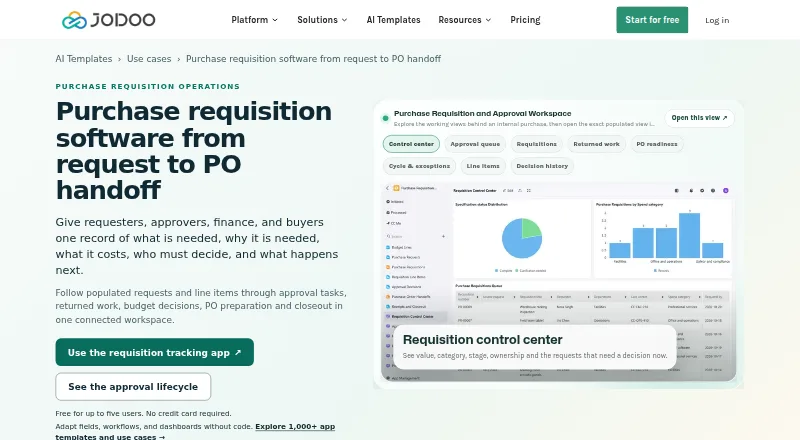
Jodoo Purchase Requisition Software manages purchase requests through approval and handoff to a buyer. A requisition can record the requester, department, item or service, quantity, estimate, category, needed-by date, budget, and justification. It can also track suggested suppliers, quotes, alternatives, conflict declarations, compliance evidence, and sourcing notes. Approval records may include thresholds, budget owners, functional reviewers, decisions, conditions, returned information, and timestamps; approved demand can then be assigned to a buyer and tracked by PO status. Administrators can adjust fields, evidence rules, conditional approvers, return routes, buyer queues, and reminders without coding. Jodoo lists Android, iOS, web, and API access, plus REST APIs, webhooks, custom Python or Node.js plugins, Zapier, and Make.com integrations. It says data is encrypted in transit and at rest, identifies ISO 27001 and SOC 2 Type 1 and Type 2 certifications, and hosts the service on AWS servers in Singapore. Business is billed yearly at $12 per user per month and starts at $60 per month for five users. Jodoo recommends an ERP or specialist procurement suite for catalogs, supplier networks, accounting commitments, tax, payment, and inventory costing.
Who it suits
Jodoo suits organizations that want configurable purchase-request, approval, and buyer-handoff workflows. Organizations needing punchout catalogs, supplier networks, accounting commitments, tax, payment, or inventory costing are directed toward an ERP or specialist procurement suite.
What it does well
- Captures detailed request and supplier context.
- Conditional approval routes can be adjusted without coding.
- Offers Android, iOS, web, and API access.
- Business includes unlimited monthly submissions.
What to know first
- Business starts at $60/month for five users.
- Free plan allows 5 users.
- Page recommends another system for catalogs, payments, and inventory costing.
Limits
The Free plan allows five users, 20,000 total data volume, 10,000 automation runs per year and 200 MB annual file upload. Business includes 750,000 total data volume, 300,000 automation runs per year and 120 GB annual file upload; it starts at $60/month for five users and is billed yearly.
Plans
| Plan | Billed and limits | Price |
|---|---|---|
| Free | 5 free users · 20,000 total data volume · 10,000 automation runs/year · 200 MB annual file upload · 1,000 monthly submissions · unlimited apps | Free |
| Business | $144.00 per user per year (= $12.00 per user/month, billed annually) · $12 per user per month, billed yearly; starts at $60/month (includes 5 users) · 750,000 total data volume · 300,000 automation runs/year · 120 GB annual file upload · unlimited monthly submissions · unlimited apps | $144 a year |
| Enterprise | Custom quote · 3,000,000 total data volume · 1,000,000 automation runs/year · 360 GB annual file upload · unlimited monthly submissions · unlimited apps | On request |
As jodoo.com lists them, read 29 Sept 2026. The maker's own page has the final word.
Getting started
- Open the Jodoo purchase requisition software website.
- Choose the Free plan or a paid plan; the paid plan has a 15-day trial.
- Use the web app or access Jodoo through its Android or iOS app.
- Configure request fields, evidence rules, approvers, return routes and buyer queues.
- Submit purchase requests for approval and buyer assignment.
Overview
Jodoo Purchase Requisition Software is a configurable tool for collecting purchase requests and routing them through approval before they reach a buyer. It suits organizations that need request and approval steps shaped around their own policies. Its focus is the requisition handoff, not end-to-end procurement or finance.
That boundary is important: organizations needing punchout catalogs, supplier networks, sourcing events, accounting commitments, tax, payments, or inventory costing should look to an ERP or specialist procurement suite instead.
Key features
- Request forms: Requests can capture the requester, department, item or service, quantity, estimate, category, needed-by date, budget, and justification. That gives approvers a common record to assess, including why the purchase is needed and when.
- Supplier context: Suggested suppliers, quotes, alternatives, conflict declarations, compliance evidence, and sourcing notes can accompany a request. This preserves useful context for review, but does not provide sourcing events or a supplier network.
- Approval and buyer handoff: Records can include thresholds, budget owners, functional reviewers, decisions, conditions, returned information, and timestamps. Approved requests can be assigned to buyers and tracked by PO status, connecting approval to follow-through without replacing a full purchasing system.
- Configurable routing: Administrators can adjust fields, evidence rules, conditional approvers, return routes, buyer queues, and reminders without coding. That flexibility is useful when review rules vary by request, though teams should expect to configure the workflow to match their process.
- Integration and security: Jodoo lists REST APIs, webhooks, custom Python or Node.js plugins, Zapier, and Make.com integrations; its pricing page lists Zapier and Make for Enterprise. It says data is encrypted at rest and in transit and identifies ISO 27001 and SOC 2 Type 1 and Type 2 certifications. The service is hosted on AWS servers in Singapore, a location to weigh against organizational data-residency requirements.
- Mobile access: Users can access Jodoo through its website and Android and iOS apps. The product also lists API support.
Pricing
Jodoo uses a freemium model, with a free plan, paid plans from $12/user/mo (annual), and a 15-day trial. The Business price is billed yearly at $12 per user per month and starts at $60/month for five users.
| Plan | Price and limits | Best fit |
|---|---|---|
| Free | free. Five free users, 20,000 total data volume, 10,000 automation runs/year, 200 MB annual file upload, 1,000 monthly submissions, and unlimited apps. | Small teams evaluating or running a modest workflow within the user, submission, storage, and automation caps. |
| Business | $12 per user per month, billed yearly; starts at $60/month for five users. 750,000 total data volume, 300,000 automation runs/year, 120 GB annual file upload, unlimited monthly submissions, and unlimited apps. | Teams that need more capacity and no monthly submission cap, and can commit to annual billing. |
| Enterprise | Custom pricing. 3,000,000 total data volume, 1,000,000 automation runs/year, 360 GB annual file upload, unlimited monthly submissions, and unlimited apps. | Organizations needing the higher stated data, automation, and file-upload allowances. |
The free tier caps users, submissions, uploads, and automation, so growing request volume can make the paid step necessary. Business removes the monthly submission limit and raises the other listed allowances, but still has annual automation and file-upload quotas. Enterprise raises those quotas further; its price is custom. The comparison also lists email and Discord support, plus a Help Center, online courses, and Template Center learning resources.
Platforms
Jodoo supports web, Android, iOS, and API access. Mobile apps extend access beyond the browser, while API support is relevant to organizations connecting the workflow to other systems.
Who it's for
Jodoo is a sensible fit for organizations that want to formalize internal purchase requests, capture supplier context, and route approvals with configurable rules before assigning work to buyers. Its stated use by more than 20,000 organizations and founding in 2015 provide company context, but the decisive question is whether its workflow boundary matches the buyer’s process. It is not the right choice for teams expecting requisitions to flow into a complete catalog, sourcing, accounting, payment, or inventory-costing system within one product.
Pros and cons
- Pro: Configurable fields, conditional approvers, return paths, buyer queues, and reminders let administrators adapt the approval process without coding.
- Pro: Request, supplier, and approval records can keep justification and review history together through buyer assignment and PO-status tracking.
- Pro: The free plan supports five users and unlimited apps, making it possible to start with a bounded workflow before paying.
- Con: The free plan limits monthly submissions to 1,000 and annual uploads to 200 MB, which may constrain busier or document-heavy teams.
- Con: The product stops short of catalogs, sourcing events, accounting commitments, tax, payments, and inventory costing, so organizations needing those functions will need another system.
- Con: AWS hosting in Singapore may not suit organizations with different data-location requirements.
Alternatives
Purchase Request Software is a useful broader directory to compare if Jodoo’s requisition-focused scope does not match your needs.
- Catalystk is worth considering for buyers who prioritize a free plan billed forever with unlimited records and web and mobile access; its Max plan is listed at ₹225 a month per user.
- RAQOZ Purchase Approvals is an option for teams seeking a web-based purchase approvals product with a free plan; its maker identifies Cyclotron Technologies as publisher and operator.
- RAQOZ Purchase Requisition Software is another web-based requisition option with a free plan.
- workro desk Purchase Approvals is a web-based purchase approvals option with a free plan.
- TeroTAM Purchase Requisition Module may suit teams seeking a paid module across Android, iOS, web, and Windows, with custom pricing based on selected solutions, users or locations, and tracked assets or equipment.
- CodeGlo Purchase Approval is a paid alternative with Android, iOS, and web platforms.
- ProcureSprint PR to PO is a paid, web-based option from Mindsprint, which says it is headquartered in Singapore and has a global workforce of 3,200+ professionals.
- Next Requisitions is a paid alternative offered for self-hosted and web use.
Verdict
Choose Jodoo if your priority is a configurable internal requisition and approval workflow that carries request context through to buyer assignment. Its combination of detailed request records and adjustable routing is the main reason to pick it. Look elsewhere if you need the broader procurement and financial functions that Jodoo explicitly leaves to an ERP or specialist suite.
Verdict
Jodoo provides configurable requisition approvals and handoff, with request and supplier details recorded along the way. Its stated system boundary makes it less suited to organizations seeking a full procurement or ERP suite for catalogs, payments, and costing.
Questions
Is there a free plan?
Yes. The Free plan costs nothing and includes five users.
How much does Business cost?
Business is $12 per user per month, billed yearly, and starts at $60/month for five users. The plan listing gives the annual per-user price as $144 a year.
Is there a free trial?
Yes. Jodoo lists a 15-day trial.
Which platforms are supported?
Jodoo lists web, Android, iOS and API access.
What integrations does Jodoo list?
It lists REST APIs, webhooks, custom Python or Node.js plugins, Zapier and Make.com. The pricing comparison lists Zapier and Make for Enterprise.
Where is Jodoo hosted, and what security certifications does it identify?
Jodoo says its service is hosted on AWS servers in Singapore, with data encrypted at rest and in transit. It identifies ISO 27001 and SOC 2 Type 1 and Type 2 certifications.
Facts from Jodoo Purchase Requisition Software's own pages
- Approvals and handoff
- Approval records can include thresholds, budget owners, functional reviewers, decisions, conditions, returned information, and timestamps, followed by buyer assignment and PO status. · jodoo.com, 29 Sept 2026
- Company
- Jodoo’s About page says it was founded in 2015 and that more than 20,000 organizations use it. · jodoo.com, 29 Sept 2026
- Configuration
- Jodoo says administrators can adjust fields, evidence rules, conditional approvers, return routes, buyer queues, and reminders without coding. · jodoo.com, 29 Sept 2026
- Data location
- Jodoo says its service is hosted on AWS servers in Singapore. · jodoo.com, 29 Sept 2026
- Founded
- 2015 · jodoo.com, 23 Sept 2026
- Integrations
- Jodoo lists REST APIs, webhooks, custom Python or Node.js plugins, Zapier, and Make.com integrations; its pricing page lists Zapier and Make for Enterprise. · jodoo.com, 29 Sept 2026
- Mobile apps
- Jodoo says users can access apps through its website and Android and iOS apps. · jodoo.com, 29 Sept 2026
- Purpose
- The purchase requisition workflow captures requests, routes budget and policy approvals, returns incomplete requests for information, and hands approved demand to buyers. · jodoo.com, 29 Sept 2026
- Request details
- A requisition can record requester, department, item or service, quantity, estimate, category, needed-by date, budget, and justification. · jodoo.com, 29 Sept 2026
- Security
- Jodoo says data is encrypted at rest and in transit and identifies ISO 27001 and SOC 2 Type 1 and Type 2 certifications. · jodoo.com, 29 Sept 2026
- Supplier context
- The workflow can track suggested suppliers, quotes, alternatives, conflict declarations, compliance evidence, and sourcing notes. · jodoo.com, 29 Sept 2026
- Support
- The pricing comparison lists email support, Discord support, and learning and training resources including a Help Center, online courses, and Template Center. · jodoo.com, 29 Sept 2026
- System boundary
- The page recommends an ERP or specialist procurement suite for punchout catalogs, supplier networks, sourcing events, accounting commitments, tax, payment, and inventory costing. · jodoo.com, 29 Sept 2026
Where Jodoo Purchase Requisition Software stands on Freedom251
- Purchase Request Software#3 of 25