Freedom251 › Reverse Engineering Tools

JEB
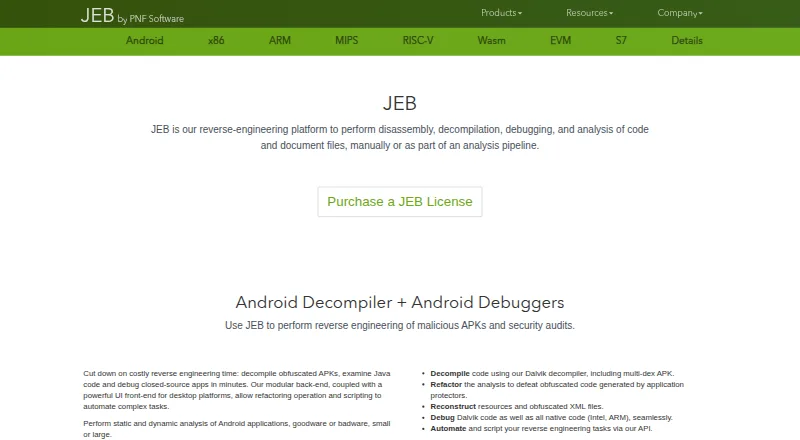
What JEB is
JEB is a reverse-engineering platform for disassembling, decompiling, debugging, and analyzing code and document files. Its Android tools cover static and dynamic app analysis, including multi-dex decompilation, resource reconstruction, and Dalvik and native-code debugging. Modules also cover Intel x86 and x86-64, ARM, MIPS, RISC-V, WebAssembly, Ethereum contracts, Siemens S7 PLC programs, and PDFs. Python and Java scripts and plugins can automate analysis, including through headless front ends. The GUI runs on Windows, Linux, and macOS for x64 and arm64 systems and requires JDK 21 or above. Community Edition is free and described as suitable for researchers, students, hobbyists, and nonprofit reverse engineers; its listed plan covers x86 and x86-64 decompilation. The demo restricts decompilation, project saving and loading, clipboard use, and session length, and requires an internet connection. Paid plans include Android modules at $140 a month, Pro at $2,000 a year, Pro Floating at $4,000 a year, and Pro OEM at $8,000 a year.
Who it suits
JEB suits reverse engineers who need analysis tools for Android, native code, or the other listed targets. Its free Community Edition is aimed at researchers, students, hobbyists, and nonprofit reverse engineers.
What it does well
- Android static and dynamic analysis tools
- Modules cover code, contracts, PLC programs, and PDFs
- Python and Java scripting and plugin support
- Free Community Edition for x86 and x86-64 decompilation
What to know first
- GUI requires JDK 21 or above
- Demo requires an internet connection
- Demo sessions are time-limited
- Paid plans start at $140 a month
Limits
Community Edition’s listed plan covers x86 and x86-64 decompilation. The demo restricts decompilation, disables project saving and loading and clipboard use, limits session length, and requires an internet connection.
Plans
| Plan | Billed and limits | Price |
|---|---|---|
| JEB Community Edition | x86/x64 focus · researchers, students, hobbyists and nonprofits · most disassemblers and file analyzers | Free |
| JEB Demo | subset decompilation · no project save/load · no clipboard · time-limited sessions · internet required | Free |
| JEB Android | Yearly · Android modules · official UI · extensions · offline use | $1,200 a year |
| JEB Android | Monthly · Android modules · official UI · extensions · offline use | $140 a month |
| JEB Pro | Yearly · All modules · official UI · extensions · offline use · third-party clients | $2,000 a year |
| JEB Pro Floating | Yearly · All modules · floating seats · extensions · offline use | $4,000 a year |
| JEB Pro OEM | Yearly · All modules · SaaS/back-end integrations · third-party clients · offline use | $8,000 a year |
As pnfsoftware.com lists them, read 15 Oct 2026. The maker's own page has the final word.
Getting started
- Open https://www.pnfsoftware.com/jeb/.
- Choose Community Edition, a demo, or a paid license.
- For the GUI client, use Windows, Linux, or macOS on x64 or arm64.
- Install or use JDK 21 or above for the GUI client.
- Use Python or Java to write scripts and plugins for automation.
JEB is a reverse-engineering platform for professionals and researchers analyzing apps, binaries, and other technical files. It is best suited to work that spans Android and multiple architectures or benefits from scripted analysis; the Community Edition is a narrower starting point, while broader module access is a significant paid commitment.
Overview
JEB brings disassembly, decompilation, debugging, and analysis of code and document files into one platform. Its modules cover Intel x86 and x86-64, ARM, MIPS, RISC-V, WebAssembly, Ethereum contracts, Siemens S7 PLC programs, and PDF documents. That breadth is a real advantage for practitioners who move between targets, but plan choice matters because the Android plan is limited to Android modules while Pro plans include all modules.
PNF Software, founded by Nicolas Falliere in 2013, is based in Silicon Valley, California. JEB has a mixed licensing model, with free, monthly, annual, floating-seat, and OEM options.
Key features
Android and other targets
JEB supports static and dynamic Android application analysis, including multi-dex decompilation, resource reconstruction, and debugging of Dalvik and native code. That makes the Android edition a focused choice for app analysis without paying for the full module set. Native-code and bytecode decompilation and debugger integration broaden its use beyond Android. RISC-V support has boundaries: RV128, RVE, and several exotic extensions are excluded, and floating-point decompilation is planned rather than included.
Automation and integrations
Python and Java scripting, plugin support, and headless front ends let teams build repeatable analysis workflows rather than rely solely on the desktop client. The VIBRE assistant and MCP server connect to OpenAI, Anthropic, Google Gemini, and AWS Bedrock compatible endpoints, as well as MCP clients including Codex CLI, Claude CLI, OpenCode, and LM Studio. These integrations add options for connected workflows, while offline work is specifically included in the Android and Pro plans.
Desktop client and licensing
The GUI client runs on Windows, Linux, and macOS on x64 and arm64 systems and requires JDK 21 or above. A floating license allows up to its licensed seat count to connect concurrently; a seat becomes free when a client leaves, which suits shared capacity better than assigning each user a dedicated seat.
Pricing
JEB offers a free trial, but its demo limits decompilation to a subset of code, disables project saving and loading and clipboard use, imposes time-limited sessions, and requires an internet connection. It is useful for a constrained evaluation, not a substitute for an unrestricted offline workflow.
- JEB Community Edition: 0.00 USD, free. It provides x86 and x86-64 decompilation and is aimed at researchers, students, hobbyists, and reverse engineers at nonprofit organizations. The narrow architecture scope makes it a poor fit for broader production work.
- JEB Android: $140 a month, billed monthly at $140 per user. It includes Android modules, the official UI client, extensions, and offline work. It is the focused paid option for Android specialists who do not need all modules.
- JEB Pro: $2,000 a year, billed yearly at $2,000 per user. It includes all modules, the official UI client, extensions, and offline work. This is the stronger fit for individual practitioners working across JEB's target range.
- JEB Pro Floating: $4,000 a year, billed yearly at $4,000 per seat. It includes all modules, floating seats, the official UI client, and extensions. Teams can share licensed concurrent capacity, though the price is per seat rather than per user.
- JEB Pro OEM: $8,000 a year, billed yearly at $8,000 per server. It includes all modules, SaaS and back-end integrations, and third-party front-end clients. This targets product or service integration, not a standard individual desktop workflow.
Eligible JEB Pro license holders can add priority support for 30% of the license cost, with replies within one business day and prioritized bug reports. The published entry price of $1,200/user/yr does not match the listed JEB Pro annual price of $2,000 per user, so buyers should compare the specific plan scope and terms before committing.
Platforms
The desktop client supports Windows, Linux, and macOS on x64 and arm64, with JDK 21 or above required. JEB also supports API-based automation and headless front ends. The desktop prerequisite is relevant for managed environments; the stated platform coverage does not make the client a web app.
Who it's for
JEB is a strong fit for reverse engineers who need Android analysis alongside native and bytecode decompilation, debugging, or specialized targets such as PLC programs and PDF documents. The Community Edition suits the stated researcher, student, hobbyist, and nonprofit audience when x86 and x86-64 are enough. Android-only practitioners can avoid the full Pro price with the monthly Android plan. Teams needing broad module coverage should weigh Pro's per-user cost against Floating's shared concurrent seats; OEM is the relevant route when the software must sit behind a service or third-party interface.
Pros and cons
- Pro: A wide set of code and document targets, including Android, WebAssembly, Ethereum contracts, PLC programs, and PDFs, reduces the need to switch tools across those formats.
- Pro: Python and Java scripts, plugins, and headless front ends support automation for repeatable or large-scale analysis.
- Pro: Android analysis includes static and dynamic workflows, multi-dex decompilation, resource reconstruction, and Dalvik and native debugging.
- Con: The free Community Edition is limited to x86 and x86-64 decompilation, while the demo restricts code coverage and core project functions and requires internet access.
- Con: Full module access starts at a substantial annual per-user price, and Floating and OEM carry higher annual seat or server costs.
- Con: The desktop client requires JDK 21 or above, and RISC-V support excludes several variants with floating-point decompilation still planned.
Alternatives
For adjacent options, browse Decompiler Software or Reverse Engineering Tools.
- Binary Ninja is worth considering if its free evaluation and education plan, with five decompilation architectures but no API or plugin access, is enough; its listed Personal plan is a one-time purchase.
- Boomerang is a free, BSD-licensed open-source decompiler for readers seeking that alternative.
- IDA Pro offers a free edition for x86-32 and x86-64 disassembly with two cloud-based decompilers, or a paid Essential plan for readers comparing a different paid option.
- rev.ng may suit readers interested in a Free Software decompilation pipeline, with its UI offered commercially in cloud and standalone versions.
- Bytecode Viewer is a free, GPL v3 open-source option for readers whose needs fit that tool.
- CFR is a free option for readers seeking a tool with no paid plans or usage limits stated.
- Ghidra is another free option for readers comparing alternatives.
- ILSpy is a free, MIT-licensed open-source alternative.
Verdict
Choose JEB if your work genuinely benefits from its combination of Android analysis, broad target coverage, and automation, and select the edition that matches those needs. The Community Edition is a practical fit for its stated audience and limited architectures; professionals needing all modules should budget for Pro or a floating license. Look elsewhere if you need broad capability at no cost or cannot accept the demo's constraints and the paid plans' substantial annual pricing.
Verdict
JEB offers broad target coverage and automation options, with a free edition for a narrower set of users and targets. Check the demo restrictions and paid-plan scope against the work you need to do.
Questions
Is JEB free?
Yes. JEB Community Edition is free. A demo is also available, with restrictions and time-limited sessions.
What does JEB Community Edition cover?
Its listed plan includes x86 and x86-64 decompilation. It is described as suitable for researchers, students, hobbyists, and reverse engineers at nonprofit organizations.
Which operating systems does the JEB GUI support?
The GUI client runs on Windows, Linux, and macOS for x64 and arm64 systems. It requires JDK 21 or above.
What does JEB Android cost?
JEB Android costs $140 a month, billed monthly per user. It includes Android modules, the official UI client, extensions, and offline work.
What does JEB Pro cost?
JEB Pro costs $2,000 a year, billed yearly per user. It includes all modules, the official UI client, extensions, and offline work.
Who makes JEB?
PNF Software makes JEB. The company was founded in 2013 and is located in Silicon Valley, California.
Facts from JEB's own pages
- AI and integrations
- JEB's VIBRE assistant and MCP server connect to OpenAI, Anthropic, Google Gemini, and AWS Bedrock compatible endpoints, and MCP clients including Codex CLI, Claude CLI, OpenCode, and LM Studio. · pnfsoftware.com, 29 Sept 2026
- Android analysis
- Its Android tooling performs static and dynamic analysis, including multi-dex Dalvik decompilation, resource reconstruction and obfuscation refactoring. · pnfsoftware.com, 15 Oct 2026
- Android debugging
- JEB debugs Dalvik and native Intel or ARM code and can hook sensitive APIs. · pnfsoftware.com, 15 Oct 2026
- API and SDK
- JEB exposes Java and Python APIs for scripts, plugins, analysis modules and custom front ends under the com.pnfsoftware.jeb namespace. · pnfsoftware.com, 15 Oct 2026
- Automation API
- Users can write scripts and plugins in Python or Java and build headless front ends for automated analysis. · pnfsoftware.com, 29 Sept 2026
- Change: JEB 5.40
- The May 6, 2026 release added a Java Embedded Python runner, improved API documentation and broadened JDK support. · pnfsoftware.com, 15 Oct 2026
- Change: JEB 5.48
- The October 7, 2026 release hardened ELF parsing, upgraded emulators, fixed dexdec optimizers and added MCP bytecode and asynchronous script tools. · pnfsoftware.com, 15 Oct 2026
- Company
- PNF Software is located in Silicon Valley, California, and was founded by Nicolas Falliere in 2013. · pnfsoftware.com, 29 Sept 2026
- Company customers
- LinkedIn says hundreds of paying customers use JEB, including government agencies, defense contractors, antivirus vendors, laboratories, universities and technology companies. · linkedin.com, 15 Oct 2026
- Company founding
- PNF Software says Nicolas Falliere founded the company in 2013 in Silicon Valley, California. · pnfsoftware.com, 15 Oct 2026
- Company legal record
- A California business directory reports PNF Software, Inc. as an active Cupertino corporation filed on January 8, 2015. · bizprofile.net, 15 Oct 2026
- Company size
- LinkedIn lists PNF Software as a public software-development company with 2–10 employees. · linkedin.com, 15 Oct 2026
- Demo limits
- The demo limits decompilation to a subset of code, disables saving and loading projects and clipboard use, has time-limited sessions, and requires an internet connection. · pnfsoftware.com, 29 Sept 2026
- Desktop platforms
- The GUI runs on Windows, Linux/GTK and macOS, each in x64 and arm64 variants. · pnfsoftware.com, 15 Oct 2026
- Developer repository
- PNF's public JEB sample-code repository contains client, plugin and script examples and is shown with 223 stars and 52 forks. · github.com, 15 Oct 2026
- Documentation depth
- The manual covers installation, analysis workflows, debugging, Android, native, WebAssembly, Ethereum, S7, MCP, scripting, plugins, front ends and configuration. · pnfsoftware.com, 15 Oct 2026
- Documentation limitation
- The manual says its user section is not exhaustive and directs readers to the blog for additional use cases. · pnfsoftware.com, 15 Oct 2026
- Extensibility
- Client scripts are generally Python, back-end plugins are Java, and users can provide intermediate-representation optimizers and headless clients. · github.com, 15 Oct 2026
- Floating license
- A floating license allows up to its licensed seat count to connect concurrently, with a seat freed when a client leaves. · pnfsoftware.com, 29 Sept 2026
- Founded
- 2013 · pnfsoftware.com, 28 Sept 2026
- Free edition audience
- JEB Community Edition is described as suitable for researchers, students, hobbyists, and reverse engineers at nonprofit organizations. · pnfsoftware.com, 29 Sept 2026
- G2 listing
- G2's alternatives page identifies JEB Decompiler but displays no JEB star rating or review count. · g2.com, 15 Oct 2026
- Headquarters
- Silicon Valley, California, United States · pnfsoftware.com, 28 Sept 2026
- Installation model
- Registered users receive a custom-generated ZIP package electronically by email containing the back end and desktop UI client. · pnfsoftware.com, 15 Oct 2026
Where JEB stands on Freedom251
- Reverse Engineering Tools#19 of 73
- Decompiler Software#11 of 24