Freedom251 › Reverse Engineering Tools
FLOSS
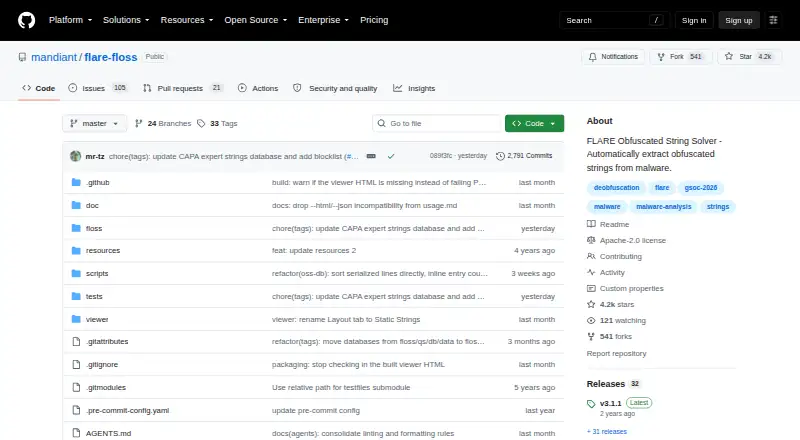
What FLOSS is
FLOSS analyzes malware binaries to extract strings that static analysis alone may leave obscured. It recovers static, stack, tight, and decoded strings, and can identify language-specific strings in Go and Rust programs. Its layout-aware output adds file-structure context and tags to static strings, including details from embedded databases. For PE files, analysis features include section delimiters and structure annotations, filtering for strings that overlap instructions, and options to highlight or mute strings using embedded databases.
The project offers standalone executables, a Python package, and source installation, with installation instructions for Windows, Linux, and macOS. FLOSS can also be called from Python in automated analysis systems; its documented Python API requires Python 3.10 or later and may change between releases. The CLI is the stable documented interface. Additional scripts can load results into Binary Ninja or IDA Pro. For review, FLOSS provides a hosted viewer for JSON output with search and filters, and can produce a standalone HTML report. It is free software under the Apache-2.0 license.
Who it suits
FLOSS suits malware analysts who need to recover and inspect strings in binaries, including Go and Rust programs. It also fits automated analysis workflows that can use its Python interface, and teams that review results through its JSON viewer, HTML reports, or scripts for Binary Ninja and IDA Pro.
What it does well
- Extracts static, stack, tight, and decoded strings.
- Identifies language-specific strings in Go and Rust programs.
- Adds file-structure context and tags to static strings.
- Offers a hosted JSON viewer and standalone HTML reports.
- Available as binaries, a Python package, or source.
- Apache-2.0 licensed and free.
What to know first
- The documented Python API requires Python 3.10 or later.
- The Python API can change between releases.
- The project identifies the CLI as its stable documented interface.
Plans
| Plan | Billed and limits | Price |
|---|---|---|
| FLOSS | Apache-2.0 licensed software · standalone binaries, Python package, or source installation | Free |
As github.com lists them, read 5 Oct 2026. The maker's own page has the final word.
Getting started
- Open the FLOSS project website.
- Choose a standalone executable, Python package, or source installation.
- Use the installation instructions for Windows, Linux, or macOS.
- For automation, use the Python API with Python 3.10 or later.
- Review JSON output in the hosted viewer or generate a standalone HTML report.
Verdict
Choose FLOSS when malware analysis calls for extracting and organizing strings, including language-specific strings from Go and Rust binaries. Its multiple installation routes and result viewers support different workflows. Teams building around the Python API should account for its documented version requirement and potential changes between releases.
Questions
How much does FLOSS cost?
FLOSS is free. Its listed plan is free, and the repository identifies the license as Apache-2.0.
Which systems can I install FLOSS on?
The installation documentation refers to standalone executables and commands for Windows, Linux, and macOS.
Can I automate FLOSS?
Yes. FLOSS can be used from Python in automated analysis systems. Its documented Python API requires Python 3.10 or later and can change between releases.
Is the Python API stable?
The project describes its CLI as the stable documented interface. It says the Python API can change between releases.
Can I view or export FLOSS results?
A hosted viewer supports FLOSS JSON output with search and filters. FLOSS can also generate a standalone HTML report.
Does FLOSS integrate with Binary Ninja or IDA Pro?
Additional scripts can load FLOSS output into Binary Ninja or IDA Pro.
Facts from FLOSS's own pages
- Analysis features
- Features include PE section delimiters, PE structure annotations, filtering of strings overlapping instructions, and highlighting or muting strings using embedded databases. · github.com, 5 Oct 2026
- API stability
- The project describes its CLI as the stable documented interface and says the Python API can change between releases. · github.com, 5 Oct 2026
- Automation
- FLOSS can be used from Python in automated analysis systems; its documented Python API requires Python 3.10 or later. · github.com, 5 Oct 2026
- Context
- Layout-aware output adds file structure context and tags to static strings, including information from embedded databases. · github.com, 5 Oct 2026
- Installation
- The project offers standalone executables, a Python package, and installation from source. · github.com, 5 Oct 2026
- Integrations
- Additional scripts can load FLOSS output into tools such as Binary Ninja or IDA Pro. · github.com, 5 Oct 2026
- Language support
- It can identify and extract language-specific strings from Go and Rust programs. · github.com, 5 Oct 2026
- License
- The repository identifies its license as Apache-2.0. · github.com, 5 Oct 2026
- Purpose
- FLOSS uses static analysis to extract and deobfuscate strings from malware binaries. · github.com, 5 Oct 2026
- Results viewer
- The project provides a hosted viewer for FLOSS JSON output with search and filters, and supports generating a standalone HTML report. · github.com, 5 Oct 2026
- String types
- It extracts static, stack, tight, and decoded strings. · github.com, 5 Oct 2026
- Supported systems
- The installation documentation refers to standalone executables and commands for Windows, Linux, and macOS. · github.com, 5 Oct 2026
Where FLOSS stands on Freedom251
- Reverse Engineering Tools#15 of 73