Freedom251 › Chemistry Simulation Software

Interactive Chemistry
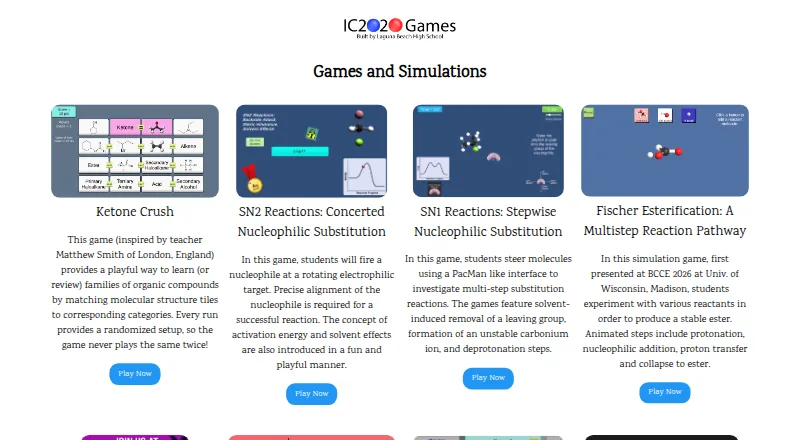
What Interactive Chemistry is
Interactive Chemistry offers science games and simulations for teaching principles from middle school through university level. Its activities cover ionic and covalent bonding, cellular respiration, reactions, and molecular interactions. The games were created by chemistry teacher Steven Sogo with help from high school students at Laguna Beach High School. The site describes its purpose as making free web-based learning activities for science.
The Cell Model 2025 game works on iPads, Android tablets, and most phones. The Double Replacement Reaction Simulator is playable on laptops, Chromebooks, and mobile devices. In the Matchmaker double replacement game, students receive immediate feedback when they produce correct products and can practice balancing equations; its page links to suggested lessons and an instructional video. The service lists Android, iOS, macOS, web, and Windows, and its plan is Free. Users can report bugs or suggest features through forms, and the maker says its experiments and prototypes are unfinished and may have bugs. Prototype code is available on GitHub for users who want to finish it themselves.
Who it suits
It suits teachers and learners looking for chemistry practice through games and simulations, from middle school through university. Device access varies by activity, so users should check the supported devices for the particular game.
What it does well
- Covers bonding, respiration, reactions, and molecular interactions.
- Matchmaker gives feedback on correct products.
- Matchmaker provides equation-balancing practice.
- Classroom lessons and an instructional video are linked.
What to know first
- The maker describes experiments and prototypes as unfinished.
- Prototypes may contain bugs or problems.
Limits
The listed Free plan costs nothing and provides free web-based games and simulations. The maker says experiments and prototypes may be unfinished and may contain bugs and problems.
Plans
| Plan | Billed and limits | Price |
|---|---|---|
| Free | Free web-based games and simulations | Free |
As interactivechemistry.org lists them, read 29 Sept 2026. The maker's own page has the final word.
Getting started
- Open the Interactive Chemistry website.
- Choose a game or simulation for the topic you want to teach or study.
- Use a compatible device: listed platforms include Android, iOS, macOS, web, and Windows.
- For Matchmaker, open its page to find suggested lessons and an instructional video.
Overview
Interactive Chemistry is a collection of science games and simulations for teaching chemistry and related science topics from middle school through university. It suits teachers and students looking for focused practice without a software fee. Its range of activities is useful, but unfinished prototypes may contain bugs, so it is not a dependable substitute for a polished, uniform lab platform.
Created by chemistry teacher Steven Sogo with help from Laguna Beach High School students, the project has been led by Sogo since 2019. Its mix of virtual labs, molecular modeling, reaction simulation and equation tools makes it a flexible source of classroom activities, rather than one integrated course or laboratory environment. It is included in Chemistry Simulation Software.
Key features
Activities focus on particular concepts, which lets teachers select practice for a lesson without committing to a single broad simulation environment. The trade-off is that the experience may vary from one project to another, and the maker cautions that experiments and prototypes can have problems.
- Topic-specific games: Ionic and covalent bonding, cellular respiration, reactions and molecular interactions give teachers material across several areas of science instruction.
- Reaction and equation practice: In Matchmaker, students get immediate feedback when they form correct products and can practice balancing equations. The Double Replacement Reaction Simulator works on laptops, Chromebooks and mobile devices, making reaction practice usable across common classroom hardware.
- Classroom support: Matchmaker links to suggested lessons and an instructional video, helping teachers place the activity within a lesson rather than use it as an isolated exercise.
- Mobile model activity: Cell Model 2025 is playable on iPads, Android tablets and most phones, a practical fit for classes with mixed devices.
- Community contribution: Users can report bugs or suggest features through linked forms, and prototype code is available on GitHub for people who want to finish projects themselves. That openness may appeal to technically inclined users, but it does not remove the risk of encountering unfinished work.
Pricing
The Free plan costs nothing and includes free web-based games and simulations. There are no paid tiers or seat limits to weigh against one another, so it is an easy option for teachers and learners who need no-cost concept practice. The main cost is not financial: unfinished projects may be unreliable, and the collection does not promise the consistency of a finished product.
Platforms
Interactive Chemistry supports Android, iOS, macOS, web and Windows, with delivery listed as mixed. Device support varies by activity: Cell Model 2025 works on iPads, Android tablets and most phones, while the Double Replacement Reaction Simulator supports laptops, Chromebooks and mobile devices. This makes it suitable for varied classroom setups, though users should check the needs of a particular activity before assigning it.
Who it's for
Teachers seeking free, targeted activities for chemistry and related science topics are the clearest fit, especially when they want equation feedback or a lesson-linked reaction game. Students can use the activities for focused practice across devices. Those who need a consistently polished, fully developed virtual lab should look elsewhere, as the maker identifies some projects as unfinished prototypes.
Pros and cons
- Pros: No software fee. The free plan offers web-based games and simulations, so teachers can assign practice without a software charge.
- Pros: Useful reaction feedback. Matchmaker responds when students make correct products and includes equation-balancing practice, providing more guidance than a bare simulation.
- Pros: Classroom links and broad device reach. Suggested lessons and a video support Matchmaker, while selected activities cover phones, tablets, laptops and Chromebooks.
- Cons: Prototype reliability is uncertain. The maker warns that experiments may contain bugs and problems, which makes the collection a weaker choice for instruction that depends on consistently finished software.
- Cons: Activities are specific rather than unified. The collection spans topics and formats, but it is not presented as one consistent laboratory experience.
Alternatives
Choose Beyond Labz if you want free instructor access to teach, preview and build assignments, or a 20-week Chemistry option for a one-time payment of 31.95 USD. Its free tier is aimed at instructors; Interactive Chemistry instead gives learners free games and simulations without a paid tier.
ChemCollective Virtual Lab is a free choice for educators and students who want a virtual lab that can also be distributed freely. Collisions Higher Education may suit US-based college or university educators seeking free instructor access, with a separate student subscription priced at $15 a year.
For open-source simulations that are free to students and teachers online or by download, consider PhET Interactive Simulations. ChemTube3D is another free educational resource; Molecular Workbench offers free, open-source software maintained by the Concord Consortium.
PraxiLabs has a free plan with one month of access, three simulations, basic real-time guidance and English and Arabic interfaces, with no credit card required. MoleculAR is a free Android and iOS option with a QR code library available at no cost.
Verdict
Interactive Chemistry is a sensible first choice for teachers and students who want free, focused science activities, particularly reaction and equation practice with feedback. Its device reach and classroom materials add practical value. Look elsewhere if your teaching depends on a consistently finished virtual lab: the maker's warning about prototype bugs is the main reason to treat this as a useful supplement, not a dependable all-purpose platform.
Verdict
Interactive Chemistry combines topic-specific games with simulations and classroom materials, including feedback and equation practice in Matchmaker. Its unfinished prototypes may have bugs, so treat them as works in progress.
Questions
How much does Interactive Chemistry cost?
Its Free plan is listed as free.
What platforms does it support?
The listed platforms are Android, iOS, macOS, web, and Windows. The Cell Model 2025 game is playable on iPads, Android tablets, and most phones.
What chemistry topics do the activities cover?
Topics include ionic and covalent bonding, cellular respiration, reactions, and molecular interactions.
Who created the games?
Chemistry teacher Steven Sogo created them with support from high school students at Laguna Beach High School.
Is the code open source?
The maker says prototype code is available on GitHub for users to finish themselves.
What classroom materials are available?
The Matchmaker double replacement game page links to suggested lessons and an instructional video.
Facts from Interactive Chemistry's own pages
- Classroom materials
- The Matchmaker double replacement game page links to suggested lessons and an instructional video. · interactivechemistry.org, 29 Sept 2026
- Contact support
- The site invites users to report bugs or suggest features through linked forms, and lists [email protected] for email contact. · interactivechemistry.org, 29 Sept 2026
- Creator
- The games were created by chemistry teacher Steven Sogo with support from high school students at Laguna Beach High School. · interactivechemistry.org, 29 Sept 2026
- Device access
- The Double Replacement Reaction Simulator is playable on laptops, Chromebooks, and mobile devices. · interactivechemistry.org, 29 Sept 2026
- Founded
- 2019 · interactivechemistry.org, 23 Sept 2026
- Learning feedback
- The Matchmaker double replacement game gives immediate feedback when students create correct products and provides practice balancing equations. · interactivechemistry.org, 29 Sept 2026
- Mission
- The site says its mission is to provide free web-based games and simulations for teaching science principles. · interactivechemistry.org, 29 Sept 2026
- Mobile access
- The Cell Model 2025 game is playable on iPads, Android tablets, and most phones. · interactivechemistry.org, 29 Sept 2026
- Open source
- The maker says prototype code is available on GitHub for users to finish themselves. · interactivechemistry.org, 29 Sept 2026
- Prototype limits
- The maker describes its experiments and prototypes as unfinished projects that may contain bugs and problems. · interactivechemistry.org, 29 Sept 2026
- Team background
- The maker says it was founded in 2019 and is led by Mr. Sogo, a chemistry teacher at Laguna Beach High School. · interactivechemistry.org, 29 Sept 2026
- Topics
- Its games cover chemistry topics including ionic bonding, covalent bonding, cellular respiration, reactions, and molecular interactions. · interactivechemistry.org, 29 Sept 2026
- What it offers
- Interactive Chemistry provides science games and simulations for teaching principles from middle school through university level. · interactivechemistry.org, 29 Sept 2026
Where Interactive Chemistry stands on Freedom251
- Chemistry Simulation Software#7 of 33