Freedom251 › Chemistry Simulation Software
ChemTube3D
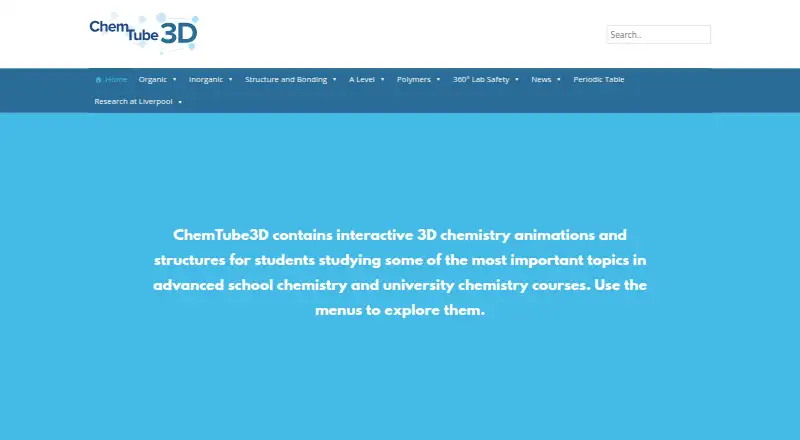
What ChemTube3D is
ChemTube3D is a free educational resource for exploring chemistry through interactive 3D structures, animations, and supporting information. It covers organic mechanisms, organic structure and bonding, inorganic chemistry, polymers, and A-level chemistry, for students, lecturers, and practising chemists. In a browser, users can explore animated structures with the JSmol viewer. Organic reaction schemes animate bond breaking and forming, charges, and lone pairs, while learning designs guide activities using the 3D material. Chemistry pages can be embedded in a learning management system or virtual learning environment through LTI. The site reports testing with Canvas and Blackboard; the LTI tool comes through OpenOChem, and users can apply for a key. Free iOS and Android apps are available, with the iOS app containing a selection of Organic Chemistry and Structure and Bonding. Selected reaction transition-state models can be downloaded in STL and X3D formats for 3D printing. The site invites users to contact Nick Greeves with feedback or problems and describes a feedback feature on individual pages.
Who it suits
ChemTube3D suits chemistry students, lecturers, and practising chemists studying A-level and undergraduate topics. It also offers LMS/VLE embedding through LTI and selected models for 3D printing.
What it does well
- Free educational resource.
- Interactive structures use the JSmol browser viewer.
- Pages can be embedded through LTI.
- Free iOS and Android apps are available.
- Selected models download in STL and X3D formats.
What to know first
- The iOS app contains only a selection of material.
- LTI users need to apply for a key.
- 3D printing downloads cover selected models.
Plans
| Plan | Billed and limits | Price |
|---|---|---|
| Free | Freely available educational resource | Free |
As chemtube3d.com lists them, read 4 Oct 2026. The maker's own page has the final word.
Getting started
- Open https://www.chemtube3d.com/ in a web browser.
- Explore animated structures using the JSmol viewer.
- Install the free iOS or Android app for mobile access.
- Apply for an LTI key through OpenOChem if you want to embed ChemTube3D pages in an LMS or VLE.
ChemTube3D is a free visual chemistry resource for students, teachers and working chemists. It suits lessons and self-study where molecular shape and reaction movement need to be seen in three dimensions. Its strongest case is focused, browser-based explanation rather than a complete laboratory environment.
Overview
Founded in 2008 in Liverpool, ChemTube3D assembles interactive structures, animated reactions and explanatory material for organic mechanisms, organic structure and bonding, inorganic chemistry, polymers and A-level chemistry. The range covers school and undergraduate needs while remaining centered on molecular visualization.
Activities called learning designs provide guided ways to use the animations, which gives lecturers more structure than a gallery of isolated models. Selected transition-state structures can be downloaded as STL or X3D files for 3D printing, extending a digital lesson into a physical classroom model.
Key features
Interactive structures and mechanisms
The browser-based JSmol viewer lets learners manipulate animated three-dimensional structures. Organic reaction schemes show bonds breaking and forming, together with charges and lone pairs. This makes electron movement and spatial changes easier to follow than a static reaction diagram, particularly in mechanism teaching. The emphasis is explanatory visualization, not a general-purpose molecular design workstation.
Teaching and virtual practical support
Learning designs organize activities around the models, helping instructors direct a class or an individual study session. ChemTube3D also identifies virtual labs, molecular modeling and reaction simulation among its capabilities, so it can support conceptual practice alongside demonstrations. Those labels do not turn it into a broad, instrumented laboratory replacement; readers needing extensive experimental workflows should look elsewhere.
LMS embedding and physical models
Pages can be placed inside an LMS or VLE through LTI, with Canvas and Blackboard testing reported. The LTI connection is supplied through OpenOChem, and users can apply for a key for its LTI tools. That can make ChemTube3D easier to incorporate into an existing course, although setup requires obtaining and configuring that key. Downloadable transition-state models in STL and X3D provide a practical option for classes with access to 3D printers.
Pricing
ChemTube3D's Free plan costs nothing and is described as a freely available educational resource. There is no trial period because the resource is already free, and no paid tier, seat charge or usage quota is stated. Students, lecturers and practising chemists can therefore use the same offering, with no upgrade path for expanded model coverage or administrative controls.
Platforms
The service is delivered on the web and has Android and iOS apps. The browser is the main route for the JSmol interactive material and LTI embedding. The iOS app contains a selection from Organic Chemistry and Structure and Bonding, while the Android and iOS offerings are presented as free companion apps rather than full replacements for the website. Selected models are downloadable for 3D printing in STL and X3D formats.
Who it's for
Chemistry students can use the animations to connect formulas with three-dimensional form and mechanism steps. Lecturers can build guided activities around the learning designs and place pages in a Canvas or Blackboard course through LTI. Practising chemists may value a quick visual reference for structures and reactions. A-level and undergraduate learners are explicitly within the intended audience. It is a weaker fit for users seeking a comprehensive virtual laboratory, broad experiment catalog or complete mobile parity with the web resource.
Pros and cons
Pros
- Free access: the entire offering is available at no cost, making it practical for individual learners and teaching cohorts.
- Mechanism visualization: animated bond changes, charges and lone pairs clarify organic reaction steps that static images can obscure.
- Guided teaching material: learning designs give instructors a framework for activities rather than only standalone models.
- Course integration: LTI embedding can place ChemTube3D pages inside an LMS or VLE, with Canvas and Blackboard support reported.
- Printable models: STL and X3D transition-state downloads support physical demonstration where 3D printing is available.
Cons
- Partial mobile coverage: the iOS app contains only a selection of Organic Chemistry and Structure and Bonding material, so mobile users should not expect the full site.
- Focused rather than comprehensive: its visual models and simulations do not amount to a broad, instrumented virtual lab.
- LTI setup step: embedding requires applying for an OpenOChem key, adding administrative work for course teams.
Alternatives
Chemistry Simulation Software is the broader category to scan when you want to compare multiple approaches. Choose Beyond Labz instead if you need a freemium product with Android, iOS, macOS, web and Windows coverage, free instructor access and a one-time Chemistry purchase of 31.95 USD for 20-week access. ChemCollective Virtual Lab is a better fit for a free virtual-lab package that can be installed, used and distributed on Android, iOS, macOS, web and Windows.
Collisions Higher Education suits US college or university educators wanting free instructor access, with student subscriptions at $15 a year. Pick Interactive Chemistry for free web games and simulations whose prototype code is available on GitHub. PhET Interactive Simulations is preferable when you want open-source simulations that students and teachers can use online or download across web, desktop and mobile platforms.
Molecular Workbench is a free, open-source option for Linux, macOS, web and Windows. PraxiLabs is the choice when a guided paid service is acceptable: its free plan lasts one month with three simulations, while the monthly plan costs $6.99 a month. MoleculAR is a free Android and iOS app centered on a downloadable QR-code library.
Verdict
Choose ChemTube3D if you need no-cost, visually detailed chemistry material for mechanisms, structures and guided teaching, especially in a browser or an LMS. Its combination of animated 3D explanation, LTI support and printable transition-state models is distinctive for classroom use. Look elsewhere if your priority is a full virtual laboratory, extensive experiments or a complete mobile catalog rather than a curated visual resource.
Verdict
ChemTube3D offers free visual chemistry material across several subject areas, with browser interaction, mobile apps, and LTI embedding. Its mobile and downloadable model selections are limited to the stated subsets.
Questions
Is ChemTube3D free?
Yes. The Free plan costs nothing, and the resource is freely available.
Is there a free trial?
No. The listed free trial availability is no.
Which platforms does it support?
The listed platforms are Android, iOS, and web.
Can ChemTube3D be used in an LMS or VLE?
Yes. Pages can be embedded using LTI. The LTI tool is provided through OpenOChem, and users can apply for a key.
Is ChemTube3D open source?
A press release states that ChemTube3D by Nick Greeves is licensed under a Creative Commons Attribution-Noncommercial-Share Alike 2.0 UK: England & Wales License.
Who founded ChemTube3D?
ChemTube3D was founded in 2008 and is headquartered in Liverpool, United Kingdom.
Facts from ChemTube3D's own pages
- 3D interaction
- Users can interact with animated 3D structures through the JSmol viewer in a web browser. · chemtube3d.com, 4 Oct 2026
- 3D printing
- Selected reaction transition-state models are available for download in STL and X3D formats. · chemtube3d.com, 4 Oct 2026
- Audience
- The resource is aimed at chemistry students, lecturers, and practising chemists, including users studying A-level and undergraduate topics. · chemtube3d.com, 4 Oct 2026
- Founded
- 2008 · chemtube3d.com, 28 Sept 2026
- Headquarters
- Liverpool, United Kingdom · chemtube3d.com, 28 Sept 2026
- License
- The press release states that ChemTube3D by Nick Greeves is licensed under a Creative Commons Attribution-Noncommercial-Share Alike 2.0 UK: England & Wales License. · chemtube3d.com, 4 Oct 2026
- LMS integration
- ChemTube3D pages can be embedded in an LMS or VLE using LTI; the site reports testing with Canvas and Blackboard. · chemtube3d.com, 4 Oct 2026
- LTI setup
- The LTI tool is provided through OpenOChem, and the site says users can apply for a key that works for its LTI tools. · chemtube3d.com, 4 Oct 2026
- Mobile apps
- ChemTube3D announced free iOS and Android apps, with the iOS app containing a selection of Organic Chemistry and Structure and Bonding. · chemtube3d.com, 4 Oct 2026
- Purpose
- ChemTube3D provides interactive 3D chemistry animations and structures with supporting information for students, lecturers, and practising chemists. · chemtube3d.com, 4 Oct 2026
- Reaction animations
- Organic reaction schemes show mechanisms with animated bond breaking and forming, charges, and lone pairs. · chemtube3d.com, 4 Oct 2026
- Support
- The site invites users to contact Nick Greeves with feedback or problems and describes a feedback feature on individual pages. · chemtube3d.com, 4 Oct 2026
- Teaching
- The site includes learning designs intended to guide users through activities made possible by the 3D animations. · chemtube3d.com, 4 Oct 2026
- Topics
- Its subject areas include organic mechanisms, organic structure and bonding, inorganic chemistry, polymers, and A-level chemistry. · chemtube3d.com, 4 Oct 2026
Where ChemTube3D stands on Freedom251
- Chemistry Simulation Software#6 of 33