Freedom251 › Event Abstract Management Software
HotCRP
What HotCRP is
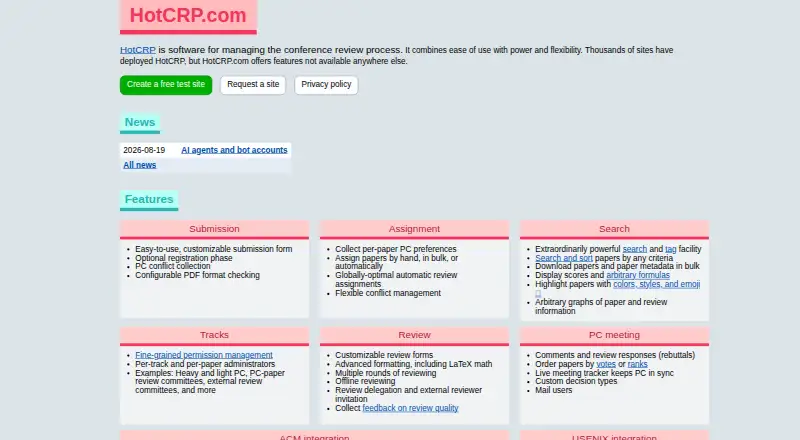
HotCRP manages conference paper submissions, reviews, and program committee work. It is available as open-source software for self-hosting or through the hosted HotCRP.com service. Submission tools include customizable forms, optional registration, conflict collection, and configurable PDF checks. Papers can be assigned manually, in bulk, or automatically, including with globally optimal assignments. Search, sorting, bulk downloads, formulas, and tags help organize papers. Review workflows support custom forms, LaTeX math, multiple rounds, offline reviewing, delegation, and external reviewers. For committee meetings, HotCRP provides rebuttals, votes, ranks, a live tracker, custom decision types, and mailing tools. Its REST API uses bearer tokens with limited scopes, such as read-only access or access to selected papers. HotCRP.com connects with ACM publication services for copyright forms, final versions, PDF checks, proceedings, and Digital Library export. Self-hosting requires users to run a web server and install software including Nginx, PHP 7.3 or higher, and MariaDB. Free plans are available for some sponsored and classroom uses; the Independent plan costs $7.50 per submission, payable after the submission deadline.
Who it suits
HotCRP suits conference, journal, or workshop organizers handling submissions and review stages. Self-hosting is an option for teams able to run a web server; a hosted version is also available.
What it does well
- Supports automatic paper assignment, including globally optimal assignments.
- Reviews can include multiple rounds and offline reviewing.
- Committee tools include rebuttals, votes, and a live tracker.
- REST API tokens can have limited scopes.
- HotCRP.com integrates with ACM publication services.
What to know first
- Self-hosting requires a web server and specified software.
- Independent events pay $7.50 per submission.
- Independent-site support is limited to bug fixes.
- Classroom use has no support.
Limits
The free test site has email restrictions and a limited lifetime. Classroom use requires approval with evidence of actual classroom use and has no support; independent conferences pay $7.50 per submission after the deadline, with support limited to bug fixes.
Plans
| Plan | Billed and limits | Price |
|---|---|---|
| ACM-sponsored | no direct cost · ACM-sponsored conferences, journals and workshops | Free |
| USENIX-sponsored | no direct cost · USENIX-sponsored conferences, journals and workshops | Free |
| Classroom | free · Educational classes · approval required · no support | Free |
| Free test site | free · Email restrictions · limited lifetime | Free |
| Independent | after the submission deadline · Independent conferences, journals and workshops · support limited to bug fixes | $7.50, paid once |
| IEEE-sponsored | payment due after the submission deadline · IEEE-financially-sponsored conferences, journals and workshops | On request |
As hotcrp.com lists them, read 15 Oct 2026. The maker's own page has the final word.
Getting started
- Visit HotCRP.com for the hosted service.
- Choose a plan matching the event or use: ACM-sponsored, USENIX-sponsored, Classroom, Free test site, Independent, or IEEE-sponsored.
- For self-hosting, run a web server with Nginx, PHP 7.3 or higher, MariaDB, and the listed PHP packages.
- Use the REST API with bearer-token authentication if API access is needed.
HotCRP is conference-review software for organizers managing paper submissions, peer review, and committee decisions. It suits academic conferences with demanding review workflows; its focused tools are a strong draw, but independent events must weigh a per-submission charge or the work of running their own server.
Overview
HotCRP connects submission intake, reviewer assignment, review rounds, and program committee decisions in one workflow. Blind review, mixed submission types, multiple stages, and a schedule builder make it more than a basic paper-collection form, while its emphasis remains conference review rather than broad event management.
Organizers can use the open-source software on their own server or choose HotCRP.com. Self-hosting requires Nginx, PHP 7.3 or higher, MariaDB, and several PHP packages, making it a sensible route for teams able to maintain that environment. Hosted service removes that operational burden, but privacy and support terms matter: submission and review artifacts may be retained indefinitely, and independent conference support is limited to bug fixes.
Key features
Submissions and assignments
Customizable forms, optional registration, program committee conflict collection, and configurable PDF checks let chairs shape the submission process. Papers can be assigned by hand, in bulk, or automatically, including with globally optimal assignment. The range gives chairs useful control over intake and workload distribution, provided the committee supplies suitable conflict and review information.
Review and committee decisions
Custom review forms, LaTeX math, multiple rounds, offline reviewing, delegation, and external reviewer invitations support committees with different review practices. Meeting tools cover rebuttals, votes, rankings, a live meeting tracker, custom decision types, and mailing users, keeping discussion and decisions connected to the paper workflow.
Search, integrations, and access
Search and sorting by criteria, bulk downloads, arbitrary formulas, and paper tags help chairs work across large submissions sets. The REST API uses bearer tokens, which can be restricted to read-only access or a subset of papers, a useful safeguard when connecting other tools. HotCRP.com integrates with ACM publication services for copyright forms, final versions, PDF checks, proceedings construction, and Digital Library file export; USENIX uses HotCRP for all its conferences and workshops.
HotCRP.com says site managers control access to submission and review artifacts, which may be stored indefinitely. Browsing data is generally kept for up to two years; evidence tied to potential misbehavior may be preserved indefinitely and shared with legitimate investigations. Organizers should decide whether those retention terms suit their participants and policies.
Pricing
The free routes are tied to particular uses rather than being a general free tier. ACM-sponsored conferences, journals, and workshops and USENIX-sponsored conferences, journals, and workshops can use their respective plans at no cost; the USENIX site must be created by USENIX. The Classroom plan is free for teachers at educational institutions, requires evidence of actual classroom use for approval, and has no support. A Free test site costs nothing, with email restrictions and a limited lifetime, so it is for trying the service rather than running an ongoing conference.
The Independent plan costs $7.50, paid once: payment of $7.50 per submission is due after the submission deadline. It serves independent conferences, journals, and workshops, but support is limited to bug fixes. That model avoids a server to operate, yet the charge scales with submissions and does not buy broad support. IEEE-sponsored conferences, journals, and workshops have custom pricing, with payment due after the submission deadline.
For teams outside the sponsored and classroom categories, the practical choice is between the independent per-submission payment and the engineering responsibility of self-hosting the open-source version. The free test site is constrained by email restrictions and lifetime, while classroom access is both purpose-limited and unsupported.
Platforms
HotCRP supports web use, Linux, self-hosting, and an API. The self-hosted route gives technically equipped organizers control over deployment, while the hosted service is the alternative for teams that do not want to provision the stated server stack.
Who it's for
HotCRP is best suited to academic conference chairs and committees that need configurable intake, several review rounds, assignment options, and structured meeting decisions. Sponsored ACM or USENIX organizers have dedicated free plans, and educators may qualify for the classroom plan if they can document actual classroom use. Independent organizers should choose it when the review workflow merits the per-submission cost or they can operate the software themselves. It is a weaker fit for events chiefly seeking general registration and event-management tools, or for classroom users who need support.
Pros and cons
- Pro: Submission, assignment, review, rebuttal, voting, and decision tools cover the central conference paper lifecycle in a connected workflow.
- Pro: Scoped API tokens can limit access to read-only operations or selected papers, useful when granting integrations narrower access.
- Pro: ACM publication-service integration handles several steps from copyright forms through proceedings and Digital Library export.
- Con: Self-hosting requires a web server and a stack including Nginx, PHP 7.3 or higher, and MariaDB, which is a real operational commitment.
- Con: The independent plan charges $7.50 per submission after the deadline and limits support to bug fixes.
- Con: Classroom use has no support, and hosted artifact retention may be indefinite, considerations for educators and privacy-conscious committees.
Alternatives
For adjacent conference and event workflows, see Call for Papers Software and Event Abstract Management Software.
- ConfTool is worth considering for smaller non-commercial events: its free license is available on request for up to 150 participants and local installation only, with no support.
- Fourwaves may suit organizers prioritizing abstracts and registrations: its free Starter plan allows 25 abstract submissions a year, unlimited registrations and events, and charges a 3% service fee.
- Sessionize is an option for free community events, with a free plan restricted to that use rather than internal, private, promotional, marketing, profit, or commercial events.
- AbstractWiz offers a small-event starting point: its free plan allows up to 20 submissions and has no import feature, while its Standard plan is $270, paid once for unlimited submissions and all features.
- Airballoon is another conference option.
- EasyChair may appeal to smaller conferences seeking a capped entry plan: Free allows up to 20 submissions with no technical support, while Professional is $3.90, paid once per submission for up to 60 submissions.
- Fireside is a free, open-source alternative under the Apache-2.0 license.
- MeetingHand Abstract Management is another option for abstract and registration management, with a free plan capped at 25 registrations or abstracts.
Verdict
Choose HotCRP if your conference needs a capable, configurable paper-review process and you can qualify for a sponsored plan, pay per submission, or maintain your own server. Its strongest reason to choose it is the depth of its submission-to-committee workflow; look elsewhere if you need wider independent-site support, do not want server responsibilities or per-submission costs, or require different artifact-retention terms.
Verdict
HotCRP covers submission, review, and committee meeting workflows, with hosted and self-hosted routes. Organizers should account for the self-hosting requirements or the per-submission cost and support limits that apply to particular plans.
Questions
Is HotCRP free?
Free plans are listed for ACM-sponsored events, USENIX-sponsored events, classroom use, and a limited-lifetime test site. The Independent plan costs $7.50 per submission, due after the submission deadline.
Can I host HotCRP myself?
Yes. The open-source software can be self-hosted, and requires a web server with Nginx, PHP 7.3 or higher, MariaDB, and several PHP packages.
What platforms does HotCRP support?
The listed platforms are API, Linux, self-hosted, and web.
Does HotCRP integrate with ACM services?
HotCRP.com integrates with ACM publication services for copyright forms, final versions, PDF checks, proceedings construction, and Digital Library file export.
What support comes with the plans?
Support for independent conference sites is limited to bug fixes. Classroom use has no support.
Who can use the Classroom plan?
It is for teachers at educational institutions. Approval requires evidence of actual classroom use.
Facts from HotCRP's own pages
- ACM integration
- ACM-sponsored events receive publication-processing features through the HotCRP site-wide agreement. · hotcrp.com, 15 Oct 2026
- API
- The REST API uses JSON responses, supports GET and POST operations and exposes paper, review, document, search and assignment operations. · hotcrp.com, 15 Oct 2026
- API authentication
- External clients authenticate with bearer tokens created in Account settings, with scopes that can restrict read/write access or paper subsets. · hotcrp.com, 15 Oct 2026
- Assignments
- Papers can be assigned by hand, in bulk, or automatically, including globally optimal automatic review assignments. · hotcrp.com, 3 Oct 2026
- CLI tooling
- The project includes a hotcrapi command-line tool for calling HotCRP APIs, including hosted sites. · github.com, 15 Oct 2026
- Conflict collection
- HotCRP collects program-committee conflicts as part of submission management. · hotcrp.com, 15 Oct 2026
- Developer activity
- The GitHub repository shows more than 18,000 commits, 439 stars and 137 forks. · github.com, 15 Oct 2026
- Download release
- The project page lists HotCRP 3.4 tarball released in August 2026 with a SHA-256 checksum. · read.seas.harvard.edu, 15 Oct 2026
- Extensibility
- The development manual covers advanced configuration, software internals and extension development. · github.com, 15 Oct 2026
- Formula engine
- HotCRP formulas can calculate statistics such as averages, weighted averages, variance and counts and can be used in searches and displays. · help.hotcrp.com, 15 Oct 2026
- Help coverage
- The help center documents chair operations, searching, keywords, tags, tracks, review rounds, review ratings, voting, ranking, formulas and bulk assignments. · help.hotcrp.com, 15 Oct 2026
- Historical adoption
- The original author reported use at SIGCOMM, USENIX ATC, NSDI, ISCA and SOSP conferences. · usenix.org, 15 Oct 2026
- Independent deployment
- The IACR maintains a HotCRP fork that adds cryptographic-database conflict detection, final-version and rights forms, external slide/video hosting and LNCS front-matter generation. · github.com, 15 Oct 2026
- Installation work
- Installation involves creating or initializing a MariaDB database, editing configuration, routing the site through index.php, tuning PHP and database limits and enabling a mail transport agent. · github.com, 15 Oct 2026
- Limit: OAuth token validation
- The OAuth documentation says HotCRP does not currently verify that returned tokens were cryptographically signed by a provider's public key and instead relies on TLS. · github.com, 15 Oct 2026
- Limit: self-hosting burden
- The required web server, PHP, MariaDB, PDF and mail stack creates operational work for self-hosting teams. · github.com, 15 Oct 2026
- Limit: small-event fit
- A Reddit discussion characterized HotCRP as potentially overkill when a simple submission and review workflow is all that is needed. · reddit.com, 15 Oct 2026
- Limit: support
- Independent hosted sites receive bug-fix-only support, while classroom sites have no support. · hotcrp.com, 15 Oct 2026
- Notable news
- The home page lists an August 19, 2026 news item about AI agents and bot accounts. · hotcrp.com, 15 Oct 2026
- OAuth and OpenID Connect
- HotCRP can act as an OAuth 2.0 and OpenID Connect provider and exposes authorization, token, revocation and dynamic-registration endpoints when enabled. · hotcrp.com, 15 Oct 2026
- Open source and hosting
- The open-source HotCRP software requires users to run their own web server, while HotCRP.com provides a hosted version. · read.seas.harvard.edu, 3 Oct 2026
- Open source licence
- HotCRP is distributed under the Click licence, described by the project as BSD-like. · github.com, 15 Oct 2026
- Origin date
- HotCRP was initially written in summer 2006 for the HotNets V workshop. · usenix.org, 15 Oct 2026
- Praise: automation value
- The original design paper emphasizes a search-centered interface and reduced interaction modes to make reviewing easier. · usenix.org, 15 Oct 2026
Where HotCRP stands on Freedom251
- Event Abstract Management Software#1 of 29
- Call for Papers Software#1 of 24