Freedom251 › Alert Management Software
HEAL Software Event Correlation
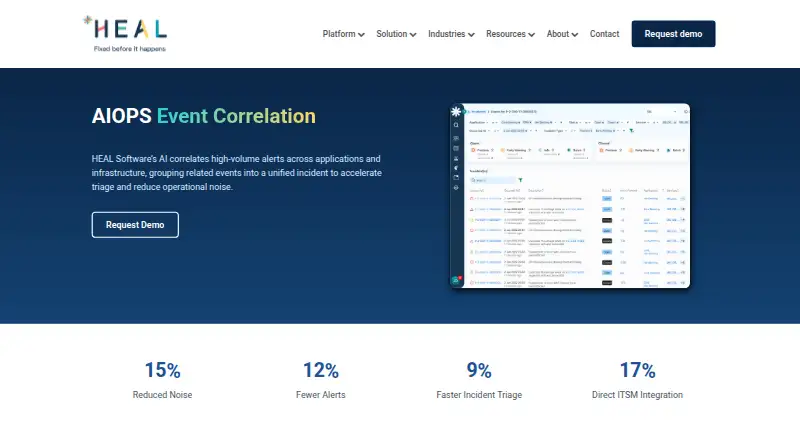
What HEAL Software Event Correlation is
HEAL Software Event Correlation brings application and infrastructure alerts together as incidents for triage. It consolidates metrics, logs, events, and application alerts into one ITSM ticket per incident, groups related events, and identifies the initiating trigger. Incidents are ranked by their effects on users, service-level agreements, and revenue. HEAL says its AI learns patterns, identifies causal links, and adapts as systems change. The platform ingests telemetry from on-premises, cloud, and container environments, and connects with observability and ITSM systems through agents, connectors, and standardized data models. The product page names ServiceNow, Jira, and BMC Remedy as destinations for correlated incidents. Intended users include incident response and IT operations, SRE and platform engineering, and IT governance and service management teams. It is available on the web and for self-hosted deployment; the company also describes SaaS and on-premises options. For on-premises use, HEAL says processing stays inside the enterprise network, with encryption, role-based access controls, and audit logging protecting operational data. Pricing is provided by request, with custom quotes based on monitored hosts, data ingestion volume, and number of users.
Who it suits
The product is aimed at incident response and IT operations, SRE and platform engineering, and IT governance and service management teams. It may suit organizations handling alerts across on-premises, cloud, or container environments.
What it does well
- Consolidates alerts into one ITSM ticket per incident
- Groups related events and identifies initiating triggers
- Ranks incidents by user, SLA, and revenue impact
- Names ServiceNow, Jira, and BMC Remedy as destinations
- Offers self-hosted and web deployment
What to know first
- No free plan
- Pricing is available by request
- Custom quote depends on hosts, data volume, and users
Plans
| Plan | Billed and limits | Price |
|---|---|---|
| Custom quote | Pricing based on monitored hosts, data ingestion volume, and number of users; subscription, consumption-based, and enterprise agreements | On request |
As healsoftware.ai lists them, read 11 Oct 2026. The maker's own page has the final word.
Getting started
- Visit the HEAL Software Event Correlation website.
- Request solution information and pricing from HEAL.
- Choose a deployment model: SaaS or on-premises; the product is also listed as web and self-hosted.
- Connect existing observability and ITSM systems through agents, connectors, and standardized data models.
- Set up correlated incident destinations such as ServiceNow, Jira, or BMC Remedy.
Verdict
HEAL Software Event Correlation focuses on reducing alert duplication and organizing related signals into incidents for triage. Organizations need to request a quote, and on-premises deployments keep processing inside the enterprise network, according to HEAL.
Questions
What does HEAL Software Event Correlation do?
It consolidates metrics, logs, events, and application alerts into one ITSM ticket per incident. It groups related events, identifies the initiating trigger, and ranks incidents by impact.
Which ITSM systems are named?
The product page names ServiceNow, Jira, and BMC Remedy as destinations for correlated incidents.
What deployment options are available?
HEAL describes SaaS and on-premises deployment models. The product is listed for web and self-hosted use.
How is pricing determined?
Pricing is available by request. Custom quotes are based on monitored hosts, data ingestion volume, and number of users.
What telemetry environments does it support?
HEAL says it ingests telemetry from on-premises, cloud, and container platforms.
What security measures apply to on-premises use?
HEAL says processing remains inside the enterprise network. Encryption, role-based access controls, and audit logging protect operational data.
Facts from HEAL Software Event Correlation's own pages
- Adaptive AI
- The company says its AI dynamically learns patterns, identifies causal links, and adapts as systems change. · healsoftware.ai, 5 Oct 2026
- AI behavior
- The page says its AI dynamically learns patterns, identifies causal links, and adapts to system changes, unlike static rules. · healsoftware.ai, 11 Oct 2026
- Causal grouping
- Its AI clusters related events and identifies the initiating trigger. · healsoftware.ai, 11 Oct 2026
- Company
- HEAL Software says it is headquartered in Bangalore and serves organizations worldwide in financial services, banking, and technology. · healsoftware.ai, 5 Oct 2026
- Company headquarters
- The company About page says HEAL Software is headquartered in Bangalore and serves organizations worldwide. · healsoftware.ai, 11 Oct 2026
- Compliance
- HEAL's eBook says it supports GDPR, HIPAA, and FedRAMP compliance requirements. · healsoftware.ai, 11 Oct 2026
- Deduplication
- It consolidates metrics, logs, events, and application alerts into a single ITSM ticket per incident. · healsoftware.ai, 11 Oct 2026
- Deployment
- The eBook says HEAL offers SaaS and on-premises deployment models. · healsoftware.ai, 11 Oct 2026
- Deployment and use
- The company describes its AIOps platform as integrating with existing observability and ITSM systems through agents, connectors, and standardized data models. · healsoftware.ai, 5 Oct 2026
- Headquarters
- Bangalore, India · healsoftware.ai, 28 Sept 2026
- Intended users
- The product page identifies incident response and IT operations teams, SRE and platform engineering teams, and IT governance and service management teams. · healsoftware.ai, 11 Oct 2026
- ITSM integrations
- Correlated incidents can be written into ServiceNow, Jira, and BMC Remedy. · healsoftware.ai, 11 Oct 2026
- Pricing
- The company’s contact page offers a request form for solution information; it does not state a product price. · healsoftware.ai, 5 Oct 2026
- Prioritization
- It ranks incidents by impact on users, SLAs, and revenue. · healsoftware.ai, 11 Oct 2026
- Purpose
- HEAL correlates high-volume alerts across applications and infrastructure into unified incidents to speed triage and reduce operational noise. · healsoftware.ai, 11 Oct 2026
- Security
- HEAL's eBook says the platform supports role-based access controls, end-to-end encryption, enterprise SSO, and data-residency requirements, and is SOC 2 Type II certified. · healsoftware.ai, 11 Oct 2026
- Supported environments
- The event correlation page says HEAL ingests telemetry from on-premises, cloud, and container platforms. · healsoftware.ai, 11 Oct 2026
Where HEAL Software Event Correlation stands on Freedom251
- Alert Management Software#29 of 36