Freedom251 › Alert Management Software

Alerta
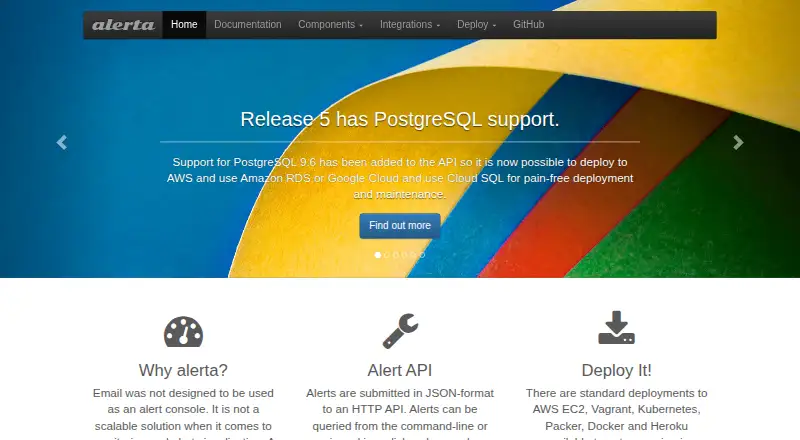
What Alerta is
Alerta is a free, open-source alert management system for collecting and processing monitoring alerts. It combines a JSON API server, a web console, and a command-line tool. Send alerts as JSON over HTTP; the API can correlate alerts from different sources, remove duplicates, or suppress them. Alerts that share an environment, resource, event, and severity are de-duplicated. You can also query alerts from the command line.
Alert data can include multiple services, tags in any format, and custom attributes. The web console shows alerts and is designed for desktop, tablet, and mobile screens. Built-in webhooks include AWS CloudWatch, Grafana, Graylog, New Relic, PagerDuty, Pingdom, Prometheus Alertmanager, Slack, Google Stackdriver, and Telegram. The homepage also lists monitoring sources such as Prometheus, Riemann, Nagios, Zabbix, netdata, Sensu, and Pingdom.
Python plugins can add capabilities without changing Alerta’s core source. A single instance can keep customer alerts separate, so customers see and act on their own alerts while administrators can view all customers’ alerts. Authentication options include Basic Auth, LDAP, OpenID Connect, SAML 2.0, OAuth2, CAS, API keys, and HMAC. The project lists deployment options including Docker and Kubernetes, among others.
Who it suits
Alerta suits teams that need a self-hosted place to collect and process alerts from multiple monitoring sources. Its customer-specific views and range of authentication options may also fit deployments serving multiple customers.
What it does well
- Free and open source.
- Correlates, de-duplicates, and suppresses alerts from multiple sources.
- Alerts support multiple services, flexible tags, and custom attributes.
- Web console is designed for desktop, tablet, and mobile screens.
- Python plugins extend the system without changes to its core source.
- Customer views can separate alerts while giving administrators an all-customer view.
What to know first
- Authentication is disabled by default.
Getting started
- Visit https://alerta.io/ for project information.
- Choose a listed deployment route such as Docker, Kubernetes, AWS EC2, Vagrant, Packer, or Heroku.
- Send JSON alerts to the HTTP API, or query alerts from the command line.
- Configure authentication and HTTPS/SSL if the web UI will be publicly accessible.
Verdict
Choose Alerta if you need a free, open-source system to process alerts from multiple sources, with flexible alert data and customer-specific views. Teams making the web UI publicly accessible should enable authentication and use HTTPS/SSL, as advised in the deployment documentation.
Questions
Is Alerta free?
Yes. It is listed as free and open source.
What platforms does Alerta support?
Listed platforms include API, Linux, self-hosted, and web.
Which monitoring integrations are listed?
Built-in webhooks include AWS CloudWatch, Grafana, Graylog, New Relic, PagerDuty, Pingdom, Prometheus Alertmanager, Slack, Google Stackdriver, and Telegram. The homepage also lists sources including Prometheus, Riemann, Nagios, Zabbix, netdata, and Sensu.
Can Alerta de-duplicate alerts?
Yes. Alerts with the same environment, resource, event, and severity are de-duplicated.
What authentication methods does it support?
Options include Basic Auth, LDAP, OpenID Connect, SAML 2.0, OAuth2, CAS, API keys, and HMAC.
Facts from Alerta's own pages
- Alert customization
- Alerts can include multiple services, tags in any format, and custom attributes. · alerta.io, 2 Oct 2026
- Alert format
- Alerts are submitted in JSON format to an HTTP API, and alerts can also be queried from the command line. · alerta.io, 2 Oct 2026
- Alert processing
- The API can correlate, de-duplicate, or suppress alerts from multiple sources. · docs.alerta.io, 3 Oct 2026
- Authentication
- Authentication options include Basic Auth, LDAP, OpenID Connect, SAML 2.0, OAuth2, CAS, API keys, and HMAC authentication. · docs.alerta.io, 3 Oct 2026
- Components
- Alerta combines a JSON API server with a web UI and command-line tool. · docs.alerta.io, 3 Oct 2026
- Customer views
- A single Alerta instance can separate alerts by customer so customers can only see and action their own alerts while administrators can see all customers’ alerts. · alerta.io, 2 Oct 2026
- De-duplication
- Alerts with the same environment, resource and event are de-duplicated when received with the same severity. · docs.alerta.io, 2 Oct 2026
- Deployment
- Alerta can be deployed using Docker, and its quick start also documents installing the server and CLI with pip. · docs.alerta.io, 3 Oct 2026
- Docker
- The official Docker image includes the API server, web UI, housekeeping, plugins, webhooks and authentication providers. · docs.alerta.io, 2 Oct 2026
- Extensibility
- Python plugins can extend Alerta without modifying its core source code. · docs.alerta.io, 3 Oct 2026
- Flexible alert data
- An alert can have multiple services, tags in any format, and custom attributes. · alerta.io, 3 Oct 2026
- Integrations
- Built-in webhooks include AWS CloudWatch, Grafana, PagerDuty, Pingdom, Prometheus Alertmanager, Slack, Google Stackdriver, and Telegram. · docs.alerta.io, 3 Oct 2026
- Maker
- The homepage copyright line names Nick Satterly. · alerta.io, 2 Oct 2026
- Monitoring sources
- The homepage lists integrations for Prometheus, Riemann, Nagios, Zabbix, netdata, Sensu, Pingdom and CloudWatch. · alerta.io, 2 Oct 2026
- Purpose
- Alerta consolidates and de-duplicates alerts from multiple sources for at-a-glance visualization. · docs.alerta.io, 3 Oct 2026
- Security configuration
- Authentication is disabled by default, and the documentation advises enabling it and using HTTPS/SSL when the web UI is publicly accessible. · docs.alerta.io, 2 Oct 2026
- Security guidance
- The deployment documentation advises enforcing authentication and HTTPS/SSL when the web UI is publicly accessible. · docs.alerta.io, 3 Oct 2026
- Support
- The project lists Slack, a FAQ, and a GitHub issue tracker as support resources. · docs.alerta.io, 3 Oct 2026
- Web console
- The web console displays alerts and is optimized for desktop, tablet and mobile. · alerta.io, 2 Oct 2026
Where Alerta stands on Freedom251
- Alert Management Software#26 of 36
- IT Alerting Software#20 of 23