Freedom251 › Application Performance & Observability - Enterprise Software

groundcover
by groundcover
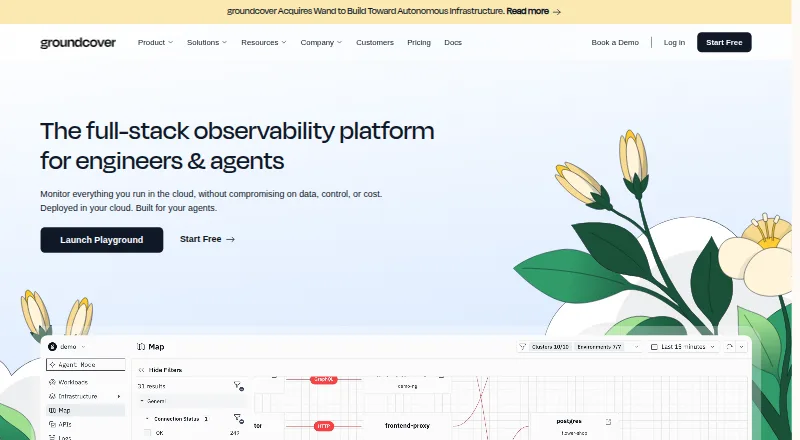
What groundcover is
groundcover is a cloud-native observability platform for monitoring production environments. Its eBPF sensor collects metrics, logs, and traces without code changes or manual instrumentation, processing data at the edge. The product says it ingests telemetry in real time without sampling. Bring Your Own Cloud places the backend in the customer’s cloud while groundcover manages it and hosts the interface; Fully On-Prem hosts both backend and interface on customer premises, including cloud or physical servers. Integrations include Kubernetes, OpenTelemetry, Prometheus, AWS CloudWatch, Google Cloud Monitoring, Azure, MongoDB Atlas, Redis Cloud, Datadog, and GitHub. Agent Mode can investigate telemetry and create dashboards, monitors, gcQL queries, and OTTL pipelines. The free plan includes 12-hour data retention and Slack Community support. Pro is $30 a month per host; Enterprise is $35 a month per host; On Premise is $50 a month per host. Billing uses average monthly monitored Kubernetes nodes or Linux hosts, not telemetry ingestion volume.
Who it suits
It suits teams monitoring production environments that want metrics, logs, and traces from an eBPF sensor. Its cloud and on-premises deployment choices may suit teams with different infrastructure needs.
What it does well
- Collects metrics, logs, and traces without instrumentation.
- Ingests data in real time without sampling.
- Offers Bring Your Own Cloud and Fully On-Prem.
- Includes a free plan with 12-hour retention.
- Supports listed integrations including Kubernetes and Prometheus.
What to know first
- Free plan has 12-hour data retention.
- Free plan support is via Slack Community.
- Pro costs $30 a month per host.
- Pricing is based on monitored hosts, not telemetry volume.
Limits
The Free plan includes 12-hour data retention and Slack Community support. Pro starts at $30 per host per month; Enterprise adds unlimited data retention at $35 per host per month.
Plans
| Plan | Billed and limits | Price |
|---|---|---|
| Free | Free forever · 12 hour data retention · Slack Community · No credit card required · BYOC | Free |
| Pro | Per host, per month · All available integrations and data sources · SSO support · Standard data retention · Standard support · BYOC | $30 a month |
| Enterprise | Per host, per month · Everything in Pro · RBAC support · Unlimited data retention · Premium support · BYOC | $35 a month |
| On Premise | Per host, per month · Everything in Enterprise · Self-hosted data plane · Self-hosted UI · Isolated authentication · Full On-Prem | $50 a month |
As groundcover.com lists them, read 28 Sept 2026. The maker's own page has the final word.
Getting started
- Visit the groundcover website.
- Choose the Free plan, which is billed Free forever and requires no credit card, or select a paid plan.
- Choose BYOC or Fully On-Prem deployment according to the plan and hosting arrangement.
- Use the web UI or the supported Linux and self-hosted options.
groundcover is an observability platform for production systems, using eBPF to gather telemetry across Linux and Kubernetes environments. It is best suited to teams that need broad visibility and control over where monitoring data is hosted. Its main appeal is unsampled collection paired with several deployment choices; per-host pricing and short free-plan retention are important trade-offs.
Overview
The eBPF sensor collects metrics, logs, and traces without application code changes or manual instrumentation. It processes data at the edge, and groundcover says ingestion is real time and unsampled. Distributed and transaction tracing, dependency mapping, real user monitoring, and log correlation make this a broad observability option rather than a tool focused on one telemetry type.
Deployment flexibility is a strength. Bring Your Own Cloud (BYOC) places the backend in the customer’s cloud, managed by groundcover, while groundcover hosts the UI. Fully On-Prem keeps both backend and UI on customer premises, including cloud or physical servers. Billing follows average monthly monitored Kubernetes nodes or Linux hosts, not telemetry volume: that can make host counts easier to budget, but costs may not track data generation.
Key features
- Edge-based telemetry: Collection of metrics, logs, and traces without manual instrumentation can suit teams seeking production visibility without code changes. Real-time, unsampled ingestion is a meaningful advantage when sampling would leave gaps, though the published pricing basis is hosts rather than volume.
- Deployment choices: BYOC offers a managed backend in the customer’s cloud with a groundcover-hosted interface. Fully On-Prem keeps both components on customer premises, which is the option for organizations that need the UI hosted alongside the backend.
- Integrations: Connections include Kubernetes, OpenTelemetry, Prometheus, AWS CloudWatch, Google Cloud Monitoring, Azure, MongoDB Atlas, Redis Cloud, Datadog, and GitHub. This range can help teams bring existing sources into the platform.
- Agent Mode: The AI agent can investigate telemetry and create dashboards, monitors, gcQL queries, and OTTL pipelines. It runs on Amazon Bedrock, OpenAI ChatGPT, or Anthropic Claude inside the customer’s cloud; prompts, logs, and traces stay within that infrastructure, according to groundcover.
- Security and support: The Trust Center covers CCPA, GDPR, HIPAA, ISO/IEC 27001:2022, SOC 2 Type 2, and PCI DSS topics and provides access to security documents. Standard support operates during business hours, with response targets ranging from under 8 hours for critical issues to under 72 hours for low-priority issues.
Pricing
groundcover uses freemium pricing, with paid plans billed per monitored host per month. The free plan is a useful way to start, but its 12-hour retention and Slack Community support make it a limited fit for teams needing longer history or formal support.
| Plan | Price | What it includes | Best suited to |
|---|---|---|---|
| Free | free | Free forever; 12 hour data retention; Slack Community; no credit card required; BYOC | Evaluation or smaller deployments that can work within short retention and community support. |
| Pro | $30 a month | Per host, per month; all available integrations and data sources; SSO support; standard data retention; standard support; BYOC | Teams that need integrations, SSO, and standard support beyond the free tier. |
| Enterprise | $35 a month | Per host, per month; everything in Pro; RBAC support; unlimited data retention; premium support; BYOC | Organizations that need role-based access, unlimited retention, or premium support. |
| On Premise | $50 a month | Per host, per month; everything in Enterprise; self-hosted data plane and UI; isolated authentication; Full On-Prem | Teams that require both the data plane and interface to be self-hosted. |
The higher tiers add retention, support, access controls, and deployment control, so the price step from Pro to Enterprise may matter most to teams with long-lived investigations or stricter access needs. The free tier’s 12-hour window is a substantial constraint for historical analysis.
Platforms
groundcover supports Linux, self-hosted deployment, and web access. Its hybrid deployment model allows a managed arrangement in the customer’s cloud or a fully on-premises setup.
Who it's for
groundcover is a strong candidate for infrastructure and platform teams monitoring Kubernetes or Linux hosts that want metrics, logs, and traces together, without adding instrumentation, and need a choice between BYOC and fully on-premises hosting. It is less compelling for buyers whose costs should scale with telemetry volume, or who need substantial retention and support but cannot justify per-host paid tiers.
Pros and cons
- Pro: eBPF collection covers metrics, logs, and traces without code changes or manual instrumentation, lowering the need for application-level changes to begin gathering telemetry.
- Pro: BYOC and Full On-Prem provide meaningful control over backend and UI placement for different infrastructure requirements.
- Pro: The paid tiers distinguish standard from unlimited retention and premium support, making the trade-up clear for teams with longer operational needs.
- Con: The free plan retains data for only 12 hours and provides Slack Community support, limiting its usefulness for extended incident review.
- Con: Per-host pricing is not tied to telemetry volume, which may be a mismatch for environments where host count is a poor proxy for monitoring cost.
- Con: The On Premise tier costs $50 a month per host, a material premium over Pro for teams that specifically need self-hosted data and UI.
Alternatives
For a wider view of the category, compare eBPF Observability Tools, Observability Platforms, Application Performance Monitoring, Metrics Monitoring Tools, Kubernetes Monitoring, and Log Management Software.
- Kubeshark is worth comparing for a free community plan capped at 3 nodes or 60 pods, with unlimited API call capacity and a requirement for internet connectivity.
- DeepFlow is an alternative for teams seeking a free open-source edition that supports Linux servers and selected Kubernetes, cloud, and container environments.
- Qpoint may suit teams focused on endpoint discovery and monitoring, with its community tier covering up to 25 endpoints and including policy plugins and source enforcement.
- Coroot offers a self-hosted Apache 2.0 Community Edition with core features; consider it when an open-source self-hosted starting point is preferable.
- Inspektor Gadget is a free open-source tools and framework option, with Linux 5.10+ and BTF required for project gadgets.
- Kindling is free forever, with no premium tiers, subscriptions, or feature gates.
- Odigos offers an open-source Apache 2.0 tier for core OpenTelemetry tracing with community support.
- Parca is another alternative.
Verdict
Choose groundcover if your team monitors Kubernetes or Linux hosts and wants unsampled eBPF telemetry with a path from BYOC to full on-premises hosting. The combination of broad telemetry and deployment control is its clearest reason to choose it. Look elsewhere if 12-hour free retention is too short, if per-host billing does not fit your workload, or if the paid support and retention tiers do not match your budget.
Verdict
groundcover combines eBPF-based telemetry collection with cloud and on-premises deployment options. Compare the retention, support, and per-host plan details with your monitoring needs.
Questions
Is groundcover free?
Yes. The Free plan is billed Free forever and includes 12-hour data retention and Slack Community support. No credit card is required.
How much do paid plans cost?
Pro is $30 per host per month, Enterprise is $35 per host per month, and On Premise is $50 per host per month. Billing is based on average monthly monitored Kubernetes nodes or Linux hosts.
Where can groundcover run?
Listed platforms are Linux, self-hosted, and web. BYOC puts the backend in the customer’s cloud while groundcover hosts the UI; Fully On-Prem places both backend and UI on customer premises.
What integrations are listed?
Integrations include Kubernetes, OpenTelemetry, Prometheus, AWS CloudWatch, Google Cloud Monitoring, Azure, MongoDB Atlas, Redis Cloud, Datadog, and GitHub.
What does Agent Mode do?
It can investigate telemetry and create dashboards, monitors, gcQL queries, and OTTL pipelines. It runs on Amazon Bedrock, OpenAI ChatGPT, or Anthropic Claude inside the customer’s cloud.
Who makes groundcover?
The maker is groundcover, with headquarters in Tel Aviv and California.
Facts from groundcover's own pages
- AI agent
- Agent Mode can investigate telemetry and create dashboards, monitors, gcQL queries, and OTTL pipelines. · groundcover.com, 28 Sept 2026
- AI data handling
- Agent Mode runs on Amazon Bedrock, OpenAI ChatGPT, or Anthropic Claude inside the customer’s cloud, and the page says prompts, logs, and traces never leave that infrastructure. · groundcover.com, 28 Sept 2026
- Billing
- Pricing is based on average monthly monitored Kubernetes nodes or Linux hosts, rather than telemetry ingestion volume. · groundcover.com, 28 Sept 2026
- Data processing
- The sensor processes and captures data at the edge, and the product states that it ingests data in real time without sampling. · groundcover.com, 28 Sept 2026
- Deployment
- Bring Your Own Cloud deploys the backend in the customer’s cloud while groundcover manages it, and the UI is hosted by groundcover. · groundcover.com, 28 Sept 2026
- Free plan
- Yes · groundcover.com, 23 Sept 2026
- Free-plan limit
- The Free plan includes 12 hour data retention and Slack Community support. · groundcover.com, 28 Sept 2026
- Headquarters
- Tel Aviv, Israel · groundcover.com, 23 Sept 2026
- Integrations
- Listed integrations include Kubernetes, OpenTelemetry, Prometheus, AWS CloudWatch, Google Cloud Monitoring, Azure, MongoDB Atlas, Redis Cloud, Datadog, and GitHub. · groundcover.com, 28 Sept 2026
- On-premises
- The Fully On-Prem deployment hosts both the backend and UI on customer premises, including cloud or physical servers. · groundcover.com, 28 Sept 2026
- Product
- groundcover is a cloud-native observability platform powered by eBPF for monitoring production environments. · groundcover.com, 28 Sept 2026
- Security and compliance
- The Trust Center lists CCPA, GDPR, HIPAA, ISO/IEC 27001:2022, SOC 2 Type 2, and PCI DSS compliance topics and offers access to security documents. · trust.groundcover.com, 28 Sept 2026
- Paid from
- 30 · groundcover.com, 23 Sept 2026
- Support
- Standard support offers business-hours availability with stated response targets from under 8 hours for critical issues to under 72 hours for low-priority issues. · groundcover.com, 28 Sept 2026
- Telemetry
- Its eBPF sensor collects metrics, logs, and traces with no code changes or manual instrumentation. · groundcover.com, 28 Sept 2026
Where groundcover stands on Freedom251
- Application Performance & Observability - Enterprise Software#5 of 26
- Observability Platforms#7 of 30
- Log Management Software#26 of 111
- Kubernetes Monitoring#14 of 54
- Monitoring Observability#8 of 30
- Metrics Monitoring Tools#11 of 37
- Application Performance & Observability - Midmarket Software#8 of 26
- eBPF Observability Tools#9 of 29
- Application Performance Monitoring#12 of 37
- Runtime Monitoring Software#19 of 56
- Container Monitoring#19 of 49