Freedom251 › eBPF Observability Tools
Inspektor Gadget
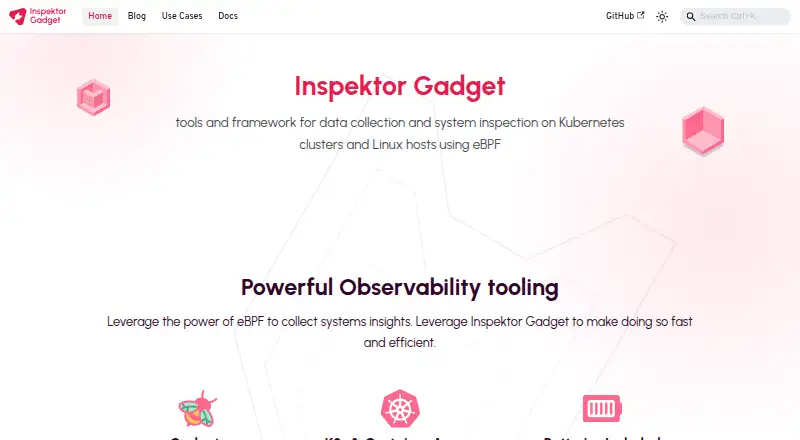
What Inspektor Gadget is
Inspektor Gadget is an open-source toolkit for collecting eBPF data and inspecting Kubernetes clusters and Linux hosts. Its gadgets package eBPF programs as OCI images that can be deployed to examine systems. The toolkit adds Kubernetes context, including pod and container names, to low-level kernel data, and it can export collected information to observability tools. WebAssembly modules can process data and customize operators, while developers can also work with the framework through a Go library. On Kubernetes, it runs as a DaemonSet, with one pod on each cluster node. Project-developed gadgets require Linux kernel 5.10 or later with BTF enabled. Listed Kubernetes platforms include Minikube, AKS, EKS, GKS, OpenShift, and Talos; AWS Fargate, Azure Container Instances, and GKE Autopilot are marked unsupported. Official image-based gadgets are signed, and operators can restrict which gadgets are allowed to run. The project has no long-term support releases; maintenance and security updates go to the latest release only.
Who it suits
Inspektor Gadget suits developers and operators who need eBPF-based system inspection across Linux hosts or supported Kubernetes environments. It also offers a Go library and WebAssembly customization for teams extending its framework.
What it does well
- Adds Kubernetes pod and container context to kernel data
- Exports collected data to observability tools
- Operators can restrict permitted gadgets
- Open-source tools and framework are free
What to know first
- Project gadgets require Linux kernel 5.10+ with BTF
- AWS Fargate is listed as unsupported
- Only the latest release receives maintenance and security updates
Limits
Project-developed gadgets require Linux kernel 5.10 or later with BTF enabled. AWS Fargate, Azure Container Instances, and GKE Autopilot are unsupported; only the latest release receives maintenance and security updates.
Plans
| Plan | Billed and limits | Price |
|---|---|---|
| Inspektor Gadget | Open-source tools and framework · Linux 5.10+ with BTF required for project gadgets | Free |
As inspektor-gadget.io lists them, read 2 Oct 2026. The maker's own page has the final word.
Getting started
- Visit the Inspektor Gadget website.
- Prepare a Linux host or supported Kubernetes environment.
- For project gadgets, ensure Linux kernel 5.10 or later with BTF enabled.
- On Kubernetes, deploy Inspektor Gadget as a DaemonSet with one pod per node.
- Use gadgetctl from a Linux, macOS, or Windows client.
- Configure --allowed-gadgets if operators need to limit runnable gadgets.
Overview
Inspektor Gadget is a free, open-source toolkit and framework for eBPF-based inspection of Linux hosts and Kubernetes clusters. It is aimed at platform, security, and observability engineers who need kernel-level signals tied to workload context, rather than a packaged dashboard for nontechnical users. The combination is compelling, but adoption depends on kernel compatibility, supported cluster environments, and a willingness to stay on the latest release.
Key features
Its gadgets package eBPF programs as OCI images that can be deployed and run for system inspection. In Kubernetes, deployment as a DaemonSet puts one pod on every cluster node, providing a consistent node-level collection model. This is practical for fleet-wide visibility, although it adds a cluster workload that must be operated and secured.
The project automatically enriches kernel data with higher-level Kubernetes information, including pod and container names. That context makes low-level events more actionable when investigating workload behavior. Data can be exported to observability tools, so Inspektor Gadget can feed an existing monitoring stack instead of requiring a complete replacement.
Extensibility is a central strength. WebAssembly modules can post-process data and customize operators, and a Go library lets developers embed the framework in their own tooling. These capabilities suit teams that want to build specialized workflows; organizations seeking a fixed, turnkey monitoring product may find the framework-oriented approach unnecessarily demanding.
Security features support controlled deployment. Official image-based gadgets are signed with cosign, with documentation for signature verification. The --allowed-gadgets flag restricts runnable gadgets by digest, tag, or image prefix, giving operators a way to enforce an approved image policy.
Pricing
The Inspektor Gadget plan costs free. It includes the open-source tools and framework, with no paid tier or subscription terms stated. This is attractive for teams able to provide their own infrastructure and operational support, but the zero price does not remove the Linux, Kubernetes, maintenance, or engineering commitments.
Platforms
Inspektor Gadget is self-hosted and supports API, Linux, macOS, and Windows. Linux is the execution foundation for project-developed gadgets: kernel 5.10 or later with BTF enabled is required. macOS and Windows are supported as clients through gadgetctl, not as substitutes for the Linux hosts running the eBPF workloads.
The requirements list Minikube, AKS, EKS, GKS, OpenShift, and Talos as supported Kubernetes platforms. AWS Fargate, Azure Container Instances, and GKE Autopilot are marked unsupported, which can rule it out for managed-container architectures built around those services.
Who it's for
Choose Inspektor Gadget when your team needs network visibility, application tracing, or kernel profiling with Kubernetes-aware attribution and can manage self-hosted infrastructure. It is particularly well suited to engineers who value programmable collection and export into an existing observability pipeline.
It is a weaker fit for teams that cannot control host kernels, run on an unsupported serverless platform, or want long-term maintenance branches. The project states that only the latest release receives security updates and maintenance, so upgrade planning is part of normal ownership.
Pros and cons
Pros
- Kubernetes context for eBPF data: pod and container enrichment makes kernel events easier to relate to applications.
- OCI-based gadgets: packaged programs are deployable units that fit image-oriented operations.
- Extensible processing: WebAssembly and Go integration support custom operators and pipelines.
- Deployment controls: cosign verification and allowed-gadget restrictions help govern executable content.
- No license charge: the open-source plan removes subscription cost.
Cons
- Strict host prerequisite: project gadgets require Linux 5.10 or newer with BTF enabled.
- Environment exclusions: AWS Fargate, Azure Container Instances, and GKE Autopilot are unsupported.
- Latest-release-only policy: security and maintenance require keeping up with current releases.
- Self-hosted responsibility: deployment, upgrades, and observability integration remain with the adopting team.
Alternatives
Kubeshark is a better choice when you want a freemium Kubernetes-focused option with a Community plan capped at three nodes or 60 pods, internet connectivity, unlimited API calls, and community support.
DeepFlow suits readers seeking a free, open-source observability option covering Linux servers and selected Kubernetes, cloud, and container environments, with a free trial available.
Qpoint is worth considering for endpoint-oriented discovery and monitoring, with its Community plan supporting up to 25 endpoints and built-in policy plugins.
Coroot fits teams wanting a self-hosted community edition plus paid tiers, including a Standard plan priced at $1 a month billed per monitored CPU core.
groundcover offers a freemium alternative with a free-forever plan, 12-hour data retention, Slack community support, and BYOC.
Kindling is a simpler free option with no premium tiers, subscriptions, or feature gates.
Odigos is preferable when your priority is OpenTelemetry tracing through an Apache 2.0 open-source edition.
Parca provides an Apache 2-licensed open-source option focused on continuous profiling.
For a broader comparison, see eBPF Observability Tools.
Verdict
Inspektor Gadget is a strong choice for engineering-led teams that need programmable eBPF inspection enriched with Kubernetes identity and can operate Linux-based, self-hosted infrastructure. Its main reason to choose it is the blend of packaged OCI gadgets, cluster context, and extensibility at no license cost. Look elsewhere if your environments include unsupported managed-container platforms or if maintaining only the latest release conflicts with your change-management policy.
Verdict
Inspektor Gadget combines system inspection with Kubernetes-aware context and extensibility for eBPF workflows. Check the kernel requirement, supported environments, and latest-release-only maintenance before adopting it.
Questions
How much does Inspektor Gadget cost?
Inspektor Gadget is free and open source. Its listed plan costs nothing.
Does Inspektor Gadget run on macOS and Windows?
The supported operating systems include Linux, with macOS and Windows clients available through gadgetctl. Project-developed gadgets require Linux kernel 5.10 or later with BTF enabled.
Which Kubernetes environments are supported?
The requirements page lists Minikube, AKS, EKS, GKS, OpenShift, and Talos. AWS Fargate, Azure Container Instances, and GKE Autopilot are marked unsupported.
Is Inspektor Gadget open source?
Yes. It is an open-source toolkit and framework, and the project identifies as a Cloud Native Computing Foundation Sandbox Project.
How is Inspektor Gadget deployed on Kubernetes?
It is deployed as a DaemonSet, with one pod on each cluster node.
How are releases maintained?
The project has no long-term support releases. Only the latest release receives security updates and maintenance.
Facts from Inspektor Gadget's own pages
- Access controls
- Operators can restrict which gadgets may run by digest, tag, or image prefix using the --allowed-gadgets flag. · inspektor-gadget.io, 2 Oct 2026
- Data export
- The project supports collecting and exporting data to observability tools. · inspektor-gadget.io, 2 Oct 2026
- Deployment
- On Kubernetes, Inspektor Gadget is deployed as a DaemonSet, with one pod per cluster node. · inspektor-gadget.io, 2 Oct 2026
- Extensibility
- WebAssembly modules can post-process data and customize operators, and the framework can be used through a Go library. · inspektor-gadget.io, 2 Oct 2026
- Gadgets
- Gadgets package eBPF programs as OCI images that can be deployed and run to inspect systems. · inspektor-gadget.io, 2 Oct 2026
- Kubernetes awareness
- It automatically enriches low-level kernel data with higher-level information such as Kubernetes pods and container names. · inspektor-gadget.io, 2 Oct 2026
- Kubernetes support
- The requirements page lists Minikube, AKS, EKS, GKS, OpenShift, and Talos as supported platforms. · inspektor-gadget.io, 2 Oct 2026
- Linux requirement
- Gadgets developed by the project require Linux kernel 5.10 or later with BTF enabled. · inspektor-gadget.io, 2 Oct 2026
- Project status
- Inspektor Gadget identifies itself as a Cloud Native Computing Foundation Sandbox Project. · inspektor-gadget.io, 2 Oct 2026
- Purpose
- Inspektor Gadget is a set of tools and a framework for eBPF-based data collection and system inspection on Kubernetes clusters and Linux hosts. · inspektor-gadget.io, 2 Oct 2026
- Security
- Official image-based gadgets are signed with cosign, and the documentation describes verifying gadget signatures. · inspektor-gadget.io, 2 Oct 2026
- Security updates
- The project says it has no long-term support releases and that only the latest release receives security updates and maintenance. · inspektor-gadget.io, 2 Oct 2026
- Unsupported environments
- The requirements page marks AWS Fargate, Azure Container Instances, and GKE Autopilot as unsupported. · inspektor-gadget.io, 2 Oct 2026
Where Inspektor Gadget stands on Freedom251
- eBPF Observability Tools#5 of 29