Freedom251 › Passkey Authentication Software
Google Cloud Identity
What Google Cloud Identity is
Google Cloud Identity centrally manages users and groups as an Identity as a Service solution. It can federate identities with services such as Active Directory and Microsoft Entra ID, and provides single sign-on to thousands of SaaS apps, including Salesforce, SAP SuccessFactors, and Google Workspace. MFA options include security keys, Google Prompt, authenticator codes, backup codes, SMS, voice calls, and passkeys. A unified console manages Android, iOS, and Windows devices, with options to enforce policies, wipe company data, deploy apps, and view reports. Automated provisioning can create, update, or delete user profiles in third-party cloud apps. Directory Sync extends Active Directory users to the cloud, while Secure LDAP supports traditional apps and infrastructure. The Free edition provides 50 user licenses by default, with additional free licenses available by request. Premium's annual fixed-term plan costs $6 a month; its flexible plan costs $7.20 a month. Premium includes automated provisioning and context-aware access. Premium lists 24x7 chat and email support and a 99.9% SLA; Free lists Google Cloud Communities support.
Who it suits
Cloud Identity suits organizations managing users, app access, and Android, iOS, or Windows devices from a central console. It may also fit teams connecting Active Directory identities to cloud services or automating app provisioning.
What it does well
- Free edition includes 50 user licenses by default
- SSO to thousands of SaaS apps
- Supports multiple MFA methods, including passkeys
- Manages Android, iOS, and Windows devices
- Premium annual plan costs $6 a month
What to know first
- Free edition starts with 50 user licenses by default
- Flexible Premium plan costs $7.20 a month
- 24x7 chat and email support is listed for Premium
Limits
The Free edition provides 50 user licenses by default. Additional free licenses can be requested at no cost.
Plans
| Plan | Billed and limits | Price |
|---|---|---|
| Cloud Identity Premium — Annual/Fixed-Term Plan | billed annually · Enterprise security features · Automated user provisioning · Context-Aware Access · Advanced endpoint management · 15 GB pooled storage per end user | $6 a month |
| Cloud Identity Premium — Flexible Plan | billed monthly · Monthly per-user billing · No annual commitment · Enterprise security features · Automated user provisioning · Context-Aware Access | $7.20 a month |
| Cloud Identity Free | free subscription · 50 user licenses by default · additional free licenses requestable | Free |
| Cloud Identity Premium | per user · Billed as part of a Google Workspace subscription · additional enterprise security, application management, and device management features | $7.20 a month |
| Cloud Identity Premium Flexible | monthly per user · no term commitment · add/remove users anytime · cancel anytime | $7.20 a month |
| Cloud Identity Premium Annual/Fixed-Term | $6 per license monthly, annual commitment · 1-year commitment · license reductions only at renewal · early cancellation still billed | $72 a year |
As cloud.google.com lists them, read 19 Sept 2026. The maker's own page has the final word.
Getting started
- Open the Google Cloud Identity website.
- Choose the Free edition or a Premium plan.
- Set up users and groups in the central identity service.
- Connect identity providers or cloud apps using supported SAML 2.0 or OpenID Connect integrations.
- Manage supported devices through the unified console.
Overview
Google Cloud Identity is a cloud service for centrally managing organizational users and groups. It is best suited to businesses connecting Google identities with cloud apps, devices or an existing Microsoft directory. Its appeal is the breadth of identity and endpoint controls; the trade-off is that several enterprise capabilities require Premium.
Key features
Identity, app access and authentication
Cloud Identity can federate identities between Google and Active Directory or Microsoft Entra ID, which makes it relevant to organizations bridging cloud and established directory environments. Directory Sync extends Microsoft Active Directory users to the cloud, while Secure LDAP supports access to traditional apps and infrastructure.
Single sign-on covers thousands of SaaS applications, including Salesforce, SAP SuccessFactors and Google Workspace. Hundreds of cloud apps integrate out of the box, and pre-integrated applications can use SAML 2.0 or OpenID Connect. That breadth can simplify access across a varied app estate, though it is most compelling when an organization wants centralized identity rather than customer-facing authentication.
MFA options include Google Prompt, security keys, Google Authenticator and other TOTP generators, backup codes, SMS, voice calls and passkeys. Cloud Identity also includes context-aware access, account takeover protection and threat investigation through Security Center. These controls give administrators several ways to strengthen sign-in, with context-aware access and other enterprise security features included in Premium.
Provisioning and device management
Automated provisioning can create, update or delete user profile information in third-party cloud apps from one place. The Cloud Identity API supports provisioning and management of identity resources, making the service relevant to organizations that need to manage identity programmatically as well as through its central service.
A unified console manages Android, iOS and Windows devices. Administrators can enforce policies, wipe company data, deploy apps and view reports. Premium adds advanced endpoint management, so organizations that need deeper device controls should budget for the paid edition rather than assume the Free edition covers the same requirements.
Pricing
Cloud Identity is freemium. Cloud Identity Free costs nothing and starts with 50 user licenses; additional free licenses can be requested at no cost. That makes it a practical starting point for organizations that need centralized identity without a per-user charge, but Premium is the tier for automated provisioning, context-aware access and advanced endpoint management.
Cloud Identity Premium — Annual/Fixed-Term Plan costs $6 a month, billed annually. It includes enterprise security features, automated user provisioning, context-aware access, advanced endpoint management and 15 GB pooled storage per end user. The annual commitment brings the lowest stated per-user price, but is a poorer fit for organizations that need month-to-month flexibility.
Cloud Identity Premium — Flexible Plan costs $7.20 a month, billed monthly. It includes monthly per-user billing, no annual commitment, enterprise security features, automated user provisioning and context-aware access. It costs more than the annual plan and the plan details do not include the advanced endpoint management or pooled storage described for the annual option.
Cloud Identity Premium is also priced at $7.20 a month per user when billed as part of a Google Workspace subscription, adding enterprise security, application management and device management features. Premium includes 24x7 chat and email support and a 99.9% SLA; Free includes Google Cloud Communities support. Organizations should choose the plan based on both commitment and the specific controls they need, not just the entry price.
Platforms
Cloud Identity supports Android, iOS, web and Windows, as well as an API for identity resource provisioning and management. Its stated device controls cover Android, iOS and Windows, while the API gives teams a route to manage identity resources in their own workflows.
Who it's for
Cloud Identity is a strong fit for organizations managing employee identities across Google, Microsoft directory infrastructure and cloud applications, especially those that also want centralized device administration. The Free edition is worth considering when the default 50 licenses are sufficient or additional free licenses can be requested. Premium is better suited to teams that need automated provisioning, context-aware access, advanced endpoint management, enterprise security features or its listed support and SLA. It is less directly suited to developers seeking customer identity tooling: its central purpose is managing organizational users and groups.
Pros and cons
- Pro: Federation, Directory Sync and Secure LDAP support organizations with both cloud services and traditional directory infrastructure.
- Pro: Broad SaaS SSO and multiple MFA methods give administrators several options for centralized sign-in and stronger authentication.
- Pro: The Free edition starts with 50 licenses and permits requests for more at no cost.
- Con: Automated provisioning, context-aware access and advanced endpoint management are Premium capabilities, so the Free edition is not a substitute for the full enterprise control set.
- Con: The lower $6 a month price requires annual billing; the flexible monthly plan costs $7.20 a month.
Alternatives
For a customer identity focus, cidaas has a free customer IAM plan with 500 registered users, core authentication functions and community support, plus a 30-day trial period. FusionAuth is an alternative with a free, self-hosted Community plan offering unlimited use and core authentication features. Okta Customer Identity Cloud offers an Essentials plan at $35 a month for up to 500 monthly active users, 10 organizations and standard support.
Ory offers a production plan at $770 a year; its Developer tier is also an option. Supabase has a free plan with 50,000 monthly active users, 500 MB database per project, 5 GB egress and 1 GB file storage. Authgear is an open-source alternative that says users can self-host, migrate or switch to any OIDC-compliant provider. Authio Lobby has a free Developer plan for projects under 10,000 monthly active users, with no SSO or SCIM. Clerk has a free Hobby plan with 50,000 monthly retained users per app, up to three dashboard seats, five user impersonations and three social connections.
Readers comparing categories can also browse Passkey Authentication Software, Single Sign-On Software, Customer Identity and Access Management Software and Identity and Access Management Software.
Verdict
Choose Google Cloud Identity if you need one service to manage workforce identities across Google, Microsoft directories, SaaS applications and supported devices. Its main advantage is the combination of federation, SSO, provisioning and endpoint controls, with a free entry point. Look elsewhere if your priority is customer identity, or if Premium's paid tiers and annual commitment do not suit your budget or purchasing needs.
Verdict
Cloud Identity combines identity federation, app SSO, device management, and provisioning in a central service. The Free edition has an initial 50-license allocation, while Premium adds enterprise features and its listed support and SLA.
Questions
Does Cloud Identity have a free plan?
Yes. Cloud Identity Free includes 50 user licenses by default, and additional free licenses can be requested at no cost.
How much does Premium cost?
The annual fixed-term plan is $6 a month. The flexible plan is $7.20 a month, billed monthly.
Which platforms does Cloud Identity support?
Listed platforms are Android, API, iOS, web, and Windows.
Which single sign-on protocols are supported?
Cloud Identity supports SAML and OIDC, including pre-integrated SAML 2.0 and OpenID Connect apps.
Can it connect with Active Directory?
Yes. Directory Sync can extend Microsoft Active Directory users to the cloud. Secure LDAP supports access to traditional apps and infrastructure.
What support and service level does Premium list?
The editions page lists 24x7 chat and email support and a 99.9% SLA for Premium.
Facts from Google Cloud Identity's own pages
- Agentless management
- Basic device management can operate without an endpoint agent and provides wipe and inventory controls. · cloud.google.com, 15 Oct 2026
- API
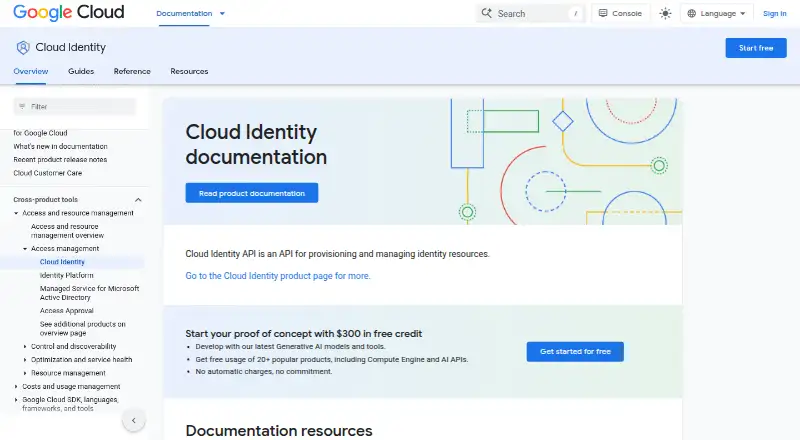
- The Cloud Identity API is for provisioning and managing identity resources. · docs.cloud.google.com, 30 Sept 2026
- App integrations
- Cloud Identity integrates with hundreds of cloud applications out of the box and supports pre-integrated SAML 2.0 and OpenID Connect apps. · cloud.google.com, 30 Sept 2026
- Authentication extensibility
- Groups API calls can authenticate as an end user or as a service account, including domain-wide delegation. · docs.cloud.google.com, 15 Oct 2026
- Automated provisioning
- Automated user provisioning can create, update, or delete user profile information in third-party cloud apps from one place. · cloud.google.com, 30 Sept 2026
- BYOD
- Endpoint management supports bring-your-own-device deployments. · cloud.google.com, 15 Oct 2026
- Cloud Identity API
- The Cloud Identity API provisions and manages identity resources. · cloud.google.com, 15 Oct 2026
- Cloud resource access
- Cloud Identity accounts can be used with Google Cloud IAM to control access to cloud resources. · docs.cloud.google.com, 15 Oct 2026
- Company size
- LinkedIn lists Google as a public software-development company with more than 10,001 employees and headquarters in Mountain View, California. · linkedin.com, 15 Oct 2026
- Deprecation
- Cloud Identity POSIX groups were deprecated, with existing groups scheduled for removal on or after September 26, 2025. · docs.cloud.google.com, 15 Oct 2026
- Directory synchronization
- Google Cloud Directory Sync extends an on-premises directory into Cloud Identity and synchronizes user information with HR systems. · cloud.google.com, 15 Oct 2026
- Documentation depth
- Google publishes guides, REST references, API setup instructions, release notes, support links and code samples for Cloud Identity. · cloud.google.com, 15 Oct 2026
- Documentation license
- Cloud Identity documentation is under Creative Commons Attribution 4.0 and its code samples are under Apache 2.0. · docs.cloud.google.com, 15 Oct 2026
- Endpoint management
- Administrators can manage Android, iOS and Windows devices, enforce policies, wipe company data, deploy apps, view reports and export details. · cloud.google.com, 15 Oct 2026
- Hybrid access
- Google describes Directory Sync for extending Microsoft Active Directory users to the cloud and Secure LDAP for access to traditional apps and infrastructure. · cloud.google.com, 30 Sept 2026
- Identity federation
- It can federate identities between Google and providers such as Active Directory and Microsoft Entra ID. · docs.cloud.google.com, 30 Sept 2026
- Integrations
- Google lists hundreds of cloud application integrations and thousands of pre-integrated SSO applications, including Salesforce and SAP SuccessFactors. · cloud.google.com, 15 Oct 2026
- License limit
- The Free edition provides 50 user licenses by default, and additional free licenses can be requested at no cost. · cloud.google.com, 30 Sept 2026
- Limit: GCP focus
- Gartner reviewers criticize the product as primarily centered on Google Cloud and less comprehensive than generic IAM products. · gartner.com, 15 Oct 2026
- Limit: missing collaboration feature
- A Capterra reviewer said Cloud Identity users could not use Google Chat and wanted it included. · capterra.com, 15 Oct 2026
- Limit: mobile admin coverage
- Google Play reviewers complain that the Google Admin app exposes far less functionality than the web console and has account-selection or login problems. · play.google.com, 15 Oct 2026
- Limit: policy trust and change concerns
- An App Store reviewer criticized Google's policy changes and said dependence on Google created concern about sudden service or licensing changes. · apps.apple.com, 15 Oct 2026
- Limit: setup and usability
- G2 reviewers describe account creation as demanding for newcomers and say the interface and concepts can be difficult to learn. · g2.com, 15 Oct 2026
- Limit: social login coverage
- A G2 reviewer requested more social-platform login integrations. · g2.com, 15 Oct 2026
Where Google Cloud Identity stands on Freedom251
- Passkey Authentication Software#12 of 55
- Single Sign-On Software#9 of 34
- Identity and Access Management Software#12 of 45
- Customer Identity and Access Management Software#9 of 29
- Authentication Software#10 of 31
- OAuth Server Software#16 of 32