Freedom251 › Passkey Authentication Software

Authgear
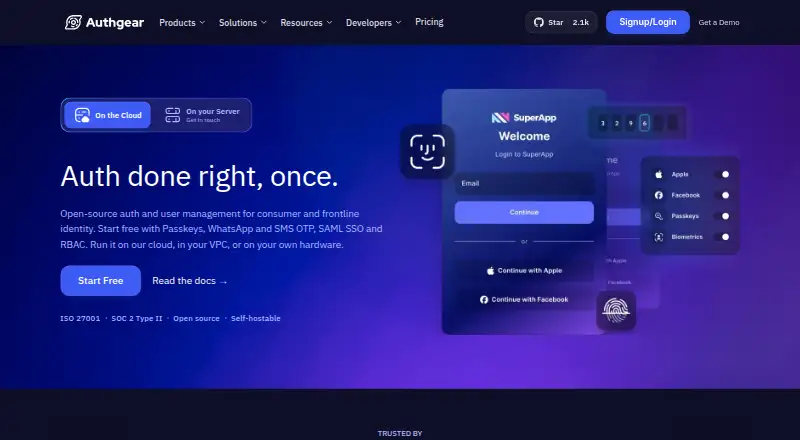
What Authgear is
Authgear is an identity-as-a-service platform for authentication and user management in web and mobile applications. It supports sign-in with email, phone, username, passwords, one-time codes, and magic links, along with mobile biometrics, passkeys, and multi-factor verification through SMS, email, or TOTP apps. Identity provider options include Google, Apple, and Azure Active Directory. Authgear offers SSO across web and mobile applications, including SAML SSO for web apps. Its user-management portal supports password resets, account locking, profile management, and scheduled deletion or anonymization. Developers can use SDKs for React, React Native, Ionic, Android, iOS, and Flutter, plus OAuth 2.0/OpenID Connect and admin, import, and export APIs. Authgear describes itself as open source and supports self-hosting; its hosted service currently runs in the USA on Google Cloud Platform infrastructure. The Free plan costs nothing and allows two applications and two admin seats, with one-day log retention and community support. Developers costs $50 a month. Paid plans start from $50/mo.
Who it suits
Authgear suits teams building web or mobile applications that need sign-in, identity management, or SSO. It also fits developers who want SDKs and APIs or the option to self-host.
What it does well
- Supports passkeys, biometrics, and multi-factor authentication.
- Offers SSO, including SAML for web apps.
- SDKs cover major listed web and mobile frameworks.
- Supports self-hosting and OIDC-compliant provider changes.
- Free plan includes unlimited MAUs.
What to know first
- Free plan allows two applications.
- Free plan allows two admin seats.
- Free plan has one-day log retention.
- Developers plan costs $50 a month.
Limits
The Free plan includes two applications, two admin seats and one-day log retention, with community support. The Developers plan is $50 per month and has the same application, seat and retention limits, with priority email support; SMS and WhatsApp messages are metered.
Plans
| Plan | Billed and limits | Price |
|---|---|---|
| Free | $0/ month · Unlimited MAUs · 100 SMS/WhatsApp messages · 2 applications · 2 admin seats · 1-day log retention · community support | Free |
| Developers | $50/ month · Unlimited MAUs · metered SMS/WhatsApp · 2 applications · 2 admin seats · 1-day log retention · priority email support | $50 a month |
| Business | $500/ month · 25,000 MAUs · +$50/5k MAUs · metered SMS/WhatsApp · 5 applications · 5 admin seats · 60-day log retention · dedicated Slack channel | $500 a month |
| Enterprise | Custom Pricing · Volume discount · data residency · custom SMS gateway · tailored SLA · dedicated account manager | On request |
As authgear.com lists them, read 15 Oct 2026. The maker's own page has the final word.
Getting started
- Visit the Authgear website.
- Choose the hosted service or self-hosting route.
- Select the Free plan or a paid plan.
- Use an official SDK or Authgear API to connect your application.
- Configure the authentication methods and identity providers your application will use.
Overview
Authgear is an identity platform for teams building web and mobile applications that need sign-in and account administration in one service. It is particularly suitable for developers who need many authentication choices, cross-application SSO and the option to run the software themselves. The main trade-off is that the less expensive plans restrict applications, administrator seats and log retention.
Authgear describes its software as open source, allowing organizations to self-host, migrate or move to another OIDC-compliant provider. Its hosted service runs in the USA on Google Cloud Platform data-center infrastructure. The company states that it is ISO 27001 and SOC 2 Type II compliant. A 30-day money-back guarantee applies to any SaaS plan.
Key features
Authentication and identity providers
Users can sign in with email, phone, username or password, as well as OTP codes and magic links. Google, Apple and Azure Active Directory are supported identity providers. Passkeys and mobile biometric login provide passwordless options, while multi-factor authentication can use SMS or email verification or a TOTP authenticator app. This breadth suits both consumer products and workforce authentication, although metered messaging on paid plans makes high-volume SMS or WhatsApp verification a cost to budget.
SSO and account administration
Single sign-on covers multiple web and mobile applications, with SAML SSO for web applications. The management portal includes password resets, account locking, scheduled deletion or anonymization and profile management. These controls reduce the need to build routine account operations, but the number of applications and administrator seats depends heavily on the plan.
Developer access and integrations
Official SDKs target React, React Native, Ionic, native Android, iOS and Flutter. OAuth 2.0/OpenID Connect, Admin, User Import and User Export APIs provide integration and migration paths. Listed integrations include Google Workspace, Microsoft 365, Mailchimp, Mailgun, Postmark, Salesforce, SendGrid, Slack, Telegram, WhatsApp and Zapier. The combination is useful for teams supporting several application stacks or connecting identity events to business systems.
Pricing
Authgear uses a freemium model. The Free plan costs nothing, billed $0 per month. It includes unlimited MAUs, 100 SMS/WhatsApp messages, two applications, two admin seats, one day of log retention and community support. It is a practical way to support a small deployment, but the two-application cap and extremely short log-retention window limit it for organizations needing broader estates or meaningful operational history.
Developers costs $50 a month, billed $50 per month. It keeps unlimited MAUs, two applications, two admin seats and one day of log retention, changes messaging to metered SMS/WhatsApp and adds priority email support. This is the sensible step up when support responsiveness matters; it does not expand the core application, seat or retention limits.
Business costs $500 a month, billed $500 per month. It includes 25,000 MAUs, with an additional $50 per 5k MAUs, metered SMS/WhatsApp, five applications, five admin seats, 60 days of log retention and a dedicated Slack channel. The larger application and seat allowances and longer retention make it better suited to a growing multi-app organization, while usage-based MAU and messaging charges require monitoring.
Enterprise uses custom pricing and adds volume discount, data residency, a custom SMS gateway, a tailored SLA and a dedicated account manager. It is the appropriate tier when deployment requirements or service commitments exceed the fixed plans.
Platforms
Authgear supports Android, iOS and web applications, exposes APIs, and can be self-hosted as well as used as a hosted service. The mobile SDK coverage is broad, spanning native and cross-platform frameworks. Self-hosting is a meaningful advantage for teams that need deployment control or an exit from a hosted identity provider; hosted service data is currently in the USA, so organizations with residency requirements should consider Enterprise.
Who it's for
Authgear fits product teams that need consumer or workforce authentication, passkeys, MFA, SSO and user administration without assembling each component separately. It is also a strong match for developers who value open-source portability and multiple SDKs. It is less compelling for a tiny single-app project that needs long log retention, or for a rapidly expanding application portfolio that would outgrow the two-app limits before reaching Business.
Pros and cons
Pros
- Wide sign-in coverage: passwords, OTP, magic links, passkeys, biometrics and MFA support varied user and security requirements.
- Portable deployment: open-source code and self-hosting support reduce dependence on one hosted provider.
- Strong integration surface: SDKs, standards-based APIs and numerous business integrations shorten implementation work.
- Useful SSO and lifecycle controls: multi-application SSO, SAML and account-management tools address both product and workforce scenarios.
Cons
- Small lower-tier footprint: Free and Developers each allow only two applications and two admin seats.
- Minimal retention on entry plans: one day of logs provides little history for investigation or operations.
- Variable messaging costs: Developers and Business meter SMS/WhatsApp usage.
- Hosted residency constraint: the hosted service is currently in the USA; other residency needs require Enterprise.
Alternatives
Choose miniOrange Identity and Access Management instead if its broader platform coverage and free Customer IAM tier with two to three social logins better match your deployment.
FusionAuth is the alternative to consider when a free self-hosted Community plan and unlimited users are the priority.
Pick Okta Customer Identity Cloud if a managed offering with up to 500 monthly active users on its $35 a month Essentials plan is a closer fit.
cidaas suits readers seeking a 30-day trial tier with 500 registered users and core authentication functions.
Consider Google Cloud Identity when enterprise security features and automated provisioning at $6 a month billed annually are the deciding factors.
Ory is an option for teams evaluating a developer tier and a production plan priced at $770 a year.
Curity Identity Server is worth choosing when a free self-hosted Community plan with unlimited users and a complete OAuth Server is preferred.
Descope is an alternative with a Free Forever tier capped at 7,500 MAUs, 10 monthly active tenants and three SSO connections.
For broader category browsing, see Customer Identity and Access Management Software and Passkey Authentication Software.
Verdict
Authgear is a strong choice for development teams that want flexible authentication, SSO, user administration and a self-hosting escape route, backed by SDKs and standards-based APIs. Choose it for portability and breadth; look elsewhere if you need more than two applications on a low-cost plan, longer entry-level log retention or hosted data residency outside the USA.
Verdict
Authgear covers sign-in, user management, and SSO, with SDKs, APIs, and self-hosting support. The Free plan has defined limits on applications, seats, and log retention; Developers starts at $50 a month.
Questions
Is Authgear free?
Yes. The Free plan costs $0 per month and includes unlimited MAUs, two applications and two admin seats.
How much do paid plans cost?
The Developers plan is $50 per month and Business is $500 per month. Enterprise has custom pricing.
Which platforms does Authgear support?
Listed platforms are Android, iOS, web, API and self-hosted. Official SDKs are available for React, React Native, Ionic, native Android, iOS and Flutter.
Can Authgear be self-hosted?
Yes. Authgear describes itself as open source and says users can self-host, migrate or switch to any OIDC-compliant provider.
Which sign-in and SSO options does it support?
Authentication options include email, phone, username, password, OTP, magic links, biometrics, passkeys and MFA. It offers SSO across web and mobile applications and SAML SSO for web applications.
What support comes with the plans?
Free includes community support, Developers includes priority email support, Business includes a dedicated Slack channel, and Enterprise includes a dedicated account manager.
Facts from Authgear's own pages
- Analytics integration
- Authgear documents Google Tag Manager integration for sending page-view and event data to Google Analytics and other marketing tags. · docs.authgear.com, 15 Oct 2026
- Android requirement
- The Android SDK supports Android 5.0 (API 21) or later. · docs.authgear.com, 15 Oct 2026
- APIs
- Authgear provides OAuth 2.0/OpenID Connect, Admin, User Import and User Export APIs. · docs.authgear.com, 1 Oct 2026
- Authentication
- It supports email, phone, username, password, OTP and magic-link authentication. · docs.authgear.com, 1 Oct 2026
- Authentication Flow API
- The Authentication Flow API uses HTTPS JSON POST requests to /api/v1/authentication_flows and supports state-token continuation. · docs.authgear.com, 15 Oct 2026
- Authentication methods
- The product supports email, phone, username, passwords, OTPs, magic links, social login, passkeys, biometrics and MFA. · docs.authgear.com, 15 Oct 2026
- Browser support
- The web SDK guide lists the latest two Firefox, Chrome and Edge major versions and the latest three Safari major versions. · docs.authgear.com, 15 Oct 2026
- Company history
- Authgear's about page says the maker has served customers since 2009 and operates a remote team across the UK, Canada, US, Taiwan and Hong Kong. · authgear.com, 15 Oct 2026
- Company size
- LinkedIn lists Authgear as a privately held IT services company headquartered in London with 51–200 employees. · uk.linkedin.com, 15 Oct 2026
- Compliance
- Authgear states that it is ISO 27001 and SOC 2 Type II compliant. · authgear.com, 15 Oct 2026
- Current status
- The official status page showed Authgear services up with HTTP 200 checks when accessed. · status.authgear.com, 15 Oct 2026
- Custom UI
- Developers can style the built-in authentication UI or build their own login and signup interface with the Authentication Flow API. · docs.authgear.com, 15 Oct 2026
- Documentation depth
- Documentation includes quick starts, framework tutorials, API references, backend JWT validation, OIDC/SAML integration and custom-flow examples. · docs.authgear.com, 15 Oct 2026
- GitHub project
- The public GitHub organization lists an open-source Go server plus public JavaScript, Android, iOS, Flutter, Next.js and NestJS SDK repositories. · github.com, 15 Oct 2026
- Hosting
- The about page says the service runs on Microsoft Azure and Google Cloud, while pricing says the managed service is currently hosted on Google Cloud in the USA. · authgear.com, 15 Oct 2026
- Identity providers
- Supported social and enterprise providers include Apple, Google, Facebook, GitHub, LinkedIn and Azure Active Directory. · docs.authgear.com, 15 Oct 2026
- Integrations
- Listed integrations include Google Workspace, Microsoft 365, Mailchimp, Mailgun, Postmark, Salesforce, SendGrid, Slack, Telegram, WhatsApp and Zapier. · authgear.com, 1 Oct 2026
- Limit: monitoring
- The G2 reviewer wanted richer monitoring and user-statistics dashboards, saying scripts were needed to extract information from audit logs. · g2.com, 15 Oct 2026
- Maker legal entity
- The hosted service terms identify Skymakers Digital Limited, registered in England and Wales at Bank Chambers, St Petersgate, Stockport, SK1 1AR, United Kingdom. · authgear.com, 15 Oct 2026
- Microsoft security assessment
- Microsoft's certification page records annual penetration testing, disaster-recovery planning, SOC 2 Type II and ISO 27001 for Authgear. · learn.microsoft.com, 15 Oct 2026
- Money-back guarantee
- Authgear states that it offers a 30-day money-back guarantee for any SaaS plan. · authgear.com, 1 Oct 2026
- Open source
- Authgear describes itself as open source and says users can self-host, migrate or switch to any OIDC-compliant provider. · authgear.com, 1 Oct 2026
- Open-source licensing
- The Authgear project is listed under the Apache License 2.0. · openhub.net, 15 Oct 2026
- Passkeys and MFA
- It supports mobile biometric login, passkeys and multi-factor authentication using SMS or email verification and TOTP authenticator apps. · docs.authgear.com, 1 Oct 2026