Freedom251 › Biometric Authentication Software

Descope
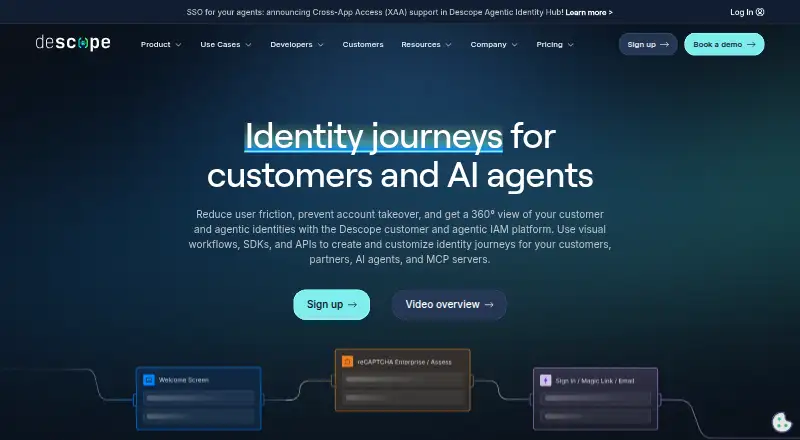
What Descope is
Descope is a customer and agentic identity platform for authentication, user management, authorization, and identity journeys. Developers can visually build login screens and authentication flows with Descope Flows, without writing code. Supported authentication methods include magic links, passkeys, social login, one-time passwords, SSO, biometrics, MFA, authenticator apps, and passwords. The platform provides client, mobile, and backend SDKs, plus REST APIs for custom implementations; Descope says all its SDKs are open source. It lists framework and language integrations including React, Next.js, Vue.js, JavaScript, Angular, Python, Node.js, Java, .NET, Go, PHP, Ruby, Kotlin, Swift, React Native, and Flutter. Native mobile SDKs support Swift iOS, Kotlin Android, Flutter, and React Native applications. Descope documents more than 50 third-party connectors for CRM, identity verification, fraud prevention, and audit uses. Its Free Forever plan costs nothing and includes 7,500 MAUs, 10 monthly active tenants, and three SSO connections. Pro costs $249 a month, billed annually; Growth costs $799 a month, billed annually.
Who it suits
Descope suits developers building authentication and identity journeys for B2C or B2B applications. Its visual flow builder, SDKs, and REST APIs serve teams implementing identity across customer and internal apps.
What it does well
- Visual flow builder creates authentication journeys without code.
- Supports multiple authentication methods, including passkeys and SSO.
- SDKs are open source.
- Free plan includes 7,500 MAUs.
What to know first
- Pro costs $249 a month, billed annually.
- Free plan includes only three SSO connections.
- Paid plans list usage-based overages.
Plans
| Plan | Billed and limits | Price |
|---|---|---|
| Free Forever | 7,500 MAUs · 10 monthly active tenants · 3 SSO connections · 1 federated app (OIDC) · 5 test users · 10,000 M2M exchanges · 2,000 MACs · 2,000 MATKs · no overages | Free |
| Pro | Billed annually · 10,000 MAUs · 35 monthly active tenants · 5 SSO connections · 2 federated apps (SAML/OIDC) · 100 test users · 50,000 M2M exchanges · 5,000 MACs · 5,000 MATKs · usage-based overages | $249 a month |
| Growth | Billed annually · 25,000 MAUs · 100 monthly active tenants · 10 SSO connections · unlimited federated apps (SAML/OIDC) · 500 test users · 100,000 M2M exchanges · 10,000 MACs · 10,000 MATKs · usage-based overages | $799 a month |
| Enterprise | Tiered discounts · premium support add-on · dedicated CS engineer · custom deployments · unlimited test users · unlimited anonymous users | On request |
As descope.com lists them, read 30 Sept 2026. The maker's own page has the final word.
Descope is a customer and agentic identity platform for teams building authentication, user management, authorization, and identity journeys into consumer or business applications. It is best suited to organizations that need varied sign-in methods, B2B tenant controls, and both visual configuration and developer integration. The main trade-off is a quota-based pricing model that becomes more consequential once usage grows.
Overview
Founded in 2022 and headquartered in Los Altos, California, Descope supports B2C and B2B applications, from a single customer app to centralized identity across customer and internal systems. Descope Flows provides a visual way to shape login screens and authentication journeys without coding the flow design itself, while SDKs and APIs connect those journeys to application code. That combination is more capable than a basic hosted login service, but teams with only simple authentication may not need its broader identity scope.
Key features
Visual flows and developer integration
Flows lets teams assemble authentication experiences visually. Client, mobile, and backend SDKs, REST APIs, and open-source SDK code preserve control for custom implementations rather than forcing a purely no-code approach.
Broad authentication coverage
Supported methods span passwords, one-time passwords, magic links, passkeys and WebAuthn, social login, SSO, biometrics, MFA, authenticator apps, security questions, recovery codes, and device authentication. This range suits products serving users with different security expectations, while adaptive access policies can apply context-sensitive controls.
Business identity administration
SAML 2.0, OAuth 2.0, and OIDC support enterprise federation. Directory synchronization and lifecycle provisioning help keep business identities aligned, and the platform supports monthly active tenants, federated applications, and machine-to-machine exchanges as well as end users. More than 50 connectors cover CRM, identity verification, fraud prevention, and audit use cases.
Security and deployment
Descope supports Android, iOS, web, APIs, and self-hosted deployments, with native SDKs for Swift, Kotlin, Flutter, and React Native. Integrations include React, Next.js, Vue, Angular, Python, Node.js, Java, .NET, Go, PHP, Ruby, and JavaScript. Communications use TLS and stored data uses full-disk encryption. Descope states certifications or authorizations including SOC 2 Type 2, ISO 27001, FedRAMP High, CSA STAR Level 2, and PCI DSS, alongside GDPR and HIPAA compliance.
Pricing
Free Forever — free: A useful starting point with 7,500 MAUs, 10 monthly active tenants, three SSO connections, one OIDC federated app, five test users, 10,000 M2M exchanges, 2,000 MACs, and 2,000 MATKs. There are no overages, and community support plus a 99% SLA are included. The low test-user and federation allowances make it better for prototyping or small deployments than broad enterprise rollouts.
Pro — $249 a month, billed annually: Raises capacity to 10,000 MAUs, 35 tenants, five SSO connections, two SAML/OIDC federated apps, 100 test users, 50,000 M2M exchanges, 5,000 MACs, and 5,000 MATKs. Web and email support and a 99.99% SLA improve operational coverage, but usage-based overages add cost risk as demand exceeds the quotas.
Growth — $799 a month, billed annually: Provides 25,000 MAUs, 100 tenants, 10 SSO connections, unlimited SAML/OIDC federated apps, 500 test users, 100,000 M2M exchanges, 10,000 MACs, and 10,000 MATKs. It keeps the 99.99% SLA and adds room for multi-tenant B2B deployments; overages remain usage-based.
Enterprise — custom pricing: Tiered discounts, a premium support add-on, a dedicated customer-success engineer, custom deployments, unlimited test users, and unlimited anonymous users target organizations with bespoke rollout or support requirements.
Platforms
Descope runs across Android, iOS, web, API, and self-hosted environments. Native mobile support covers Swift iOS, Kotlin Android, Flutter, and React Native, while server and client SDKs cover a wide range of mainstream frameworks.
Who it's for
Descope fits product and platform teams that need passwordless and traditional authentication together, enterprise SSO, tenant-aware identity, or centralized customer and workforce journeys. It is particularly suitable when visual flow design must coexist with SDK- and API-level customization. A small application with one uncomplicated sign-in path may find the quotas, integrations, and administrative breadth unnecessary.
Pros and cons
- Pros: Visual flow building reduces custom login-flow work; authentication methods cover password, passwordless, social, biometric, MFA, and SSO scenarios; open-source SDKs and broad framework coverage support integration choice; directory sync, provisioning, adaptive access, and federation address B2B requirements; self-hosted and mobile options broaden deployment.
- Cons: The free tier limits tenants, SSO connections, federated apps, and test users; Pro and Growth add usage-based overages; paid plans require annual billing; the platform's breadth can exceed the needs of a basic consumer login.
Alternatives
Choose Bitwarden instead when the priority is password management across unlimited devices and passwords, with a free tier and self-hosted support. Choose id3 Face SDK when a focused biometric identity component and a 30-day evaluation are more relevant than a full identity platform. StrongKey FIDO Server is the better fit for an open-source FIDO deployment with unlimited users, applications, and transactions in its Community Edition. Choose Ory when its API-first network and self-hosted options match your deployment model. Clerk suits teams wanting a free 50,000-MRU hobby tier and dashboard-seat limits. Hanko is a simpler passwordless-oriented option with a free 10,000-user starter tier. HUAWEI Analytics Kit is for event analytics rather than identity journeys. Choose Passwordless.dev when a focused passwordless service with up to 10,000 users is sufficient. For category comparisons, see Biometric Authentication Software, Identity and Access Management Software, Passwordless Authentication Software, Customer Identity and Access Management Software, Single Sign-On Software, and Passkey Authentication Software.
Verdict
Descope is a strong choice for teams that need configurable authentication journeys, many authentication methods, and serious B2B identity controls in one platform. Choose it for the visual-builder-plus-SDK model and broad federation and provisioning support; look elsewhere if your application needs only a simple login or cannot accommodate annual commitments and usage-based overages.
Verdict
Descope combines visual authentication-flow design with SDKs, APIs, and a broad range of authentication methods. Its free plan has defined user and connection limits, and the listed paid plans are billed annually.
Facts from Descope's own pages
- Authentication
- Supported authentication methods include magic links, passkeys, social login, one-time passwords, SSO, biometrics, MFA, authenticator apps and passwords. · descope.com, 30 Sept 2026
- Encryption
- Descope states that communications use TLS encryption and data at rest uses full-disk encryption. · descope.com, 30 Sept 2026
- Founded
- 2022 · descope.com, 23 Sept 2026
- Frameworks
- Listed integrations include React, Next.js, Vue.js, JavaScript, Angular, Python, Node.js, Java, .NET, Go, PHP, Ruby, Kotlin, Swift, React Native and Flutter. · descope.com, 30 Sept 2026
- Headquarters
- Los Altos, California, United States · descope.com, 23 Sept 2026
- Integrations
- Descope documents more than 50 third-party connectors for CRM, identity verification, fraud prevention and audit use cases. · docs.descope.com, 30 Sept 2026
- Mobile SDKs
- Native SDKs are supported for Swift iOS, Kotlin Android, Flutter and React Native applications. · docs.descope.com, 30 Sept 2026
- Open source
- Descope states that all of its SDKs are open source. · descope.com, 30 Sept 2026
- Product
- Descope is a customer and agentic identity platform for authentication, user management, authorization and identity journeys. · descope.com, 30 Sept 2026
- SDKs and APIs
- Descope provides client SDKs, mobile SDKs, backend SDKs and REST APIs for custom authentication implementations. · docs.descope.com, 30 Sept 2026
- Security certifications
- Descope states that it is SOC 2 Type 2, ISO 27001, FedRAMP High, CSA STAR Level 2 and PCI DSS certified or authorized, and GDPR and HIPAA compliant. · descope.com, 30 Sept 2026
- Support
- The Free Forever plan includes community support and a 99% SLA; Pro includes web and email support and a 99.99% SLA; Growth includes a 99.99% SLA. · descope.com, 30 Sept 2026
- Target applications
- Descope is available for both B2C and B2B applications, including consumer apps, business apps and centralized identity across customer and internal apps. · descope.com, 30 Sept 2026
- Workflow builder
- Descope Flows lets developers design login screens and authentication flows visually without writing code. · docs.descope.com, 30 Sept 2026
Where Descope stands on Freedom251
- Biometric Authentication Software#5 of 45
- Multi-Factor Authentication APIs#3 of 25
- Passkey Authentication Software#8 of 55
- Identity and Access Management Software#7 of 45
- Single Sign-On Software#6 of 34
- Authentication Software#6 of 31
- Customer Identity and Access Management Software#6 of 29
- Passwordless Authentication Software#6 of 27
- OAuth Server Software#10 of 32