Freedom251 › ROM Management Software
Gaseous
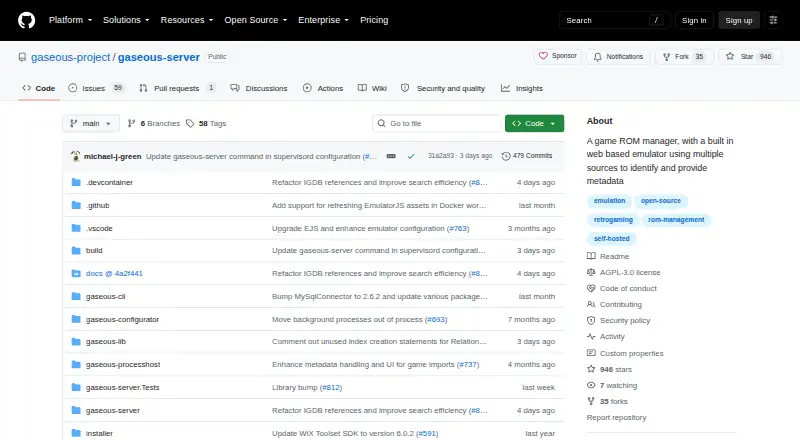
What Gaseous is
Gaseous is a free, open-source server for organizing ROMs and game titles, with basic in-browser emulation. It draws on multiple sources to identify games and supply metadata. ROM management covers platforms listed by IGDB, while built-in emulation is limited to a documented subset that includes Game Boy, Nintendo 64, PlayStation, Sega Saturn, and Super Nintendo. Deployment options include Docker, source installation, Unraid, and a Windows MSI; Windows installation is described as experimental. The documented setup requires MariaDB 11.1.2 or MySQL Server 8+ and FFmpeg. An IGDB API key is optional on the wiki home page. From version 2.0, sign-in supports passwords, two-factor authentication, and OAuth2/OIDC, including Google, Microsoft, and custom OIDC providers. The project uses the AGPL-3.0 license and provides community support through Discord. Its free plan is a self-hosted server, so users provide the database and FFmpeg. Maintainers advise against internet exposure when remote access is not needed and say exposure is at the user's own risk.
Who it suits
It suits people who want to manage a ROM library on a self-hosted server and use its supported in-browser emulators. Users should be prepared to provide the documented database and FFmpeg requirements.
What it does well
- Manages ROMs across platforms listed by IGDB.
- Built-in emulation covers a documented system subset.
- Offers Docker, source, and Unraid installation options.
- Supports two-factor authentication and OAuth2/OIDC.
- Free and open source under AGPL-3.0.
What to know first
- Requires MariaDB 11.1.2 or MySQL Server 8+ and FFmpeg.
- Windows installation is described as experimental.
- Self-hosted setup requires a database and FFmpeg.
- Internet exposure carries risk, according to maintainers.
Limits
The free plan is a self-hosted server and requires a database and FFmpeg. Windows installation is described as experimental, and built-in emulation covers a documented subset of systems.
Plans
| Plan | Billed and limits | Price |
|---|---|---|
| Gaseous Server | Self-hosted server; requires a database and ffmpeg; IGDB API key is optional when using the Hasheous proxy | Free |
As github.com lists them, read 4 Oct 2026. The maker's own page has the final word.
Getting started
- Choose Docker, source, Unraid, or the Windows MSI installation route.
- Provide MariaDB 11.1.2 or MySQL Server 8+ and FFmpeg.
- Add an IGDB API key if needed; it is optional on the wiki home page and when using the Hasheous proxy.
- Configure password sign-in, or use two-factor authentication and OAuth2/OIDC options available from version 2.0.
- Use Discord for community support if needed.
Overview
Gaseous is a self-hosted ROM and game-title manager with basic in-browser emulation. It is most compelling for people who want a single server to organize a broad game collection and play a narrower set of systems; the database and media requirements make it a poor fit for anyone seeking a plug-and-play desktop app.
Key features
Gaseous uses multiple sources to identify games and supply metadata. ROM management spans platforms listed by IGDB, but the built-in emulator supports only a documented subset, including Game Boy, Nintendo 64, PlayStation, Sega Saturn, and Super Nintendo. That makes its cataloguing reach more useful than its playback range: check system support before relying on it as an emulator.
Deployment choices include Docker, source installation, Unraid, and a Windows MSI. Running the server requires MariaDB 11.1.2 or MySQL Server 8+, plus FFmpeg. An IGDB API key is optional; it can also be optional when using the Hasheous proxy. These prerequisites are manageable for a server administrator, but they add meaningful setup and maintenance work compared with a standalone library manager.
From version 2.0, Gaseous supports password authentication, two-factor authentication, and OAuth2/OIDC sign-in. Documented OIDC options include Google, Microsoft, and custom providers. The maintainers advise against exposing the server to the internet when remote access is unnecessary and say exposure is at the user's own risk. That warning deserves weight: users should consider their access needs and security responsibilities before making the service reachable remotely.
Pricing
Gaseous Server costs nothing. The self-hosted plan includes the server, but requires a database and FFmpeg; an IGDB API key is optional when using the Hasheous proxy. The project is open source under the AGPL-3.0 license, with no paid tier described. The zero purchase price does not remove the work of providing and maintaining the server dependencies.
Platforms
Gaseous is a web-based, self-hosted server with Linux and Windows platform support. Windows installation is described as experimental, so users who want the more established deployment paths should consider Docker, source, or Unraid instead.
Who it's for
Choose Gaseous if you want ROM management and basic browser emulation together, have a compatible server environment, and are comfortable managing authentication and network exposure. It is less suitable if you want broad built-in emulation, minimal setup, or remote access without taking responsibility for securing an exposed service.
Pros and cons
- Pros: ROM management covers IGDB-listed platforms and uses multiple identification sources, giving large libraries broad cataloguing reach.
- Pros: Built-in emulation and several deployment routes let users combine basic play and collection management on a self-hosted server.
- Pros: Two-factor authentication and OAuth2/OIDC add sign-in options beyond passwords.
- Cons: The emulator supports a narrower, documented set of systems than the ROM manager can catalogue.
- Cons: A database and FFmpeg are required, so the free software still carries hosting and administration overhead.
- Cons: Windows installation is experimental, and internet exposure carries an explicit user-risk warning from the maintainers.
Alternatives
For other options, browse ROM Management Software or Game Library Managers.
- Igir is a free option for Linux, macOS, Windows, and self-hosting; choose it if those platform options suit your workflow better.
- OxyROMon is free across Linux, macOS, Windows, web, and self-hosted setups, with no paid tiers or usage limits stated.
- RomM is a free, AGPL-3.0 option with web and mobile platform support and no paid features.
- verifydump is a free command-line tool for Linux, macOS, and Windows that verifies .chd and .rvz images against Redump Datfiles; choose it for image verification rather than a server library.
- ClrMamePro is a free option for Linux and Windows.
- RomForge is free, MIT-licensed desktop software for Linux, macOS, and Windows.
- ROMie is free to download and use on Linux, macOS, and Windows, with no paid plans stated.
- ROMSorter is free and MIT-licensed for Linux, macOS, and Windows, though its current release is Win-x64 only.
Verdict
Gaseous is a good choice for technically comfortable users who want a self-hosted ROM catalog with basic browser emulation in the same system. Its broad metadata and deployment options are the main draw; the narrower emulator range, server dependencies, and caution around internet exposure are the reasons to look elsewhere.
Verdict
Gaseous combines ROM management with basic emulation and several deployment options. It is best suited to users able to manage the server requirements and heed the maintainers' internet-exposure guidance.
Questions
How much does Gaseous cost?
The Gaseous Server plan is free.
Is Gaseous open source?
Yes. The project identifies itself as open source and provides an AGPL-3.0 license.
What does Gaseous support?
ROM management supports platforms listed by IGDB. Built-in emulation supports a documented subset, including Game Boy, Nintendo 64, PlayStation, Sega Saturn, and Super Nintendo.
What does installation require?
The documented requirements include MariaDB 11.1.2 or MySQL Server 8+ and FFmpeg. An IGDB API key is optional on the wiki home page and when using the Hasheous proxy.
Which installation options are available?
The project documents Docker, source, Unraid, and Windows MSI installation options. Windows installation is described as experimental.
Which sign-in options does it offer?
From version 2.0, Gaseous supports password authentication, two-factor authentication, and OAuth2/OIDC sign-in. Documented OIDC providers include Google, Microsoft, and custom providers.
Facts from Gaseous's own pages
- Authentication
- From version 2.0, the server supports two-factor authentication and OAuth2/OIDC sign-in in addition to password authentication. · github.com, 4 Oct 2026
- Deployment
- The project documents Docker, source, Unraid, and Windows MSI installation options. · github.com, 4 Oct 2026
- Emulation
- The built-in emulator supports systems including Game Boy, Nintendo 64, PlayStation, Sega Saturn, and Super Nintendo. · github.com, 4 Oct 2026
- Experimental platform
- The installation guide describes Windows installation as experimental. · github.com, 4 Oct 2026
- Identity integrations
- Documented OIDC providers include Google, Microsoft, and custom OIDC providers. · github.com, 4 Oct 2026
- Metadata
- It uses multiple sources to identify games and provide metadata. · github.com, 4 Oct 2026
- Open source
- The repository identifies the project as open source and provides an AGPL-3.0 license. · github.com, 4 Oct 2026
- Purpose
- Gaseous Server manages ROMs and titles and provides basic in-browser emulation. · github.com, 4 Oct 2026
- Requirements
- The documented requirements include MariaDB 11.1.2 or MySQL Server 8+ and FFmpeg; an IGDB API key is optional on the wiki home page. · github.com, 4 Oct 2026
- Security guidance
- The maintainers recommend avoiding internet exposure when remote access is not needed and state that exposure is at the user's own risk. · github.com, 4 Oct 2026
- Support
- The project links users to its Discord server for community support. · github.com, 4 Oct 2026
- Supported ROMs
- ROM management supports platforms listed by IGDB, while built-in emulation supports a documented subset of systems. · github.com, 4 Oct 2026
Where Gaseous stands on Freedom251
- ROM Management Software#4 of 39
- Game Library Managers#8 of 40
- Game launchers#16 of 68