Freedom251 › Physics Simulation Software
FeenoX
What FeenoX is
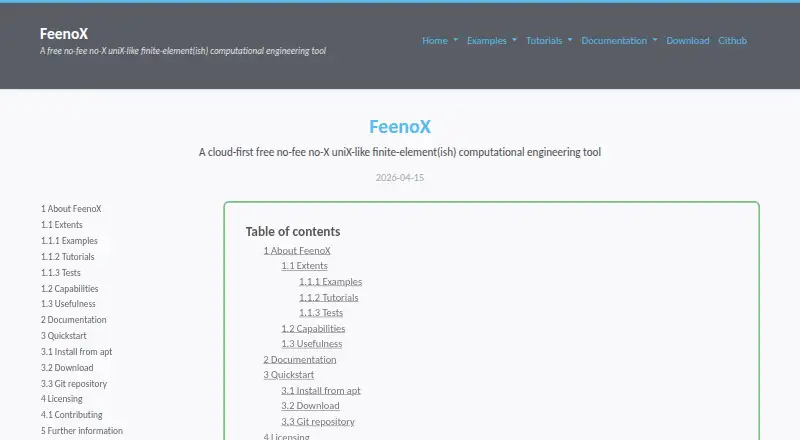
FeenoX is free, open-source computational engineering software for solving mathematical and engineering problems on one or more computers. It supports dynamical systems expressed as ODEs or DAEs, along with finite-element PDEs including heat conduction, thermo-mechanical problems, modal analysis, neutron diffusion, and neutron transport. Users describe problems in English-like plain-text input files, so a problem can be changed without recompiling. FeenoX reads Gmsh meshes and can write results in Gmsh MSH or ParaView VTK/VTU formats. Its computational libraries include GNU GSL, SUNDIALS, PETSc, and SLEPc, and it supports MPI parallelization for work across multiple computers. Installation options include Debian or Ubuntu packages, source tarballs, the GitHub repository, and generic statically linked GNU/Linux binaries. Ubuntu support begins at version 25.04. The generic binaries do not include MUMPS or MPI and use basic optimization flags. FeenoX has no graphical interface and targets GNU/Linux; browser interfaces such as SunCAE and CAEplex provide ways to access it through the web. The project directs users to GitHub Discussions for help and Issues for bug reports.
Who it suits
FeenoX suits advanced users such as engineers, Unix hackers, and academic professors who work with computational engineering on GNU/Linux. It may fit users who want plain-text problem definitions and parallel computation rather than a graphical interface.
What it does well
- Free and open source under GNU GPL version 3 or later.
- Handles ODEs, DAEs, and finite-element PDEs.
- Supports MPI parallelization.
- Reads Gmsh meshes and exports Gmsh or ParaView results.
- Plain-text inputs can be changed without recompiling.
What to know first
- Has no graphical interface.
- Targets GNU/Linux and is not expected to run in Windows.
- Generic binaries omit MUMPS and MPI.
- Generic binaries use only basic optimization flags.
Limits
The free FeenoX plan has no graphical interface and targets GNU/Linux. Generic statically linked binaries do not support MUMPS or MPI and use only basic optimization flags.
Plans
| Plan | Billed and limits | Price |
|---|---|---|
| FeenoX | GNU GPLv3+ open-source software · no graphical interface · targets GNU/Linux · generic binaries omit MUMPS and MPI | Free |
| Free | — | Free |
As seamplex.com lists them, read 28 Sept 2026. The maker's own page has the final word.
Getting started
- Visit the FeenoX website.
- Choose a Debian or Ubuntu package, a static GNU/Linux binary, a source tarball or the GitHub repository.
- For Ubuntu packages, use Ubuntu 25.04 or later.
- Define a problem in a plain-text input file and provide any mesh in Gmsh .msh format.
- Use a web interface such as SunCAE or CAEplex for browser-based access.
FeenoX is a scriptable computational-engineering solver for advanced users who define analyses in text and work in Unix-style environments. It is strongest for engineers, academics, and automation-heavy teams that need open, repeatable calculations rather than a visual modeling desktop.
Overview
FeenoX addresses mathematical problems, ordinary and differential-algebraic equations, and finite-element partial differential equations. Its application range includes heat conduction, thermo-mechanical analysis, modal analysis, neutron diffusion, and neutron transport. Problems live in self-descriptive, English-like plain-text input files, so changing an analysis does not require recompiling. That favors version-controlled, reproducible workflows, while requiring users to understand and maintain the input syntax themselves.
The software is free in both price and freedom, released under the GNU General Public License version 3 or later. Source code and dependencies are open, and unit, regression, mathematical, and code-verification tests are provided. The license permits modification and redistribution under its terms, with no warranty to the extent permitted by law.
Key features
Meshes, solvers, and output
Input meshes use Gmsh's .msh format. Results can be written as Gmsh MSH files or ParaView VTK and VTU files, giving established routes into mesh and visualization pipelines. GNU GSL, SUNDIALS, PETSc, and SLEPc supply the computational foundations. This is a practical fit for teams already using those ecosystems; it is less accommodating to workflows built around proprietary formats or visual model setup.
Parallel and connected workflows
MPI parallelization allows a problem to run across multiple computers, and the design targets arbitrarily scalable remote servers. FeenoX can sit behind web interfaces, REST APIs, standard post-processing tools, Markdown, LaTeX reporting, or large-language-model integrations. SunCAE provides web access, while CAEplex offers a browser-based cloud interface. Those options make the solver useful as a backend, although the core product remains command-line and text driven.
Open development
Users can seek help in GitHub Discussions and report bugs through GitHub Issues. Contributions from hackers and academics are welcomed, particularly new PDEs and formulations. That model suits organizations able to read source and participate upstream more than teams expecting a commercial support desk.
Pricing
The FeenoX plan costs free. It is GNU GPLv3+ open-source software with no graphical interface, targets GNU/Linux, and generic binaries omit MUMPS and MPI. The separate Free plan is also free; no paid pricing is stated. There are no seat charges, quotas, or renewal terms published. Choose it when license freedom and source access matter; the trade-off is that installation, workflow construction, and any needed support remain your responsibility.
Platforms
FeenoX is delivered as a desktop-oriented tool with API, Linux, self-hosted, and web availability. Official installation routes include Debian or Ubuntu packages, statically linked GNU/Linux binaries, source tarballs, and the GitHub repository. Ubuntu support starts at version 25.04. Generic static binaries run as standalone GNU/Linux executables, but they do not support MUMPS or MPI and use only basic optimization flags, so users needing those capabilities should use a suitable package or build from source.
There is no graphical interface, and the project is not expected to run in Windows; official documentation targets GNU/Linux. Offline access and data export are supported, while 3D visuals are available through the output and visualization workflow rather than a built-in GUI.
Who it's for
FeenoX is aimed at industry engineers, Unix hackers, academic professors, and other advanced users. It fits repeatable simulation pipelines, remote or parallel computation, and organizations that want to inspect, modify, and redistribute their solver. It is a poor match for beginners seeking point-and-click finite-element setup, Windows-first teams, or anyone who needs integrated assessment tools or a lesson library.
Pros and cons
- Pros: broad coverage from ODE/DAE systems to thermal, mechanical, modal, and neutron analyses; plain-text inputs make revisions and automation reproducible; MPI supports multi-computer execution; open licensing, source, dependencies, and verification tests support audit and customization; Gmsh and ParaView formats connect to established toolchains.
- Cons: no graphical interface places the burden of modeling on text files; Windows is outside the expected platform; generic binaries lose MUMPS and MPI support and use basic optimization; no warranty and community-based support may not satisfy teams requiring contracted assistance.
Alternatives
For broader operating-system coverage and a free GPL-based CFD platform with separate support and customization services, consider OpenFOAM. OpenSim is a free, open-source option spanning Linux, macOS, and Windows, though downloading requires a SimTK account. For command-line or file-based circuit simulation without schematic entry, choose ngspice. Xcos is a free option distributed with Scilab across Linux, macOS, and Windows.
SimFlow offers a freemium, trial-enabled path with Linux, macOS, Windows, and web availability. GNU FisicaLab is free GPL software for Linux and Windows, while Step is a free GPL-2.0+ choice for Linux. ASCEND is another free, open-source physics-simulation alternative across Linux, macOS, and Windows. Browse Physics Simulation Software for the wider category.
Verdict
Choose FeenoX if you are an advanced engineer or researcher who values open source, text-defined models, automation, and scalable GNU/Linux computation. Its strongest reason to choose it is the combination of broad engineering problem coverage and an API-friendly, reproducible workflow at no cost. Look elsewhere if you need a graphical interface, Windows support, or generic binaries with full MUMPS and MPI capabilities.
Verdict
FeenoX offers broad computational engineering capabilities through plain-text inputs and GNU/Linux installation options. Its command-line approach and binary limitations make platform and workflow fit important considerations.
Questions
Is FeenoX free?
Yes. FeenoX is free of charge and open source under the GNU General Public License version 3 or any later version.
What does FeenoX cost?
The listed FeenoX plan is free. No paid pricing is stated.
Which systems does FeenoX support?
The project targets GNU/Linux and is not expected to run in Windows. Ubuntu packages are available from version 25.04 onward.
Can FeenoX run in a browser?
Users can access FeenoX through web-based interfaces such as SunCAE and CAEplex.
How can users get help?
The project directs users to GitHub Discussions for help and GitHub Issues for bug reports.
Facts from FeenoX's own pages
- API integration
- The design supports straightforward integration with web interfaces, large language models, REST APIs, standard post-processing tools, Markdown and LaTeX reporting. · seamplex.com, 28 Sept 2026
- Assessment tools
- No · seamplex.com, 24 Sept 2026
- Audience
- Official pages present FeenoX for industry engineers, Unix hackers and academic professors, with advanced users as the target audience. · seamplex.com, 28 Sept 2026
- Authoring tools
- Yes · seamplex.com, 24 Sept 2026
- Binary limitation
- The generic statically linked GNU/Linux binaries do not support MUMPS or MPI and use only basic optimization flags. · seamplex.com, 28 Sept 2026
- Binary limitations
- Generic binaries do not support MUMPS or MPI and use only basic optimization flags. · seamplex.com, 28 Sept 2026
- Contributions welcome
- Contributions from hackers and academics are welcome, especially new PDEs and formulations. · seamplex.com, 28 Sept 2026
- Data export
- Yes · seamplex.com, 24 Sept 2026
- Delivery mode
- desktop · seamplex.com, 24 Sept 2026
- Free open source
- FeenoX is free in both the no-cost and freedom senses, and open source. · seamplex.com, 28 Sept 2026
- Free plan
- Yes · seamplex.com, 24 Sept 2026
- GitHub support
- Users can ask for help on the GitHub discussions page. · seamplex.com, 28 Sept 2026
- GUI limitation
- FeenoX has no graphical interface and is not expected to run in Windows; the official documentation targets GNU/Linux. · seamplex.com, 28 Sept 2026
- Plain-text inputs
- Problems use syntactically sugared, self-descriptive English-like plain-text input files. · seamplex.com, 28 Sept 2026
- Input model
- Problems are defined in self-descriptive English-like plain-text input files, so changing a problem does not require recompiling. · seamplex.com, 28 Sept 2026
- Installation
- Official installation options include Debian or Ubuntu packages, statically linked GNU/Linux binaries, source tarballs and the GitHub repository. · seamplex.com, 28 Sept 2026
- Integrations
- It reads Gmsh meshes, uses PETSc and SLEPc solvers, and writes Gmsh MSH or ParaView VTK/VTU results. · seamplex.com, 28 Sept 2026
- Lesson library
- No · seamplex.com, 24 Sept 2026
- License
- FeenoX is distributed under the GNU General Public License version 3 or any later version, with freedom to use, modify and redistribute it under the license terms. · seamplex.com, 28 Sept 2026
- GNU/Linux binaries
- Generic GNU/Linux binaries are provided as statically linked executables. · seamplex.com, 28 Sept 2026
- Gmsh mesh format
- Input meshes use Gmsh's .msh format. · seamplex.com, 28 Sept 2026
- MPI parallelization
- FeenoX supports MPI parallelization. · seamplex.com, 28 Sept 2026
- Offline access
- Yes · seamplex.com, 24 Sept 2026
- Parallelism
- FeenoX supports MPI parallelization and is designed for arbitrarily scalable remote servers. · seamplex.com, 28 Sept 2026
Where FeenoX stands on Freedom251
- Physics Simulation Software#5 of 89