Freedom251 › Feature Flag Software

feat
What feat is
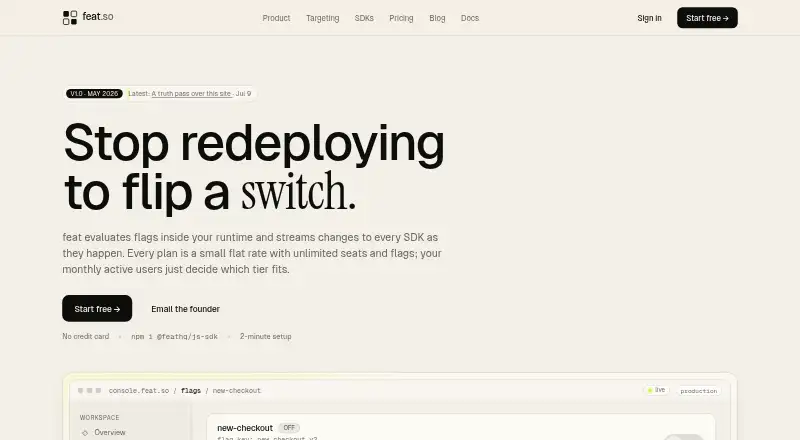
feat is a hosted feature-flag platform for early engineering teams. Server SDKs evaluate flags locally without a network request for each read, and changes stream to connected SDKs in under a second. Targeting rules can combine AND and OR conditions across users, devices, organizations, sessions, and requests. Sticky percentage rollouts keep a user, device, or organization on the same variation across requests and sessions. First-party SDKs are available for Node.js, Bun, Deno, Go, Python, Ruby, browser JavaScript, and Flutter/Dart; providers are also supplied for OpenFeature web, Node.js, and Dart SDKs. Metric sources include Segment, Mixpanel, PostHog, and custom sources. The Free plan includes 7,500 MAU, 100 server connections, two projects, unlimited environments, and unlimited flags. Starter is listed at $19 a month, billed $15/mo billed annually. Built-in experiments and Slack integration are listed as coming in Q3 2026, rather than as current features. Backend SDKs send no evaluation context to feat; browser SDKs report only hashed identifier-and-kind pairs for MAU counting. The company is based in India.
Who it suits
feat suits early engineering teams that need feature flags, targeting rules, and percentage rollouts across connected SDKs. Teams choosing a plan should compare its listed MAU and connection allowances.
What it does well
- Server SDKs evaluate flags locally
- Changes stream in under a second
- Targeting rules combine AND and OR conditions
- Sticky rollouts retain variations across sessions
- Free tier includes unlimited environments and flags
What to know first
- Free plan has 7,500 MAU
- Free plan includes 100 server connections
- Experiments and Slack integration are not current features
Limits
The Free plan allows 7,500 MAU, 100 server connections, two projects, and 30 days of audit-log retention. Starter lists 25,000 MAU, 250 server connections, and 90-day audit history; its listed monthly price is $19.00 USD, or $15/mo billed annually.
Plans
| Plan | Billed and limits | Price |
|---|---|---|
| Free | free forever · 7,500 MAU · 100 server connections · 2 projects · unlimited environments · unlimited flags · 30-day audit log · community support | Free |
| Scale | $119/mo billed annually · 500,000 MAU · 2,500 server connections · gradual rollouts coming Q3 2026 · SAML coming Q3 2026 · IP allowlisting coming Q3 2026 · Terraform provider coming Q3 2026 · SOC 2 Type II coming Q3 2026 · 3-year audit log · email support 8h | $149 a month |
| Starter | $15/mo billed annually · 25,000 MAU · 250 server connections · segments · required change comments · webhooks coming Q3 2026 · CLI coming Q3 2026 · 90-day audit log · email support 48h | $19 a month |
| Elastic | $239/mo base billed annually · 1M MAU included · $0.20 per 1,000 MAU above 1M · uncapped server connections · no grace period · same SLA and support as Scale | $299 a month |
| Growth | $39/mo billed annually · 100,000 MAU · 750 server connections · approvals · custom roles · A/B testing coming Q3 2026 · SSO enforcement coming Q3 2026 · Slack integration coming Q3 2026 · 1-year audit log · 99.9% SLA · email support 24h | $49 a month |
| Enterprise | custom contracts · SCIM · private tenancy · data residency · dedicated CSM | On request |
As feat.so lists them, read 15 Oct 2026. The maker's own page has the final word.
Getting started
- Open feat's website.
- Choose the Free plan or a paid plan.
- Connect an available first-party SDK or OpenFeature provider.
- Set flag targeting rules and percentage rollouts for your project.
feat is a hosted feature-flag service for early engineering teams that need fast server-side decisions and controlled releases. It suits developers who value broad SDK coverage, flexible rule logic, and assignments that remain stable across sessions. It is less compelling for organizations that require a fully developed experimentation suite or established compliance certifications today.
Overview
Backend SDKs evaluate flags locally, so applications do not make a network request for every read. Configuration changes stream to connected SDKs in under a second, combining low-latency checks with quick rollout updates. That architecture is practical for services that read flags frequently, although teams must still manage their own rollout logic and operational discipline.
Key features
Targeting and rollouts
Targeting rules combine conditions across users, devices, organizations, sessions, and requests with AND and OR operators. This supports precise, multi-context releases rather than only simple user attributes, but it places responsibility for designing and maintaining potentially complex rules on the engineering team.
Sticky percentage rollouts keep a user, device, or organization on the same variation across requests and sessions. Stable assignment helps staged launches remain diagnostically clear and avoids exposing one person to changing variants between visits.
SDKs and OpenFeature
First-party SDKs cover Node.js, Bun, Deno, Go, Python, Ruby, browser JavaScript, and Flutter/Dart. OpenFeature providers extend feat to the OpenFeature web, Node.js, and Dart SDKs, making it a reasonable fit for teams standardizing flag access across different runtimes. The separately stated SDK language list also includes JavaScript, Go, Python, Ruby, and Cloudflare Workers.
Integrations, privacy, and controls
Metric sources can be connected through Segment, Mixpanel, PostHog, or custom sources. A built-in statistical engine, variant tracking, metric integrations, and automatic advancement of gradual rollouts are planned for Q3 2026, so current users should not treat those as present experimentation capabilities. Slack integration is also planned for that quarter.
Backend SDKs send no evaluation context to feat. Browser SDKs report only hashed identifier-and-kind pairs for monthly active-user counting, reducing the data sent during client-side use. Customer-facing endpoints use TLS 1.2 or newer and HSTS, with managed-service encryption at rest for Postgres, R2, and KV. SOC 2 Type I scaffolding is in progress, Type II is planned after its observation window, and ISO 27001 remains on the roadmap; compliance-led buyers may therefore need a more mature provider.
Pricing
feat has a useful free entry point, with paid tiers scaling primarily by monthly active users (MAU), server connections, retention, and support.
| Plan | Price and limits |
|---|---|
| Free | free; 7,500 MAU, 100 server connections, 2 projects, unlimited environments and flags, 30-day audit history, and community support. |
| Starter | $19 a month, billed $15/mo billed annually; 25,000 MAU, 250 server connections, 90-day audit log, and email support with a 48-hour response target. |
| Growth | $49 a month, billed $39/mo billed annually; 100,000 MAU, 750 server connections, one-year audit log, 99.9% SLA, and 24-hour email support. |
| Scale | $149 a month, billed $119/mo billed annually; 500,000 MAU, 2,500 server connections, three-year audit log, and eight-hour email support. |
| Elastic | $299 a month, billed $239/mo base billed annually; 1 million MAU included, then $0.20 per 1,000 MAU above that, with uncapped server connections. |
| Enterprise | Custom pricing with SCIM, private tenancy, data residency, and a dedicated customer success manager. |
Free is suitable for small products and prototypes, especially with unlimited environments and flags, but its 7,500-MAU and 100-connection ceilings and short audit retention limit larger operations. Starter adds capacity and email support; Growth is the more credible production tier when a 99.9% SLA and longer audit history matter. Scale and Elastic target high-traffic services, while Enterprise is for organizations needing identity, tenancy, or residency controls.
Platforms
feat supports Android, iOS, web, and API use. Its SDK ecosystem spans server, browser, edge, and Flutter/Dart applications, with Cloudflare Workers included in the stated language coverage.
Who it's for
Choose feat for an early-stage engineering organization that wants local server evaluation, rapid configuration propagation, multi-context targeting, and sticky releases without building those systems itself. It is a weaker choice for teams whose primary requirement is current, built-in experimentation analytics or completed formal certifications.
Pros and cons
Pros
- Local server evaluation avoids a network call on each flag read.
- Sub-second streaming updates keep connected SDKs current.
- Rules cover users, devices, organizations, sessions, and requests with AND/OR logic.
- Sticky rollouts preserve consistent assignments across requests and sessions.
- Free tier includes unlimited environments and flags.
Cons
- Experimentation and Slack capabilities are planned rather than current.
- SOC 2 and ISO 27001 work is not yet complete.
- Free limits of 7,500 MAU and 100 server connections can constrain growing services.
- Complex targeting is powerful but demands ongoing engineering ownership.
Alternatives
See the Feature Flag Software list for a broader comparison.
Flagsmith is a better fit when open-source functionality, self-hosting, or a wider platform matrix matters. Choose Featurevisor for a free, MIT-licensed self-hosted option with no per-seat pricing, or GO Feature Flag for open-source deployment on your own infrastructure with unlimited flags.
Unleash suits teams wanting an open-source plan and self-hosting choices. ConfigCat is worth considering for a forever-free plan centered on flags, environments, and configuration-download quotas. Featureflip offers a small free Solo tier, while Featureflow provides a free hosted plan with seats, projects, environments, and SDK-request limits. Flipt is an alternative for Git-native, self-hosted workflows.
Verdict
feat is a strong choice for early teams that want privacy-conscious local evaluation, flexible targeting, and dependable sticky rollouts across many SDKs. Look elsewhere if mature experimentation analytics or completed enterprise compliance certifications are immediate requirements.
Verdict
feat provides local server-side evaluation, targeting, and sticky rollouts with SDKs across several languages. Review plan limits and distinguish listed upcoming functions from current capabilities.
Questions
Is feat free?
Yes. The Free plan costs nothing and includes 7,500 MAU, 100 server connections, two projects, unlimited environments, and unlimited flags.
How much do paid plans cost?
Starter is $19 a month, with annual billing listed at $15/mo. Growth is $49 a month, Scale is $149 a month, and Elastic is $299 a month; annual billing is also listed for each.
Which platforms and SDKs does feat support?
The listed platforms are Android, API, iOS, and web. First-party SDKs are available for Node.js, Bun, Deno, Go, Python, Ruby, browser JavaScript, and Flutter/Dart.
Does feat work with OpenFeature?
Yes. feat ships providers for the OpenFeature web, Node.js, and Dart SDKs.
Which metric integrations are available?
Pluggable metric sources include Segment, Mixpanel, PostHog, and custom sources. Slack integration is listed as coming in Q3 2026.
Who makes feat?
feat labs, inc. is based in India and was founded by Vishnu Mohanan.
Facts from feat's own pages
- Approvals
- Production changes can require per-environment approvals, configurable approver counts, comments, and expiration. · feat.so, 15 Oct 2026
- Audit history
- Audit-log retention is 30 days on Free, 90 days on Starter, 1 year on Growth, and 3 years on Scale. · feat.so, 1 Oct 2026
- Audit log
- Every plan includes an audit history recording who changed what and why. · feat.so, 15 Oct 2026
- Client evaluation
- Browser and mobile SDKs evaluate remotely and receive resolved values rather than the full rules datafile. · docs.feat.so, 15 Oct 2026
- Company
- feat labs, inc. is based in India and was founded by Vishnu Mohanan. · feat.so, 1 Oct 2026
- Company legal name
- The legal entity is feat labs, inc., incorporated in Delaware, United States. · feat.so, 15 Oct 2026
- Company location
- The about page describes feat labs, inc. as based in India. · feat.so, 15 Oct 2026
- Compliance
- SOC 2 Type I scaffolding is in progress, with Type II planned after the standard observation window; ISO 27001 is on the roadmap. · feat.so, 1 Oct 2026
- Compliance limitation
- SOC 2 Type I preparation is in progress, SOC 2 Type II is planned, and ISO 27001 is on the roadmap. · feat.so, 15 Oct 2026
- Documentation
- The documentation includes quickstart, concepts, SDK guides, OpenFeature, API-key, evaluation, rollout, and operator references. · docs.feat.so, 15 Oct 2026
- Evaluation
- Server SDKs evaluate locally in process, so flag reads do not make a network request. · docs.feat.so, 15 Oct 2026
- Experiments
- A built-in statistical engine, variant tracking, metric integrations, and auto-advance gradual rollouts are listed as coming in Q3 2026. · feat.so, 1 Oct 2026
- Experiments limitation
- A built-in statistical engine, variant tracking, metric integrations, and automatic rollout advancement are listed as future Q3 2026 work. · feat.so, 15 Oct 2026
- Feature flags
- Flags support boolean, string, number, and JSON values. · feat.so, 15 Oct 2026
- Founder
- Vishnu Mohanan identifies himself as feat's founder and says he is currently the entire engineering team. · feat.so, 15 Oct 2026
- GitHub activity
- The SDK repository page showed 19 commits, zero stars, and one fork when accessed. · github.com, 15 Oct 2026
- GitHub license
- The official JavaScript/TypeScript SDK repository is published under the MIT license. · github.com, 15 Oct 2026
- GitHub repository
- The public feathq/js-sdk repository describes itself as the official JavaScript/TypeScript SDK for feat. · github.com, 15 Oct 2026
- Headquarters
- India · feat.so, 28 Sept 2026
- Hosted-service terms
- The terms describe feat as a hosted platform and prohibit reverse engineering, scraping, and rate-limit bypass attempts. · feat.so, 15 Oct 2026
- Integrations
- Pluggable metric sources include Segment, Mixpanel, PostHog, and custom sources; Slack integration is listed as coming in Q3 2026. · feat.so, 1 Oct 2026
- IT limitation
- The documentation says native Go, Python, and Ruby OpenFeature providers are planned rather than available today. · docs.feat.so, 15 Oct 2026
- Kill switch
- Turning a flag off propagates to connected SDKs over the live stream in under a second. · feat.so, 15 Oct 2026
- Launch timing
- The maker says version 1.0 shipped in May 2026. · feat.so, 15 Oct 2026
Where feat stands on Freedom251
- Feature Flag Software#8 of 27