Freedom251 › Account Reconciliation Software
Eko Recon
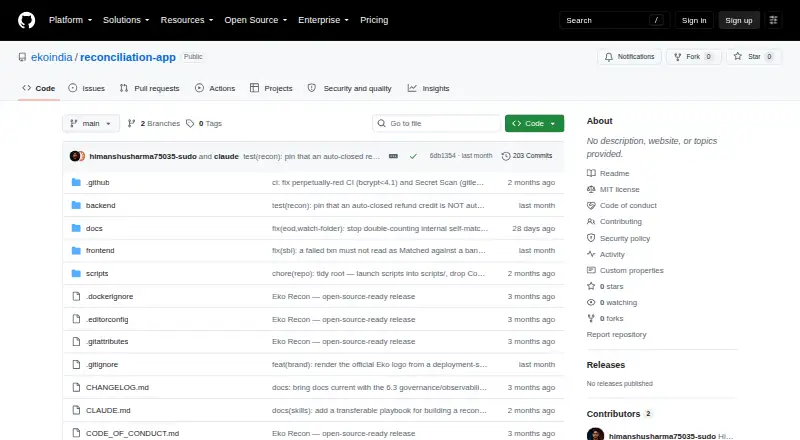
What Eko Recon is
Eko Recon is an open-source bank reconciliation platform for fintech operations. It imports CSV, XLSX/XLS, PDF, and tab-separated text files, with automatic recognition of headers and formats. Its priority-ordered rules match transactions using TID, tracking number, UTR, and amount, and it flags amount-tolerance mismatches. For exceptions, teams can review open items, match manually, record overrides with required remarks, approve through maker-checker controls, and add tags. Modules cover DMT, AePS settlement, payment gateway net settlement, QR settlement and chargebacks, E-Value wallet loads, BBPS refunds, and SBI Kiosk P01–P04. Reporting includes reconciliation summaries, ageing, SRC analysis, matched-pair exports, EOD digest emails, scheduled subscriptions, and monthly reconciliation certificate PDFs. The platform runs locally or in Docker as one container, using SQLite by default, with MySQL and PostgreSQL options for production. It exposes a JSON API documented through Swagger and ReDoc. Optional language-model integrations provide advisory output using de-identified fields, and require human approval. The software is free under the MIT license.
Who it suits
Eko Recon suits fintech operations teams reconciling settlements across the listed product modules. It may also fit teams that need self-hosted deployment, approval controls, and API access.
What it does well
- Imports four listed file formats
- Priority-ordered transaction matching rules
- Maker-checker approvals and override remarks
- Local or Docker deployment
- Free and released under the MIT license
What to know first
- SQLite is the default database
- AI output requires human approval
Plans
| Plan | Billed and limits | Price |
|---|---|---|
| Pricing not published | ask vendor for a quote | On request |
As github.com lists them, read 1 Oct 2026. The maker's own page has the final word.
Getting started
- Open the Eko Recon GitHub website.
- Choose local or Docker deployment.
- Use the default SQLite database, or configure MySQL or PostgreSQL for production.
- Import reconciliation files, or configure watch-folder uploads or cron schedules.
- Review matches and exceptions, then use the available reports and approval workflow.
Eko Recon is a bank-reconciliation system aimed at fintech finance teams rather than general bookkeeping. It suits operators handling several settlement streams who can run software themselves. The main trade-off is clear: extensive controls and workflow coverage come with self-hosting responsibility.
Overview
Eko Recon brings together reconciliation for DMT, AePS settlement, payment-gateway net settlement, QR settlement, chargebacks, E-Value wallet loads, BBPS refunds and SBI Kiosk P01–P04. That product focus makes it a credible choice for payment operations with varied settlement processes, while it is less natural for a small business seeking a simple bank-feed matcher.
Eko Bharat Ventures’ finance operations team built it for live settlement volumes across more than 12 product lines. The MIT license permits teams to inspect and adapt the code. Local and Docker deployment, SQLite by default, and production options for MySQL or PostgreSQL give technical teams control over where data runs, but also make infrastructure and maintenance part of the buying decision.
Key features
Ingestion and matching
The system accepts CSV, XLSX/XLS, PDF and tab-separated text files, recognizing headers and formats automatically. That is useful when banks and payment partners produce inconsistent exports. Its priority-ordered rule engine matches on TID, tracking number, UTR and amount, and flags amount-tolerance mismatches. Teams can therefore encode operational matching logic instead of relying only on exact file joins.
Exceptions and approvals
Open Items, manual matching, overrides with mandatory remarks, maker-checker approvals and ad hoc tags provide a structured route for unresolved transactions. Mandatory explanations and approval separation are valuable where reconciliation changes need an audit trail, although they add process discipline that may be unnecessary for a very small operation.
Reporting and automation
Reconciliation summaries, ageing and SRC analysis support oversight, while matched-pair exports, EOD digest emails, scheduled subscriptions and monthly reconciliation certificate PDFs turn results into recurring operational reporting. Watch-folder uploads, cron schedules and automatic reconciliation after ingest reduce repetitive handling. Startup self-healing migrations are aimed at keeping deployments operational as the schema evolves.
Controls and integration
Append-only audit logs, JWT and API-key authentication, IP allowlists, per-module permissions, product scoping and session logging provide a substantial control layer. The JSON API is documented through Swagger and ReDoc. AI integrations can use Anthropic, OpenAI-compatible or local providers, but receive de-identified fields and return advisory output requiring human approval; this is assistance, not unattended decision-making.
Pricing
Eko Recon is free software and open source under the MIT license. There is no recurring subscription stated for the software itself. A plan labelled “Pricing not published” carries custom pricing, so buyers needing that arrangement must request a quote. The free open-source route is the better fit for teams able to provide deployment, database and support capability; organizations wanting vendor-managed terms should clarify the quoted offering before committing.
Platforms
It supports API, web, Windows and self-hosted use. One-container Docker deployment and local operation suit controlled environments, with SQLite for straightforward starts and MySQL or PostgreSQL for production installations.
Who it's for
Choose Eko Recon when fintech operations span multiple settlement products, require exception approvals and need scheduled evidence of reconciliation. It is particularly suited to teams with engineering or infrastructure ownership. It is a poor fit for buyers who want a turnkey hosted service, a consumer mobile workflow or a general accounting package.
Pros and cons
Pros
- Broad fintech module coverage supports several settlement and refund workflows in one system.
- Priority rules, tolerance flags and controlled overrides handle both routine matches and difficult exceptions.
- Audit, authentication, scoping and approval features support governed operations.
- Open-source licensing, Docker support and database choices provide deployment flexibility.
Cons
- Self-hosting leaves infrastructure, upgrades and operational support with the adopting team.
- The workflow depth may be excessive for simple, low-volume reconciliation.
- Custom-priced commercial arrangements require a separate quote rather than a transparent published subscription.
Alternatives
For a browser-based option with a free allowance and mobile apps, consider SahiSay Reconciliation; its free plan allows five reconciliations per day, unlimited transactions per file and PDF export, while Pro costs ₹1,499 a month.
Settler is a free, self-hosted/API alternative with 10,000 monthly reconciliations and local evidence and replay traces on its Open Source plan.
speedRecon is a web-only freemium choice for single users needing up to three reconciliations per month and 300 rows per file on its free-forever plan.
OpenRecon offers a no-account, MIT-licensed self-hosted/API product with no paid tier.
For paid web products, FIS Data Integrity Manager, BankRecon, OneCap and Serrala PSP Reconciliation are alternatives.
Browse the wider Account Reconciliation Software category for more options.
Verdict
Eko Recon is a strong recommendation for technically capable fintech teams that need domain-specific matching, controlled exceptions and defensible reporting without a software-license charge. Look elsewhere if your priority is a managed cloud service with predictable subscription pricing and no deployment burden.
Verdict
Eko Recon brings transaction matching, exception handling, reporting, and access controls into one reconciliation platform. Its listed deployment options and open-source license may suit teams able to manage a local or Docker installation.
Questions
Is Eko Recon free?
Its pricing model is free, and the repository is released under the MIT license.
Which platforms does it support?
The listed platforms are API, self-hosted, web and Windows.
What file types can it ingest?
It accepts CSV, XLSX/XLS, PDF and tab-separated text files, with automatic header and format recognition.
Can it connect to AI providers?
It supports Anthropic, OpenAI-compatible and local language-model providers. They receive de-identified fields and provide advisory output requiring human approval.
Which databases can it use?
It uses SQLite by default and can switch to MySQL or PostgreSQL for production.
Who built Eko Recon?
The README says it was built by Eko Bharat Ventures' finance operations team.
Facts from Eko Recon's own pages
- AI integration
- The architecture supports Anthropic, OpenAI-compatible or local language-model providers, receiving de-identified fields only and providing advisory output requiring human approval. · github.com, 1 Oct 2026
- API
- The architecture exposes a JSON API and documents it through Swagger and ReDoc. · github.com, 1 Oct 2026
- Automation
- Watch-folder uploads, cron schedules, automatic reconciliation after ingest and startup self-healing migrations are supported. · github.com, 1 Oct 2026
- Controls
- The platform includes append-only audit logs, JWT and API-key authentication, IP allowlists, per-module permissions, product data scoping and session logging. · github.com, 1 Oct 2026
- Data ingestion
- It ingests CSV, XLSX/XLS, PDF and tab-separated text files with automatic header and format recognition. · github.com, 1 Oct 2026
- Deployment
- It runs locally or in Docker as one container, uses SQLite by default and can switch to MySQL or PostgreSQL for production. · github.com, 1 Oct 2026
- Exception workflow
- The product provides Open Items, manual matching, overrides with mandatory remarks, maker-checker approvals and ad hoc tagging. · github.com, 1 Oct 2026
- Founded
- 2006 · github.com, 28 Sept 2026
- Headquarters
- India · github.com, 28 Sept 2026
- License
- The repository is released under the MIT license. · github.com, 1 Oct 2026
- Maker context
- The README says Eko Recon was built by Eko Bharat Ventures' finance operations team and battle-tested on live settlement volumes across more than 12 product lines. · github.com, 1 Oct 2026
- Matching
- Its priority-ordered rule engine matches transactions using TID, tracking number, UTR and amount rules, with amount-tolerance mismatch flags. · github.com, 1 Oct 2026
- Product modules
- Modules cover DMT, AePS settlement, PG net settlement, QR settlement and chargebacks, E-Value wallet loads, BBPS refunds and SBI Kiosk P01–P04. · github.com, 1 Oct 2026
- Purpose
- Eko Recon is a full-stack bank reconciliation platform for fintech operations. · github.com, 1 Oct 2026
- Reporting
- Reports include reconciliation summaries, ageing, SRC analysis, matched-pairs exports, EOD digest emails, scheduled subscriptions and monthly reconciliation certificate PDFs. · github.com, 1 Oct 2026
- Security reporting
- Security vulnerabilities can be reported privately through GitHub Security Advisories or by emailing [email protected]. · github.com, 1 Oct 2026
Where Eko Recon stands on Freedom251
- Account Reconciliation Software#9 of 21