Freedom251 › Account Reconciliation Software
OpenRecon
What OpenRecon is
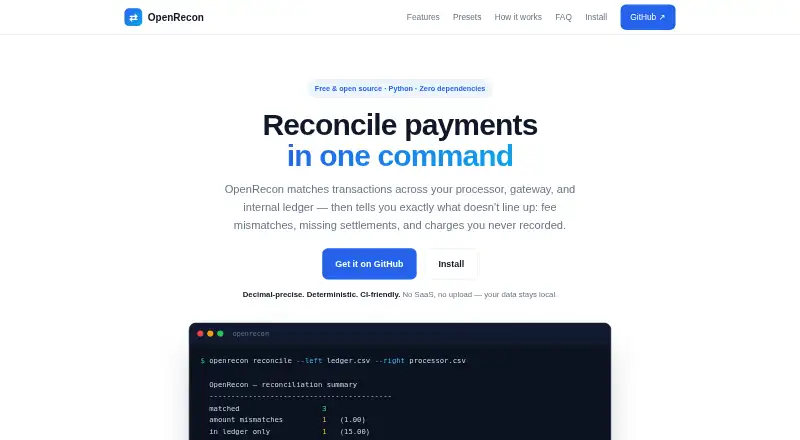
OpenRecon reconciles transactions from payment processors and gateways against an internal ledger, then identifies mismatches and missing transactions. It first checks shared IDs or references; remaining rows are compared by amount, currency, and date window. Amounts use Python Decimal for precision. Built-in presets cover Stripe, Adyen, PayPal, Razorpay, Braintree, and Square, with column auto-detection or explicit mapping. The input is two CSV files. OpenRecon provides a CLI and Python library, with console summaries and optional JSON or CSV reports. Its maker says it runs locally without network calls, keeping files on the user's computer. The CLI returns a non-zero status when discrepancies exist, which supports scheduled and CI workflows. It requires Python 3.9+ and no dependencies beyond the standard library. OpenRecon is free, with no paid tier or account requirement, and uses the MIT license. It is built and maintained by payments and fintech engineer Naresh Paturi.
Who it suits
It suits payments, finance, accounting, engineering, operations, marketplace, and audit teams that reconcile processor data with an internal ledger. It may also fit teams embedding reconciliation in internal tools.
What it does well
- Free, with no account or paid tier
- Runs locally without network calls
- Offers CLI and Python library
- Presets cover six named processors
- CLI signals discrepancies with non-zero status
What to know first
- Input is limited to two CSV files
- Many-to-one matching is a planned improvement
- Multi-currency settlement handling is planned
- Refund and chargeback handling is planned
Limits
The listed input is two CSV files. Many-to-one matching, multi-currency settlement, refund and chargeback handling, and HTML reports are planned improvements.
Plans
| Plan | Billed and limits | Price |
|---|---|---|
| Free | No paid tier · no account · MIT license | Free |
As naresh-paturi-community.github.io lists them, read 4 Oct 2026. The maker's own page has the final word.
Getting started
- Open the OpenRecon website.
- Install Python 3.9 or later.
- Prepare the two CSV files to reconcile.
- Use a built-in processor preset with column auto-detection, or map columns explicitly.
- Run OpenRecon through its CLI or use its Python library.
OpenRecon is a transaction-reconciliation tool for teams that work with processor CSVs and an internal ledger. It is best suited to technical finance, payments, and engineering teams that can use Python or command-line workflows. Its focused matching and local execution make it a practical choice for simple checks, but its two-file scope rules it out for more involved settlement work.
Overview
OpenRecon compares payment processor or gateway transactions with an internal ledger and flags mismatches and missing transactions. It first looks for shared IDs or references, then compares unmatched rows by amount, currency, and date window. That two-stage approach gives straightforward reconciliations a clear path from exact references to broader matching, while Python Decimal arithmetic avoids floating-point handling of monetary amounts.
The maker says the tool runs locally without network calls, so transaction files remain on the user's computer. That suits teams seeking a local workflow, especially those who want reconciliation inside internal tools. The trade-off is a narrow input scope: it accepts two CSV files, and more complex cases such as many-to-one matches, multi-currency settlement, refunds, and chargebacks are planned rather than supported.
Key features
Processor presets and mapping
Presets cover Stripe, Adyen, PayPal, Razorpay, Braintree, and Square. Column auto-detection can reduce setup for familiar formats, while explicit mapping gives users a way to align other CSV columns. This is useful for teams handling those processor exports, though it does not remove the need to prepare a two-file reconciliation.
CLI and library workflows
OpenRecon provides both a command-line interface and a Python library, with console summaries and optional JSON or CSV reports. Its CLI returns a non-zero status when discrepancies are present, making it suitable for scheduled checks and CI workflows that need a clear pass-or-fail signal. Python 3.9 or later is required, and the maker says no dependencies beyond the standard library are needed.
The maker invites contributions and ideas on GitHub, including pull requests for additional processor presets. That offers teams a route to contribute a format they need, but it is not a substitute for built-in handling of the more complex reconciliation cases still planned.
Pricing
OpenRecon's Free plan costs nothing. There is no paid tier or account requirement, and the software is released under the MIT license. There is no free trial; with no paid plan, there is also no upgrade tier to compare. This makes it a straightforward option for teams that can work within its two-CSV scope, rather than a low-cost entry point to a broader paid product.
Platforms
OpenRecon is offered as an API and self-hosted software. Its Python library and CLI suit teams incorporating reconciliation into scripts or internal systems; Python 3.9+ is the stated requirement. The local, no-network-call approach may appeal to teams that want files to stay on their own computers.
Who it's for
OpenRecon suits payments, finance and accounting, engineering and operations teams, marketplaces, and audit teams with simple two-file reconciliation needs. It also fits developers embedding checks in internal tools or automating them in scheduled and CI workflows. Teams handling several files, complex settlement relationships, refunds, or chargebacks should look for a tool that supports those cases.
Pros and cons
- Pros: No-cost use, no account, and an MIT license make it accessible to teams that can host and operate it themselves.
- Pros: Local processing and Decimal-based amounts support a workflow that keeps files on the user's computer and avoids floating-point arithmetic for money.
- Pros: Presets for six processors, plus automatic detection and explicit mapping, offer practical options for matching CSV columns.
- Pros: A CLI, Python library, and discrepancy-dependent exit status make it adaptable to scripts and CI checks.
- Cons: Reconciliation is limited to two CSV files, constraining work that spans multiple sources.
- Cons: Many-to-one matching, multi-currency settlement, refund and chargeback handling, and HTML reports remain planned improvements.
- Cons: The Python 3.9+ requirement and command-line or library orientation are a poor fit for readers seeking a conventional hosted interface.
Alternatives
For a wider view of the category, browse Account Reconciliation Software.
- SahiSay Reconciliation is worth considering for readers who want Android, iOS, web, or Windows access: its free plan includes five reconciliations per day, unlimited transactions per file, and PDF export, and it offers a trial.
- Settler may suit teams seeking a different self-hosted or API option: its Open Source plan includes 10,000 monthly reconciliations, local evidence and replay traces, and community support, and it also offers a cloud API and a trial.
- speedRecon is an option for readers who prefer a web app and can work within its free plan's three reconciliations per month and 300 rows per file.
- FIS Data Integrity Manager is a paid web-based alternative.
- BankRecon is a paid web alternative with a free trial; its Standard plan covers one to three entities, three to ten bank accounts, and approximately 10,000 transactions per month.
- Eko Recon is another free option, available across API, self-hosted, web, and Windows platforms, with custom pricing.
- OneCap is a paid web option with a free plan and a Starter plan for limited transaction volumes, payables and receivables ledger reconciliation, custom business rules, an AI Assistant, Excel reports, and email support.
- Serrala PSP Reconciliation is a paid alternative available through API and web platforms.
Verdict
Choose OpenRecon if your team wants free, locally run reconciliation of two CSV files and can use Python, a CLI, or a library to fit it into existing work. Its processor presets, precise monetary arithmetic, and automation-friendly exit status are strong advantages for focused checks. Look elsewhere if your reconciliations require multiple inputs, complex settlement matching, refunds, or chargeback handling.
Verdict
OpenRecon offers local CSV reconciliation with processor presets, a library, and automation-friendly CLI behavior. Its listed limitations include two-file input and several reconciliation features still planned.
Questions
How much does OpenRecon cost?
OpenRecon is free plan. It has no paid tier.
Is there a free trial or account requirement?
There is no free trial. No account is required.
Which platforms does OpenRecon support?
Its listed platforms are API and self-hosted. It requires Python 3.9 or later.
What does OpenRecon match?
It matches transactions across payment processors, gateways and an internal ledger, then reports mismatches and missing transactions. The listed input is two CSV files.
Which processor presets are included?
Built-in presets cover Stripe, Adyen, PayPal, Razorpay, Braintree and Square.
Who maintains OpenRecon, and is it open source?
Payments and fintech engineer Naresh Paturi builds and maintains it. It uses the MIT license, and the maker invites contributions on GitHub.
Facts from OpenRecon's own pages
- About
- The site says OpenRecon is built and maintained by payments and fintech engineer Naresh Paturi. · naresh-paturi-community.github.io, 4 Oct 2026
- Automation
- The CLI exits with a non-zero status when discrepancies exist, supporting scheduled and CI workflows. · naresh-paturi-community.github.io, 4 Oct 2026
- Intended users
- The maker describes use by payments, finance and accounting, engineering and operations, marketplaces, audit teams, and teams embedding reconciliation in internal tools. · naresh-paturi-community.github.io, 4 Oct 2026
- Interfaces and outputs
- OpenRecon provides a CLI and Python library, with console summaries and optional JSON or CSV reports. · naresh-paturi-community.github.io, 4 Oct 2026
- Limits
- The listed input is two CSV files; many-to-one matching, multi-currency settlement, refund and chargeback handling, and HTML reports are listed as planned improvements. · naresh-paturi-community.github.io, 4 Oct 2026
- Local data
- The maker says OpenRecon runs locally with no network calls, so ledger and processor files stay on the user's computer. · naresh-paturi-community.github.io, 4 Oct 2026
- Matching
- It first matches shared IDs or references, then matches remaining rows by amount, currency, and date window. · naresh-paturi-community.github.io, 4 Oct 2026
- Money precision
- Amounts use Python Decimal rather than floating point. · naresh-paturi-community.github.io, 4 Oct 2026
- Processor presets
- Built-in presets cover Stripe, Adyen, PayPal, Razorpay, Braintree, and Square, with column auto-detection and explicit mapping available. · naresh-paturi-community.github.io, 4 Oct 2026
- Purpose
- OpenRecon matches transactions across payment processors, gateways, and an internal ledger, and reports mismatches and missing transactions. · naresh-paturi-community.github.io, 4 Oct 2026
- Requirements
- The maker lists Python 3.9+ and no dependencies beyond the standard library. · naresh-paturi-community.github.io, 4 Oct 2026
- Support and contribution
- The maker invites contributions and ideas on GitHub and suggests opening a pull request to add a processor preset. · naresh-paturi-community.github.io, 4 Oct 2026
Where OpenRecon stands on Freedom251
- Account Reconciliation Software#2 of 21