Freedom251 › Data Lineage Tools
Egeria
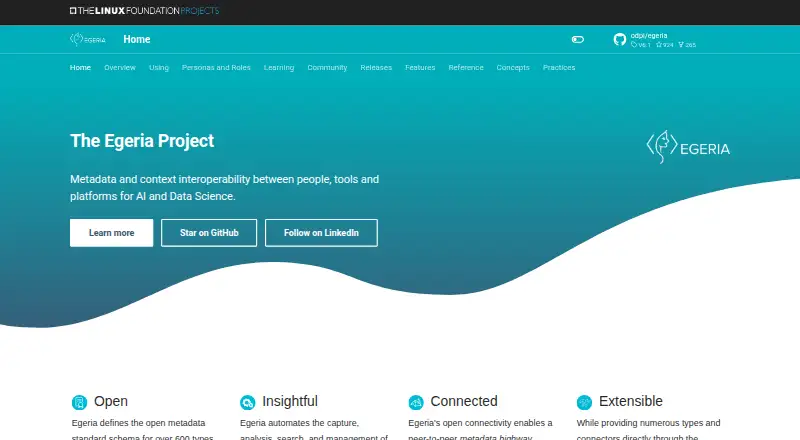
What Egeria is
Egeria is an open-source project for making metadata and context interoperable across people, tools and platforms used in AI and data science. Its open metadata schema has more than 600 types for describing an enterprise’s digital business. Specialist servers can capture, analyze, search and manage metadata, as well as extract, store and synchronize information across technologies. Egeria also supports metadata exchange, linking and federation between different repositories.
Its catalog of capabilities includes integrated cataloguing, lineage management, metadata discovery, metadata security and synchronized access control. Discovery functions cover schema extraction, resource profiling, and data class, grain, semantic and classification discovery. Connectors span integration, repositories, runtime and security, with a REST client connector also listed. Documented content packs cover PostgreSQL, Microsoft SQL Server, Oracle Database, Db2 for LUW, DuckDB, Unity Catalog, Apache Atlas and Apache Kafka. Interfaces include Egeria Explorer, Lineage Explorer, Data Mesh, The Catalog, Egeria Operations and Egeria Audit. The frameworks are designed for custom types, variations and systems. Egeria can run in a Docker container, standalone or as part of Kubernetes deployments. The community edition is free to use and includes functions for an Egeria developer.
Who it suits
Egeria suits teams working with metadata and context across varied data and AI tools, especially those needing repository exchange, discovery or lineage management. Its connectors, content packs and extensible frameworks may also suit organizations integrating multiple technologies or adapting metadata types and systems.
What it does well
- Open metadata schema includes more than 600 types
- Supports metadata exchange, linking and federation
- Discovery covers schema, resource, semantic and classification tasks
- Includes lineage management and impact analysis
- Content packs cover a range of database and data technologies
- Can run standalone, in Docker or with Kubernetes
What to know first
- Using the project requires choosing and operating a deployment such as standalone, Docker or Kubernetes
- The community edition is described as including functions for an Egeria developer
Getting started
- Visit the Egeria project website
- Choose a standalone, Docker container or Kubernetes deployment
- Review the project’s content packs and connectors for the technologies in your environment
- Use the community guide or contributor guide to participate
Verdict
Choose Egeria if you need an open-source foundation for managing and connecting metadata across heterogeneous repositories and technologies. Its broad discovery, connector and lineage capabilities are suited to complex metadata environments. Teams looking for a ready-to-use hosted app should consider that Egeria is described through standalone, Docker and Kubernetes deployment options.
Questions
Is Egeria free?
Yes. It is free and open source. The community edition is free to use and includes the functions needed by an Egeria developer.
Which platforms does Egeria support?
It is listed for API, Linux, macOS, self-hosted, web and Windows environments. Deployment options include standalone, Docker and Kubernetes.
What integrations are documented?
Content packs are listed for PostgreSQL, Microsoft SQL Server, Oracle Database, Db2 for LUW, DuckDB, Unity Catalog, Apache Atlas and Apache Kafka.
Does Egeria include lineage management?
Yes. Lineage management is in its feature catalog. The listed capabilities also include column-level lineage, report lineage and impact analysis.
Can Egeria be extended?
Yes. Its frameworks are designed to support custom types, variations and systems.
How can people participate in the project?
The project provides a community guide and a contributor guide.
Facts from Egeria's own pages
- Connectors
- The connector catalog includes integration, repository, runtime and security connectors, plus a REST client connector. · egeria-project.org, 11 Oct 2026
- Deployment
- Egeria can run in a Docker container and the project describes using it standalone or as part of Kubernetes deployments. · egeria-project.org, 11 Oct 2026
- Discovery
- Metadata discovery includes schema extraction, resource profiling, data class and grain discovery, semantic discovery and classification discovery. · egeria-project.org, 11 Oct 2026
- Extensibility
- Egeria’s frameworks are designed to be pluggable and extensible for custom types, variations and systems. · egeria-project.org, 11 Oct 2026
- Feature set
- The feature catalog includes integrated cataloguing, lineage management, metadata discovery, metadata security and synchronized access control. · egeria-project.org, 11 Oct 2026
- Free use
- The development guide states that the community edition is free to use and includes the functions needed by an Egeria developer. · egeria-project.org, 11 Oct 2026
- Integrations
- The project documents connectors and content packs for technologies including PostgreSQL, Microsoft SQL Server, Oracle Database, Db2, DuckDB, Unity Catalog, Apache Atlas, and Apache Kafka. · egeria-project.org, 11 Oct 2026
- Interfaces
- The site lists Egeria Explorer, Lineage Explorer, Data Mesh, The Catalog, Egeria Operations and Egeria Audit among its user interfaces. · egeria-project.org, 11 Oct 2026
- Interoperability
- Egeria supports metadata exchange, linking and federation between heterogeneous metadata repositories. · egeria-project.org, 11 Oct 2026
- Metadata management
- Its specialist servers capture, analyze, search and manage metadata and context, and can extract, store and synchronize information across technologies. · egeria-project.org, 11 Oct 2026
- Metadata standard
- Egeria defines an open metadata schema with over 600 types for managing context about an enterprise’s digital business. · egeria-project.org, 11 Oct 2026
- Metadata types
- Egeria defines an open metadata schema with more than 600 types for managing context about an enterprise’s digital business. · egeria-project.org, 11 Oct 2026
- Platforms
- The project’s tutorials list Linux, macOS, and Windows as supported platforms, and describe building on Unix-like systems. · egeria-project.org, 11 Oct 2026
- Purpose
- Egeria is an open source project for making metadata and related business context interoperable between tools and platforms. · egeria-project.org, 11 Oct 2026
- Release cadence
- The release policy aims to publish a core Egeria release approximately every six weeks and says updates between releases are reserved for exceptional circumstances. · egeria-project.org, 11 Oct 2026
- Security
- Listed security capabilities include metadata security and synchronized access control. · egeria-project.org, 11 Oct 2026
- Security scanning
- The contributor guidelines say dependencies are scanned for known CVEs and that code is checked with tools including GitHub CodeQL and Sonatype Lift. · egeria-project.org, 11 Oct 2026
- Support and community
- The site provides a community guide and contributor guide for people participating in the project. · egeria-project.org, 11 Oct 2026
- Technology integrations
- The site lists content packs for PostgreSQL, Microsoft SQL Server, Oracle Database, Db2 for LUW, DuckDB, Unity Catalog, Apache Atlas and Apache Kafka. · egeria-project.org, 11 Oct 2026
Where Egeria stands on Freedom251
- Data Lineage Tools#8 of 43