Freedom251 › In-Memory Databases

DiceDB
What DiceDB is
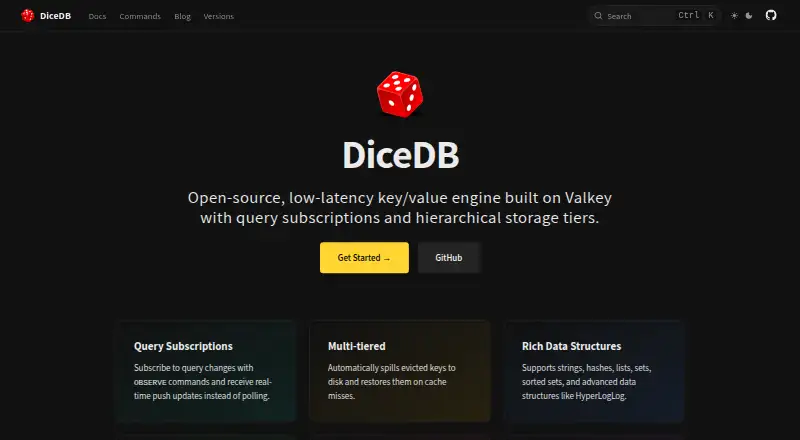
DiceDB is a Redis-compatible data structure server with query subscriptions and tiered storage. It supports strings, hashes, lists, sets, sorted sets, and HyperLogLog, and its maker says it works with Redis and Valkey clients, SDKs, commands, tools, and workflows. The OBSERVE command sends clients the current result of a read command and pushes updated results when observed keys change. Its Spill module stores evicted keys in RocksDB and restores them transparently when accessed, preserving TTLs during eviction and restoration. The official Docker image starts with Spill enabled and sets a default 250MB memory limit for that module. Docker instructions mount a local data directory so data persists across container restarts. DiceDB is available on Linux and macOS and for self-hosting; documentation also lists OpenBSD, NetBSD, and FreeBSD as supported. It is open source under BSD-3 Clause and listed as free, with no free trial. Note that the listed data-persistence field says no, while the Docker instructions describe persistence when a local data directory is mounted.
Who it suits
DiceDB suits developers using Redis- or Valkey-compatible clients and workflows who want query subscriptions or tiered storage. Its Docker setup may suit users who want data to persist across container restarts by mounting a local directory.
What it does well
- Compatible with Redis and Valkey clients and workflows
- OBSERVE pushes updated results when keys change
- Spill restores evicted keys and preserves TTLs
- Free and open source under BSD-3 Clause
What to know first
- Listed data-persistence field is no
- Docker Spill module has a default 250MB memory limit
Limits
The free plan costs nothing. In the official Docker image, Spill starts with a default 250MB memory limit; the listed data-persistence field is no, while the Docker instructions describe persistence when a local directory is mounted.
Plans
| Plan | Billed and limits | Price |
|---|---|---|
| DiceDB | Free and open source under BSD-3 Clause License | Free |
As dicedb.io lists them, read 7 Oct 2026. The maker's own page has the final word.
Getting started
- Visit https://dicedb.io/ to get started.
- Choose Linux, macOS, or a self-hosted deployment.
- For Docker, use the official image, which starts with Spill enabled.
- Mount a local data directory in Docker to preserve data across container restarts.
DiceDB is a high-performance, Redis-compatible data-structure server that adds live query subscriptions and tiered storage. It suits developers who want a self-hosted cache or data service while retaining Redis and Valkey tooling. Its strongest case is an open-source, no-cost deployment where reactive reads and disk spill matter more than a managed service.
Overview
DiceDB combines familiar Redis-style data structures with two less usual capabilities. The OBSERVE command returns the current result of a read command, then pushes refreshed results when the observed keys change. That makes it useful for applications that would otherwise repeatedly poll for updates, provided their clients can consume subscription-style results.
Its Spill module moves evicted keys into RocksDB and restores them transparently when those keys are accessed. TTLs survive both eviction and restoration, so expiration behavior does not have to be redesigned around tiering. This is a practical way to extend a memory-bound deployment, though disk-backed recovery is a different performance profile from keeping every hot key in memory.
Key features
- Redis and Valkey compatibility: DiceDB says it supports their clients, SDKs, commands, tools, and workflows. Teams with existing Redis-oriented applications can therefore consider it without abandoning their surrounding ecosystem.
- Broad data-model coverage: strings, hashes, lists, sets, sorted sets, and HyperLogLog are supported. That covers common caching, counters, collections, ranking, and cardinality workloads.
- Query subscriptions: OBSERVE pushes changed read results instead of leaving clients to poll, which is most valuable for continuously changing views.
- Tiered storage: Spill uses RocksDB for evicted keys and keeps TTLs intact. It is a fit for workloads with a large colder tail, but memory remains the first tier.
- Container deployment: the official Docker image enables Spill and gives it a default 250MB memory limit. That is a useful starting guardrail, not a workload-specific capacity plan.
- Open source: DiceDB is released under the BSD-3 Clause License, allowing self-hosted use without a subscription.
Pricing
DiceDB costs free on its DiceDB plan. The plan is free and open source under the BSD-3 Clause License, with no free trial because no trial is offered. There are no seat charges or published usage quotas. The plan's data-persistence field is marked “no,” so buyers needing a service-level persistence commitment should treat it as a cache or carefully engineer their own storage and recovery approach.
That qualification matters alongside the Docker guidance: mounting a local data directory allows data to persist across container restarts, but that deployment arrangement is not the same as a plan-level persistence guarantee. Users must own the operational design, storage, backups, and failure handling.
Platforms
DiceDB runs on Linux, macOS, and as self-hosted software. Its documentation also lists OpenBSD, NetBSD, and FreeBSD as supported operating systems, giving BSD-oriented operators more choices than the directory's primary platform labels suggest. Docker provides another route for deployment, with Spill enabled by default.
Who it's for
Choose DiceDB for a development team or operator comfortable running infrastructure who wants Redis-compatible interfaces, reactive query results, and a disk tier without licensing cost. It is especially relevant when polling is wasteful or when a memory-only footprint is too restrictive for the full key set.
Look elsewhere if you want a managed endpoint, vendor-operated durability, or a published service quota and support package. DiceDB's value comes with responsibility for hosting and persistence decisions.
Pros and cons
Pros
- Free BSD-licensed software: removes subscription cost and permits self-hosted deployment.
- Reactive reads: OBSERVE can replace repeated polling when observed keys change.
- Memory-plus-disk design: Spill extends capacity while preserving TTL behavior.
- Redis/Valkey ecosystem fit: existing clients and workflows remain relevant.
- Multiple operating systems: Linux, macOS, and BSD support broaden self-hosting options.
Cons
- No plan-level data persistence: durable operation is the user's responsibility.
- Self-hosting required: teams must manage deployment, storage, monitoring, and recovery themselves.
- Spill starts with a 250MB module limit: operators may need to tune capacity for larger workloads.
- Disk spill is not equivalent to all-memory access: workloads with frequent cold-key restores should account for tier transitions.
Alternatives
For a broader directory of comparable systems, see In-Memory Databases.
- Amazon ElastiCache is the better choice when you prefer a paid AWS service with API, web, desktop, and Linux access, plus an AWS Free Tier option.
- Redis Insight fits users seeking a free tool across Linux, macOS, Windows, web, and self-hosted environments rather than another server.
- VoltDB is worth considering for a developer edition that supports local or cloud exploration and includes sample apps, tutorials, and documentation.
- Aerospike Database suits teams evaluating a freemium database with a Community Edition capped at eight nodes, 2.5TB, and two namespaces.
- Apache Geode is another free, open-source-style option distributed in binary and source forms under the Apache License.
- SingleStore Helios offers a free shared workspace for evaluation, development, and non-production testing.
- Valkey is the straightforward alternative when you want the open-source BSD datastore itself, self-hosted on Linux or macOS.
- VMware Workstation Pro is a neutral alternative for free virtualization on Windows or Linux hosts, not a database replacement.
Verdict
DiceDB is a strong recommendation for infrastructure-capable users who want Redis compatibility plus subscriptions and disk tiering at no license cost. Choose it when self-hosting and operational ownership are acceptable; look elsewhere when managed durability, hosted support, or a defined service plan is the priority.
Verdict
DiceDB pairs Redis compatibility with subscriptions and a storage-tiering module. Consider the distinction between its listed persistence field and the mounted-directory Docker setup when choosing a deployment.
Questions
How much does DiceDB cost?
The DiceDB plan is free and costs nothing.
Is there a free trial?
No. DiceDB has no free trial.
Which platforms does DiceDB support?
It is listed for Linux, macOS, and self-hosted use. The documentation also lists Linux, macOS, OpenBSD, NetBSD, and FreeBSD as supported operating systems.
Is DiceDB open source?
Yes. It is free and open source under the BSD-3 Clause License.
Which data structures does it support?
Strings, hashes, lists, sets, sorted sets, and HyperLogLog.
How does DiceDB handle data persistence?
The listed data-persistence field is no. Docker instructions mount a local data directory so data persists across container restarts.
Facts from DiceDB's own pages
- Company details
- The opened maker pages do not state the maker's name, headquarters, or founding year. · dicedb.io, 7 Oct 2026
- Compatibility
- DiceDB says it is compatible with Redis and Valkey clients, SDKs, commands, tools, and workflows. · dicedb.io, 7 Oct 2026
- Data structures
- The homepage lists support for strings, hashes, lists, sets, sorted sets, and HyperLogLog. · dicedb.io, 7 Oct 2026
- Deployment
- The official Docker image starts with the Spill module enabled and a default 250MB memory limit for that module. · dicedb.io, 7 Oct 2026
- Disk tiering
- The Spill module stores evicted keys in RocksDB and transparently restores them when accessed. · dicedb.io, 7 Oct 2026
- License
- DiceDB is free and open source under the BSD-3 Clause License. · dicedb.io, 7 Oct 2026
- Persistent data
- The Docker instructions mount a local data directory so data persists across container restarts. · dicedb.io, 7 Oct 2026
- Query subscriptions
- The OBSERVE command sends clients the current result of a read command and pushes updated results when observed keys change. · dicedb.io, 7 Oct 2026
- Supported operating systems
- The documentation lists Linux, macOS, OpenBSD, NetBSD, and FreeBSD as supported operating systems. · dicedb.io, 7 Oct 2026
- TTL handling
- The tiering feature preserves TTLs across key evictions and restorations. · dicedb.io, 7 Oct 2026
- What it does
- DiceDB is a high-performance, Redis-compatible data structure server with query subscriptions and tiered storage. · dicedb.io, 7 Oct 2026
Where DiceDB stands on Freedom251
- In-Memory Databases#7 of 25