Freedom251 › Key-Value Databases
Infinispan
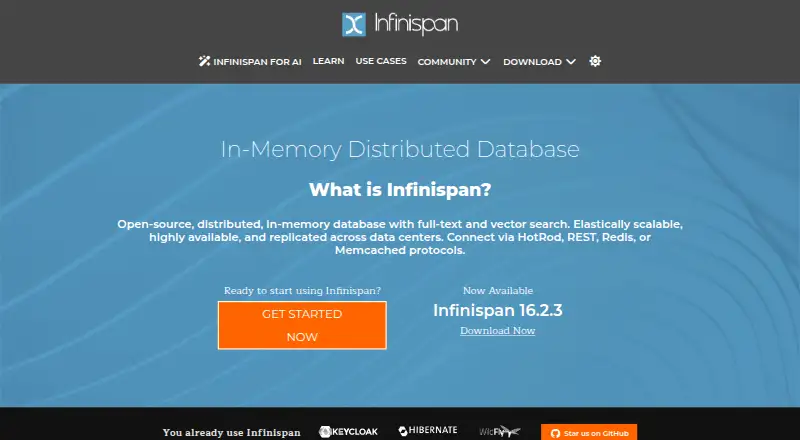
What Infinispan is
Infinispan is a free, open-source distributed in-memory database that supports caching alongside full-text and vector search. Its search features include distributed vector indexes, kNN similarity queries, semantic search, retrieval-augmented generation, and semantic caching. Applications can connect using Hot Rod, REST, Redis, or Memcached protocols; listed client libraries include Java, Go, JavaScript, C++, .NET, and Python. It can run as an embedded library, standalone server, or container image. Listed deployment options include a Kubernetes Operator and container images on OpenShift, AWS EC2, Azure, and GCP. Cache stores include filesystem, JDBC, SQL, RocksDB, and remote Infinispan clusters. Security features include role- and permission-based access control, security realms, and encryption for inter-cluster traffic and remote endpoints. It also supports distributed transactions with optimistic or pessimistic locking, configurable isolation levels, and XA recovery. Native integrations include Spring AI, LangChain4j, LangChain, and Quarkus LangChain4j. Infinispan is released under the Apache 2.0 license. Its support policy covers only the latest minor release of a major version, with support levels distinguished.
Who it suits
It suits application developers who need a self-hosted in-memory database with search, caching, or distributed transaction capabilities. Its client libraries and deployment options span several languages and environments.
What it does well
- Free under the Apache 2.0 license.
- Supports vector search and semantic search features.
- Can run embedded, as a server, or in containers.
- Provides several client libraries and connection protocols.
- Includes access controls and encryption features.
What to know first
- Only the latest minor release of a major version is supported.
- The support policy distinguishes limited support levels.
Limits
Infinispan is free under the Apache 2.0 license. The support policy covers only the latest minor release of a major version and distinguishes full, limited, and limited client support.
Plans
| Plan | Billed and limits | Price |
|---|---|---|
| Community Edition | Apache 2.0 open-source license · embedded library or standalone server · deployment and support limits not stated | Free |
As infinispan.org lists them, read 2 Oct 2026. The maker's own page has the final word.
Getting started
- Open https://infinispan.org/
- Choose an embedded library, standalone server, or container image deployment
- Connect an application through Hot Rod, REST, Redis, or Memcached
- Select a listed client library for Java, Go, JavaScript, C++, .NET, or Python
Verdict
Infinispan combines distributed in-memory storage with search, caching, and transaction features, and can be deployed in several forms. Its release-specific support policy is worth checking when selecting a version.
Questions
Is Infinispan free?
Yes. The Community Edition costs 0.00 USD and is released under the Apache 2.0 open-source license.
How can Infinispan be deployed?
It can run as an embedded library, a standalone server, or a container image. Listed options include a Kubernetes Operator and container image deployment on OpenShift, AWS EC2, Azure, and GCP.
Which connection protocols does it support?
Clients can connect through Hot Rod, REST, Redis, or Memcached.
What integrations are listed?
Native integrations include Spring AI, LangChain4j, LangChain, and Quarkus LangChain4j.
What is the release support policy?
Only the latest minor release of a major version is supported. The policy distinguishes full, limited, and limited client support.
Where can users ask questions?
For usage questions, the site recommends GitHub Discussions and Stack Overflow. Development chat is on Zulip.
Facts from Infinispan's own pages
- Client libraries
- The Hot Rod client page lists Java, Go, JavaScript, C++, .NET, and Python clients. · infinispan.org, 2 Oct 2026
- Cloud support
- The site lists a Kubernetes Operator and container image deployment on OpenShift, AWS EC2, Azure, and GCP. · infinispan.org, 2 Oct 2026
- Deployment
- Infinispan can run as an embedded library, standalone server, or container image. · infinispan.org, 2 Oct 2026
- Integrations
- The features page lists native integrations with Spring AI, LangChain4j, LangChain, and Quarkus LangChain4j. · infinispan.org, 2 Oct 2026
- License
- Infinispan is released under the Apache 2.0 open-source license. · infinispan.org, 2 Oct 2026
- Persistence
- Listed cache stores include filesystem, JDBC, SQL, RocksDB, and remote Infinispan cluster stores. · infinispan.org, 2 Oct 2026
- Product
- Infinispan is an open-source distributed in-memory database with full-text and vector search. · infinispan.org, 2 Oct 2026
- Protocols
- Clients can connect through Hot Rod, REST, Redis, or Memcached protocols. · infinispan.org, 2 Oct 2026
- Search and AI
- Features include distributed vector indexes, kNN similarity queries, semantic search, RAG, and semantic caching. · infinispan.org, 2 Oct 2026
- Security
- The feature page lists role and permission based access control, security realms, and encryption for inter-cluster traffic and remote endpoints. · infinispan.org, 2 Oct 2026
- Support channels
- For usage questions, the site recommends GitHub Discussions and Stack Overflow; development chat is on Zulip. · infinispan.org, 2 Oct 2026
- Support policy
- The releases page says only the latest minor release of a major version is supported and distinguishes full, limited, and limited client support. · infinispan.org, 2 Oct 2026
- Transactions
- Infinispan supports distributed transactions with optimistic or pessimistic locking, configurable isolation levels, and XA recovery. · infinispan.org, 2 Oct 2026
Where Infinispan stands on Freedom251
- Key-Value Databases#9 of 31
- In-Memory Databases#8 of 25
- Caching Software#10 of 27