Freedom251 › Key-Value Databases
FoundationDB
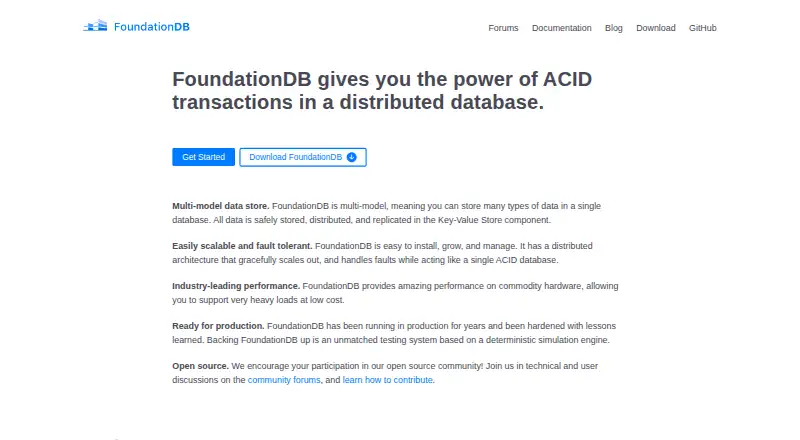
What FoundationDB is
FoundationDB is an open-source distributed database for storing structured data as an ordered key-value store across clusters of commodity servers. Reads and writes use ACID transactions that can span multiple machines. To expand capacity, add machines; FoundationDB handles partitioning, redundancy, and caching, and can place a replacement copy when a server fails. Its core API provides the key-value model, while stateless application layers can add data models, algorithms, or frameworks. Applications may use the database directly, through a layer, or combine both approaches.
FoundationDB is designed for OLTP read/write workloads and can also support OLAP through ordered range reads. Scheduled, moment-in-time backups can be saved to a remote file system. Client APIs are listed for C, Go, Python, Ruby, Java, and Node.js. TLS is supported for communication security and authentication, although cluster connections are unencrypted by default. The core has no separate query language; query languages can be implemented in layers. Transactions lasting longer than five seconds cannot commit. Linux is described as the best-tested and most performant choice for multi-machine clusters, while the macOS server is intended for single-machine development.
Who it suits
FoundationDB suits developers building structured-data applications that need distributed storage and transactions across machines. It may also fit teams that want to build on an ordered key-value core using application layers, with client APIs available in several languages.
What it does well
- ACID reads and writes can span multiple machines.
- Scale out by adding machines.
- Handles partitioning, redundancy, caching, and server failures.
- Scheduled snapshots can be stored on a remote file system.
- Client APIs include C, Go, Python, Ruby, Java, and Node.js.
What to know first
- Transactions lasting over five seconds cannot commit.
- The core does not include a separate query language.
- Cluster connections are unencrypted by default.
- The macOS server is intended for single-machine development.
Limits
FoundationDB is free and open source. Its transactions cannot last longer than five seconds; the macOS server is intended for single-machine development.
Getting started
- Visit the FoundationDB website.
- Choose a supported platform; Linux is the best-tested option for multi-machine clusters.
- Install and run FoundationDB in a self-hosted environment.
- Connect an application using a supported client API, directly or through a stateless layer.
Verdict
Choose FoundationDB if you need an open-source distributed key-value database with cross-machine ACID transactions and fault handling. Look elsewhere if your workload requires transactions longer than five seconds or a query language in the core; a separate layer is needed for query languages.
Questions
How much does FoundationDB cost?
FoundationDB is free and open source.
Is there a free plan or free trial?
A free plan is available. There is no free trial.
Which platforms are supported?
Listed platforms are API, Linux, macOS, self-hosted, and Windows. Linux is described as the best-tested and most performant option for multi-machine clusters; the macOS server is intended for single-machine development.
Which language APIs are available?
Client APIs are listed for C, Go, Python, Ruby, Java, and Node.js.
Does FoundationDB include a query language?
The core does not include a separate query language. Query languages can be implemented in layers.
Who makes FoundationDB?
The site identifies Apple Inc. as the copyright holder and says FoundationDB is an Apple trademark.
Facts from FoundationDB's own pages
- Application layers
- Applications can connect directly to FoundationDB, to a layer, or to both; layers are stateless. · apple.github.io, 5 Oct 2026
- Backups
- Its integrated backup system creates scheduled moment-in-time snapshots of the distributed database on a remote file system. · apple.github.io, 4 Oct 2026
- Current release
- The documentation identifies version 8.0.0 and says it was last updated on October 2, 2026. · apple.github.io, 5 Oct 2026
- Data models
- Applications can build richer data models on its ordered key-value store using multikey transactions. · apple.github.io, 5 Oct 2026
- Fault testing
- The project says its testing system is based on a deterministic simulation engine. · foundationdb.org, 5 Oct 2026
- Fault tolerance
- Data is replicated across multiple servers, and the system automatically finds a new location for a lost copy when a server fails. · apple.github.io, 4 Oct 2026
- Language APIs
- Client APIs are available for Python, Ruby, Node.js, Java, Go, and C. · apple.github.io, 5 Oct 2026
- Language bindings
- Officially supported client bindings are C, Go, Python, Java, and Ruby. · apple.github.io, 4 Oct 2026
- Layers
- Applications can use FoundationDB directly or through stateless layers that add data models, algorithms, or frameworks. · apple.github.io, 4 Oct 2026
- Limit: query language
- The FoundationDB core does not include a separate query language; query languages can be implemented in layers. · apple.github.io, 4 Oct 2026
- Limit: transaction duration
- Read/write transactions lasting over five seconds cannot commit. · apple.github.io, 4 Oct 2026
- Maker
- The site identifies Apple Inc. as the copyright holder and says FoundationDB is an Apple trademark. · foundationdb.org, 5 Oct 2026
- Open source
- FoundationDB describes itself as open source and links to community forums and contribution information. · foundationdb.org, 5 Oct 2026
- Performance
- The documentation describes FoundationDB as suited to read/write workloads and also performant for write-intensive workloads. · apple.github.io, 5 Oct 2026
- Platform caveat
- The macOS server is intended for single-machine development, while Linux is described as the best-tested and most performant platform for multi-machine clusters. · apple.github.io, 4 Oct 2026
- Product
- FoundationDB is a distributed database that stores structured data across clusters of commodity servers as an ordered key-value store. · apple.github.io, 4 Oct 2026
- Reserved keys
- Keys beginning with byte 0xFF are reserved for internal system use and cannot be read or written without the ACCESS_SYSTEM_KEYS transaction option. · apple.github.io, 5 Oct 2026
- Scalability
- FoundationDB scales out by adding machines and automatically handles data redundancy, partitioning, and caching. · apple.github.io, 4 Oct 2026
- Scale and resilience
- Its distributed architecture is designed to scale across clusters of commodity servers and handle hardware failures. · apple.github.io, 5 Oct 2026
- Security
- FoundationDB supports TLS for communication security and authentication, but cluster connections are unencrypted by default. · apple.github.io, 4 Oct 2026
- Support
- The project provides community forums for technical and user discussions. · foundationdb.org, 4 Oct 2026
- Transaction limit
- FoundationDB does not support long-running transactions, defined in the documentation as lasting over five seconds. · apple.github.io, 5 Oct 2026
- Transactions
- It provides global ACID transactions with strict serializability using optimistic concurrency. · apple.github.io, 5 Oct 2026
- What it does
- FoundationDB is a distributed database that organizes structured data as an ordered key-value store. · apple.github.io, 5 Oct 2026
Where FoundationDB stands on Freedom251
- Key-Value Databases#8 of 31
- Distributed Systems#19 of 30
- Database Software#47 of 74