Freedom251 › AI Code Review Tools

Cubic
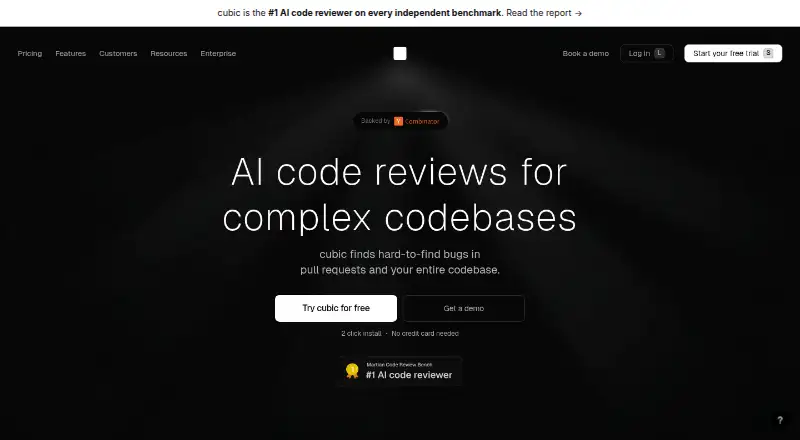
What Cubic is
Cubic provides AI code reviews for pull requests and scans codebases for bugs and security issues. It checks proposed changes against the full codebase and team rules, including possible effects elsewhere in a project. The service learns from senior developers’ past review comments and team feedback. Its workflow can auto-approve low-risk pull requests, assign each PR a merge confidence score from 1 to 5, and let coding agents fix findings. Cubic supports GitHub, including GitHub Enterprise Cloud, and lists JavaScript, TypeScript, Python, Go, Ruby, Java, and C# among supported languages. It says reviews run in isolated containers, with AI processing the PR diff and only the context needed for review. Cubic also reports TLS 1.2+ encryption in transit, AES-256 encryption at rest, and a policy barring AI providers from training on customer code. Starter Free includes 20 reviews a month for public repositories. Team is $30 a month billed yearly per developer; higher plans list larger reviewed-line allowances and added features.
Who it suits
Cubic suits teams using GitHub that want AI-assisted pull request reviews alongside codebase scans. Its paid plans include reviewed-line allowances and features such as custom review agents, while the free plan is for public repositories.
What it does well
- Checks changes against the full codebase and team rules.
- Can score merge confidence from 1 to 5.
- Supports seven listed programming languages.
- Reviews run in isolated containers.
What to know first
- GitHub Enterprise Server is not supported.
- GitLab and Bitbucket are not supported.
- Free plan covers public repositories only.
- Reviews over 200 eligible files select up to 200.
Limits
Starter Free allows 20 PR reviews a month and is free for public repositories. Team includes 40,000 reviewed lines per developer; when a team exceeds its reviewed-line allowance, reviews pause until the next billing period unless an admin enables flex capacity at $20 per 10,000 extra lines, up to a configured monthly limit. Pull requests with more than 200 eligible files are reviewed using up to 200 of the highest-priority eligible files.
Plans
| Plan | Billed and limits | Price |
|---|---|---|
| Starter Free | 20 PR reviews a month · free for public repositories | Free |
| Starter | 20 PR reviews/month · AI review agent · up to 5 custom agents · PR descriptions · Jira, Linear, Asana, Notion · unlimited AI wikis | Free |
| Max | billed yearly · 160k reviewed lines/developer · all Pro features | $160 a month |
| Max | billed monthly · 160k reviewed lines/developer · all Pro features · maximum review allowance | $200 a month |
| Team | billed yearly · 40k reviewed lines/developer · 5 custom agents · auto approvals · PR and CLI reviews · 5 private wikis · Jira, Linear, Asana | $30 a month |
| Team | billed monthly · 40k reviewed lines/developer · 5 custom agents · auto approvals · PR and CLI reviews · 5 private wikis · Jira, Linear, Asana · standard analytics | $40 a month |
| Pro | billed yearly · 80k reviewed lines/developer · 10 custom agents · faster PR and CLI reviews · coding agents · scans for 3 repositories · premium support and shared Slack | $79 a month |
| Pro | billed monthly · 80k reviewed lines/developer · 10 custom agents · faster reviews · coding agents · scans for 3 repositories · 20 private wikis · Confluence and MCP · analytics API · premium support | $99 a month |
The first 8 of 10 plans, as cubic.dev lists them, read 9 Oct 2026. The maker's own page has the final word. Every plan
Getting started
- Visit cubic.dev.
- Choose the Starter Free plan or a paid plan that fits your team.
- Connect a GitHub repository; GitHub Enterprise Cloud is supported.
- Use Cubic on the web, or download a desktop build for macOS, Windows, or Linux.
Cubic is an AI code-review service for teams using GitHub pull requests. It is best for teams that want reviews shaped by their codebase and their own review practices. Its automated workflow and codebase scans are useful strengths, but GitHub-only hosting and per-developer review limits make it a poor fit for teams on other hosts or with unpredictable review volume.
Overview
Cubic checks pull requests against the wider codebase and team rules, so review can account for possible effects beyond the changed lines. It also scans codebases for bugs and security issues. Learning from senior developers’ past comments and team feedback gives teams a way to align suggestions with established review practices.
Review scope has a hard boundary: on a pull request with more than 200 eligible files, Cubic selects up to 200 of the highest-priority files. Teams making exceptionally broad changes should not expect every eligible file to be reviewed.
Key features
- Review workflow: Cubic can auto-approve low-risk pull requests, assign each pull request a merge confidence score from 1 to 5, and let coding agents fix findings. That suits teams seeking to reduce routine review work while keeping a signal about merge confidence; teams that want review to remain entirely manual may not need these controls.
- Team-specific context: Past senior-developer comments and feedback on suggestions inform its review behavior. This is useful for teams trying to make automated review reflect their practices, though it depends on having relevant review history and feedback.
- Language and host coverage: Cubic describes itself as language-agnostic and names JavaScript, TypeScript, Python, Go, Ruby, Java, and C# among supported languages. Host support is narrower: it supports GitHub and GitHub Enterprise Cloud, but not GitHub Enterprise Server, GitLab, or Bitbucket.
- Security and data handling: Cubic says it is SOC 2 Type I compliant, encrypts data in transit with TLS 1.2+ and at rest with AES-256, and bars its AI providers from training on customer code. Reviews run in isolated containers, with AI processing the pull request diff and only the context needed for review.
Pricing
Cubic has a free plan and a free trial. Starter Free costs nothing and allows 20 PR reviews a month; it is free for public repositories. That gives public projects a way to use the service without a paid subscription, but the monthly review cap is restrictive for busier teams.
Team costs $30 a month, billed yearly, at $30 per developer / month. It includes 40k reviewed lines per developer, 5 custom review agents, 5 private wikis, PR and CLI reviews, and Jira, Linear, and Asana integrations. It is the entry paid tier for teams wanting private team resources and workflow integrations, but the per-developer allowance means total capacity scales with seats and can be exceeded.
Pro costs $79 a month, billed yearly, at $79 per developer / month. It doubles the reviewed-line allowance to 80k per developer, raises the custom review agents to 10, adds codebase scans for 3 repositories, and includes premium support with a shared Slack channel. It fits teams that need scanning and closer support, though its higher per-developer price is a meaningful step up from Team.
Max costs $160 a month, billed yearly, at $160 per developer / month. It includes every Pro feature and provides 160k reviewed lines per developer. The larger allowance is for teams with heavier review volume; teams that do not need that capacity may find Pro a more proportionate choice.
Enterprise has custom pricing and offers SSO/SAML, audit logs, custom terms, and custom review limits, with dedicated support. It is aimed at organizations needing those controls or negotiated limits rather than a fixed per-developer package.
Team, Pro, and Max reviewed-line allowances are not unlimited: reviews pause until the next billing period when a team exceeds its allowance, unless an admin enables flex capacity at $20 per 10,000 extra lines, up to a configured monthly limit. Confluence and MCP integrations are available on certain paid plans.
Platforms
Cubic is available on the web and offers desktop builds for macOS Apple Silicon, macOS Intel, Windows, and Linux. Its platform coverage does not expand its host support beyond GitHub and GitHub Enterprise Cloud.
Who it's for
Cubic is a sensible choice for GitHub teams that want codebase-aware pull request reviews, configurable team context, automated triage, or codebase scans. It is less suitable for teams on GitLab, Bitbucket, or GitHub Enterprise Server, and for organizations whose review volume regularly exceeds the included lines and cannot be managed through flex capacity.
Pros and cons
- Pro: Reviews consider the wider codebase and team rules, which can catch risks outside the changed lines.
- Pro: Senior-reviewer history and team feedback can tune suggestions to a team's practices.
- Pro: Scans, confidence scoring, low-risk auto-approval, and agent-assisted fixes support more than basic comment generation.
- Con: Git hosting is limited to GitHub and GitHub Enterprise Cloud, excluding several common alternatives.
- Con: Every paid tier has a per-developer reviewed-line allowance; exceeding it pauses reviews unless flex capacity is enabled.
- Con: Pull requests with more than 200 eligible files receive review on at most 200 selected files.
Alternatives
Compare AI Code Review Tools or Code review software if you want to survey the category. Consider CodeRabbit for another freemium option with public-repository reviews free forever and broader listed platform coverage, including self-hosted and extension options. DeepSource is another freemium choice; its Open Source plan includes unlimited public repositories and unlimited team members, alongside a stated monthly pull request review allowance. LiveReview is another freemium alternative with listed extension and self-hosted platform options. Octopus may suit teams seeking self-hosting: its free, source-available plan has no platform fees but requires customers to supply AI keys or run local models. ThinkReview offers a $10 a month Lite plan with 15 review credits a day and up to 3 custom review agents per pull request. Ironwood AI is a paid alternative with a 30-day evaluation that includes two developers and unlimited repositories and reviews. AI Code Reviewer is a free, self-hosted option where users pay only their model provider’s usage. Codacy may appeal to developers seeking an IDE plugin with support for 38 programming languages and VSCode, JetBrains, and Cursor integrations.
Verdict
Choose Cubic if your team works on GitHub and wants pull request reviews informed by codebase context and team feedback, with scanning and workflow automation in the same service. Look elsewhere if you need another Git host, broader large-change review coverage, or review capacity without per-developer limits and overage decisions.
Verdict
Cubic combines pull request reviews, codebase scanning, and team-specific review context for GitHub repositories. Check its host support and reviewed-line allowances against your team's needs before choosing a plan.
Questions
Is Cubic free?
Yes. Starter Free costs nothing and includes 20 PR reviews a month for public repositories.
How much do the paid plans cost?
Team is $30 per developer per month, billed yearly; Pro is $79 per developer per month, billed yearly; and Max is $160 per developer per month, billed yearly. Enterprise Custom has custom pricing.
Which code hosts does Cubic support?
Cubic supports GitHub, including GitHub Enterprise Cloud. GitHub Enterprise Server, GitLab, and Bitbucket are not supported yet.
Which platforms can I use?
Cubic is available on the web. Desktop builds are offered for macOS Apple Silicon, macOS Intel, Windows, and Linux.
What integrations are listed?
The pricing page lists Jira, Linear, Asana, and Notion integrations. Confluence and MCP integrations are available on certain paid plans.
What security measures does Cubic describe?
Cubic says it is SOC 2 Type I compliant, encrypts data in transit with TLS 1.2+ and at rest with AES-256, and prohibits its AI providers from training on customer code. It says reviews run in isolated containers and AI processes the PR diff and only the context needed for review.
Facts from Cubic's own pages
- Analytics API
- The analytics REST API is available on Pro and Max, uses bearer API keys, exposes pull-request and issue data, and is limited to 1,000 requests per 15 minutes. · docs.cubic.dev, 21 Oct 2026
- Automated approval
- Low-risk pull requests can be auto-approved and every pull request receives a one-to-five merge-confidence score. · cubic.dev, 21 Oct 2026
- CLI
- The CLI installs with Cubic’s shell installer, supports local reviews and CI API-key authentication, and is documented for macOS, Linux and Windows. · docs.cubic.dev, 21 Oct 2026
- Codebase scans
- Scheduled scans run thousands of agents, notify issue owners, create tickets or pull requests, and can automatically fix findings. · cubic.dev, 21 Oct 2026
- Code handling
- cubic says reviews run in isolated containers and that AI processes the PR diff and only the context needed for the review. · docs.cubic.dev, 9 Oct 2026
- Coding-agent fixes
- Claude Code, Codex and Cursor can consume Cubic findings, while Cubic background agents can create fixes and resolve tickets after merges. · cubic.dev, 21 Oct 2026
- Company
- The maker identifies itself as cubic and describes the company as backed by Y Combinator. · cubic.dev, 9 Oct 2026
- Company founders and size
- Crunchbase identifies Allis Yao and Paul Sanglé-Ferrière as founders, lists London as headquarters and gives a 1–10 employee range. · crunchbase.com, 21 Oct 2026
- Company legal record
- Companies House lists MRGE Limited as an active private software-development company incorporated in London on 17 March 2025. · find-and-update.company-information.service.gov.uk, 21 Oct 2026
- Company profile
- LinkedIn describes cubic as privately held, headquartered in the software-development sector and employing 2–10 people. · linkedin.com, 21 Oct 2026
- Data deletion claim
- The homepage says reviews run in real time, then code is wiped and is not used to train the AI. · cubic.dev, 21 Oct 2026
- Desktop
- The download page offers cubic desktop builds for macOS Apple Silicon, macOS Intel, Windows, and Linux, and describes the service as available for web. · cubic.dev, 9 Oct 2026
- Desktop availability
- Desktop downloads are offered for Apple Silicon and Intel macOS, Windows and Linux, in addition to the web application. · cubic.dev, 21 Oct 2026
- Git hosting limit
- cubic supports GitHub, including GitHub Enterprise Cloud; GitHub Enterprise Server, GitLab, and Bitbucket are not supported yet. · cubic.dev, 9 Oct 2026
- Independent benchmark
- AgentBoards reported vendor benchmark precision of 56.3%, recall of 68.6% and F1 of 61.8% for Cubic. · agentboards.org, 21 Oct 2026
- Integrations
- Official integration documentation covers Linear, Jira, Asana and GitHub Issues, while the product also documents Notion, Confluence and Slack workflows. · docs.cubic.dev, 21 Oct 2026
- Language coverage
- Cubic describes itself as language-agnostic and names JavaScript, TypeScript, Python, Go, Ruby, Java and C# among supported languages. · cubic.dev, 21 Oct 2026
- Languages
- cubic describes itself as language-agnostic and lists JavaScript, TypeScript, Python, Go, Ruby, Java, and C# among supported languages. · cubic.dev, 9 Oct 2026
- Learning
- cubic learns from senior developers’ past review comments and from team feedback on its suggestions. · cubic.dev, 9 Oct 2026
- Licence
- FAUN categorizes Cubic as closed source; Cubic’s terms grant a revocable internal-use licence and prohibit copying, modification and reverse engineering. · faun.dev, 21 Oct 2026
- Limit: agent permissions
- AgentBoards flags background-agent write access as a risk, although fixes are constrained to branches rather than direct main-branch commits. · agentboards.org, 21 Oct 2026
- Limit: billing/support complaint
- The sole Trustpilot reviewer alleged that an unused free account was changed to paid, a saved card was charged and support did not respond for a week. · trustpilot.com, 21 Oct 2026
- Limit: Git hosting
- FAUN describes Cubic as GitHub-only and says it does not support GitLab, Bitbucket or Azure DevOps. · faun.dev, 21 Oct 2026
- Limit: interface value
- The same comparison said Cubic’s separate review application and diagrams were not useful to that team, and its fix feature was not tested. · markmarkoh.com, 21 Oct 2026
Where Cubic stands on Freedom251
- AI Code Review Tools#4 of 47
- Code review software#5 of 50
- Pull Request Automation Tools#4 of 29