Freedom251 › AI Code Review Tools
ThinkReview
What ThinkReview is
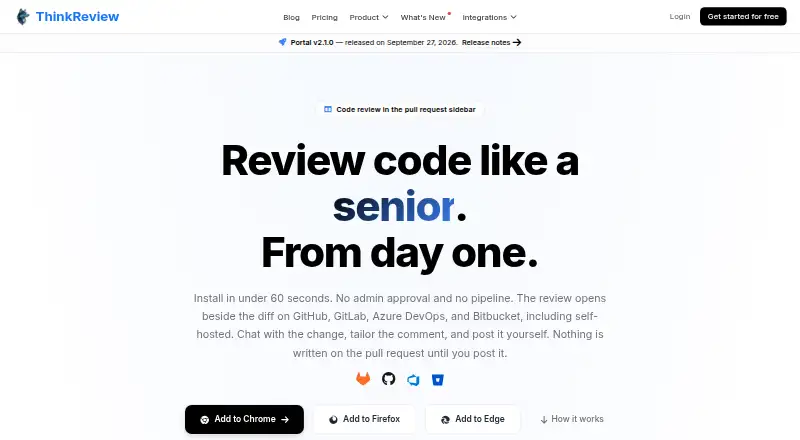
ThinkReview provides AI code reviews in a browser sidebar on pull and merge request pages. Its extension supports GitHub, GitLab, Azure DevOps, and Bitbucket, including several self-hosted editions. Reviews can suggest code-quality improvements, analyze security, recommend practices, score quality, and handle follow-up questions. Developers can chat about a change and edit a review comment; it is not added to the pull request unless they choose to post it. Users can set review standards and create agents for their projects and technology stacks. ThinkReview MCP supports live reviews from Cursor, Claude Code, and Copilot, returning structured feedback. Reviews can also run on local models with Ollama, including on air-gapped machines. The Free plan is for individual developers, with two daily review credits and small pull requests up to 1,000 lines of code changes. Lite is $10 a month and Professional is $16 a month. The maker says cloud diffs are processed in memory and discarded, while cloud conversation data may be retained for up to 90 days. Trial duration is listed inconsistently: 7 or 14 days in the FAQ, and 5 days on the homepage.
Who it suits
ThinkReview suits developers and teams seeking code-quality feedback and a review workflow across supported code hosts. Local-model and self-hosted options may suit teams with specific deployment needs.
What it does well
- Supports four named code hosts, including self-hosted editions.
- Offers security analysis and custom review rules.
- Can run reviews locally with Ollama.
- Free plan includes two review credits per day.
- Users control when review comments are posted.
What to know first
- Free plan limits reviews to small pull requests.
- Cloud conversation data may be retained for up to 90 days.
- Trial duration differs between listed pages.
- Lite costs $10 a month; Professional costs $16 a month.
Limits
The Free plan provides two review credits per day and covers small pull requests up to 1,000 lines of code changes. Lite lists 15 review credits per day and pull requests up to 40,000 lines; Professional lists 25 review credits per day. Lite allows up to three custom review agents per pull request, and Professional allows up to five.
Plans
| Plan | Billed and limits | Price |
|---|---|---|
| Lite | 15 review credits/day · PRs up to 40,000 lines · up to 3 custom review agents per PR · GitLab custom domains & Bitbucket Cloud | $10 a month |
| Professional | 25 review credits/day · up to 5 custom review agents per PR · GitHub Enterprise Server · Azure DevOps Cloud & Server · priority support | $16 a month |
| Free | For individual developers · GitLab.com & GitHub.com · 2 review credits/day · small PRs up to 1,000 lines of code changes | On request |
As thinkreview.dev lists them, read 4 Oct 2026. The maker's own page has the final word.
Getting started
- Open https://thinkreview.dev/ and choose the Free plan or a paid plan.
- Use the browser extension on a supported pull or merge request page.
- Connect a supported GitHub, GitLab, Azure DevOps, or Bitbucket service.
- Chat about a change, edit the review comment, and post it when ready.
- For local-model reviews, use Ollama; for live MCP reviews, connect Cursor, Claude Code, or Copilot.
ThinkReview is a code-review assistant for pull and merge requests, with browser-extension and coding-assistant workflows. It is best suited to developers and teams who want to tailor feedback and approve comments before they reach a pull request. Its combination of project-specific rules and local-model support is appealing, though daily caps and trial-term uncertainty deserve attention.
Overview
Reviews are manually triggered in a browser sidebar. You can discuss a change, edit the review comment and post it yourself; nothing is written to the pull request until you choose to publish it. That safeguard makes ThinkReview a better fit for teams seeking an assistant than for those expecting an automatic reviewer to leave comments on their behalf.
Feedback covers code quality, security and best practices, alongside quality scoring, follow-up questions and fix suggestions. Custom rules and project-specific agents can align reviews with a team's standards and technology stack. This flexibility is useful when general recommendations are not enough, but review-credit and agent limits constrain how much feedback teams can request.
Key features
Code-host and assistant workflows
The extension supports GitHub, GitLab, Azure DevOps and Bitbucket, including several self-hosted editions. ThinkReview MCP also supports live pull-request reviews from Cursor, Claude Code and Copilot, returning structured feedback. This gives teams more than one way to bring reviews into their development workflow.
Local and enterprise processing
With Ollama, reviews can run on local models without sending patches to the cloud, including on air-gapped machines. That is a meaningful option for teams that cannot send code diffs to hosted services. The Enterprise Gateway routes diffs, Git tool results and model traffic through the customer's network, but it is available on the Teams plan after enterprise provisioning.
The maker says cloud review diffs are processed in memory, discarded rather than stored, and not used for AI training. Cloud conversation data may be retained for up to 90 days for operational purposes, so teams should weigh that retention separately from diff handling.
Pricing
ThinkReview has a free plan and paid Lite and Professional plans. The free plan has no published price and is aimed at individual developers: it includes two review credits per day, supports GitHub.com and GitLab.com, and is limited to small pull requests of up to 1,000 lines of code changes. That is a narrow way to try the workflow, not a fit for larger changes or broader host coverage.
Lite costs $10 a month and includes 15 review credits per day, pull requests up to 40,000 lines, up to three custom review agents per pull request, GitLab custom domains and Bitbucket Cloud. It suits developers or smaller teams that need substantially more daily capacity and larger pull-request support than Free, but its host coverage is more limited than Professional.
Professional costs $16 a month and raises the allowance to 25 daily credits and up to five custom review agents per pull request. It adds GitHub Enterprise Server, Azure DevOps Cloud and Server, and priority support. Teams using those hosts, or needing more daily reviews and agents, have a concrete reason to pay the difference; other users may not need its expanded coverage.
The pricing FAQ says Lite and Professional have a seven-day trial on monthly billing or a 14-day trial on annual billing, while the homepage pricing section labels both trials as five days. Confirm the applicable trial duration before relying on it. Support is offered by live chat and email, with typical responses within 24 hours.
Platforms
ThinkReview supports API, browser extension, Linux, macOS, web and Windows. Its deployment model is hybrid, with local-model use through Ollama and an enterprise network-routing option alongside cloud reviews.
Who it's for
ThinkReview is a sensible choice for developers and teams who want review suggestions shaped by their own rules, across several code hosts, while retaining control over what gets posted. It is less compelling for teams that need uncapped daily review volume, automatic posting, or a simple, unambiguous trial commitment.
Pros and cons
- Pros: Comments remain under user control until posted, reducing the risk of unwanted AI feedback appearing on a pull request.
- Pros: Custom rules and project-specific agents can make feedback more relevant to a team's standards and stack.
- Pros: Ollama support enables local reviews, including on air-gapped machines.
- Cons: The free plan allows only two daily credits and small pull requests, limiting its usefulness for sustained or larger reviews.
- Cons: Paid plans still impose daily credit caps and per-pull-request agent limits.
- Cons: Trial duration differs between the FAQ and homepage pricing section.
- Cons: Cloud conversation data may be retained for up to 90 days, despite the separate statement that cloud diffs are discarded after in-memory processing.
Alternatives
Explore the AI Code Review Tools directory if you want to compare the category more broadly.
Choose CodeRabbit if its free reviews for public repositories suit your needs. DeepSource is an alternative with a free Open Source plan that includes unlimited public repositories and team members, plus a monthly pull-request review allowance. Consider LiveReview as another freemium option. Octopus may suit teams seeking a self-hosted, source-available option with no platform fees, using their own AI keys or local models.
Ironwood AI offers a paid product with a 30-day evaluation for two developers and one active installation. AI Code Reviewer is a free option where users pay only their model provider's usage costs. Codacy has a free Developer plan with an IDE plugin and integrations for VSCode, JetBrains and Cursor. CodeAnt AI is another paid alternative with a 14-day free trial and no credit card required.
Verdict
Choose ThinkReview if your team wants project-tailored review feedback across its code hosts, with a human deciding what reaches the pull request and local processing available when cloud patches are unsuitable. Look elsewhere if daily limits are too restrictive, unattended posting is essential, or the differing trial terms make the commitment hard to assess.
Verdict
ThinkReview combines code-review feedback, customizable rules, and user-controlled posting across several code hosts. Check the plan limits and trial details, especially if local processing or longer-term data handling matters to your team.
Questions
Is ThinkReview free?
Yes. Its Free plan is for individual developers and includes two review credits per day for small pull requests up to 1,000 lines of code changes.
What do Lite and Professional cost?
Lite costs $10 a month. Professional costs $16 a month.
How long is the free trial?
The pricing FAQ says Lite and Professional include a 7-day trial with monthly billing or a 14-day trial with annual billing. The homepage pricing section labels both as free 5-day trials.
Which code hosts are supported?
ThinkReview supports GitHub, GitLab, Azure DevOps, and Bitbucket, including several self-hosted editions.
Can reviews run locally?
Yes. With Ollama, reviews can run on local models without sending patches to the cloud, including on air-gapped machines.
What happens to cloud review data?
The maker says cloud review diffs are processed in memory, discarded, and not stored or used for AI training. The privacy policy says cloud conversation data may be retained for up to 90 days for operational purposes.
Facts from ThinkReview's own pages
- Code retention
- The maker says cloud review diffs are processed in memory and discarded without being stored or used for AI training. · thinkreview.dev, 4 Oct 2026
- Conversation data
- The privacy policy says cloud-based conversation data may be retained for up to 90 days for operational purposes. · thinkreview.dev, 4 Oct 2026
- Custom rules and agents
- Users can define review standards and create review agents tailored to their projects and technology stack. · thinkreview.dev, 4 Oct 2026
- Enterprise deployment
- The Enterprise Gateway routes diffs, Git tool results, and model traffic through the customer's network and is available on the Teams plan after enterprise provisioning. · thinkreview.dev, 4 Oct 2026
- Git integrations
- The extension supports GitHub, GitLab, Azure DevOps, and Bitbucket, including several self-hosted editions. · thinkreview.dev, 4 Oct 2026
- Intended users
- The maker describes ThinkReview as built for developers and teams who want to improve code quality and speed up reviews. · thinkreview.dev, 4 Oct 2026
- Local AI
- With Ollama, reviews can run on local models without sending patches to the cloud, including on air-gapped machines. · thinkreview.dev, 4 Oct 2026
- MCP integrations
- ThinkReview MCP supports live PR reviews from Cursor, Claude Code, and Copilot and returns structured feedback. · thinkreview.dev, 4 Oct 2026
- Product
- ThinkReview provides AI code reviews in a browser sidebar on pull and merge request pages. · thinkreview.dev, 4 Oct 2026
- Review features
- The product offers code quality suggestions, security analysis, best-practice recommendations, quality scoring, and follow-up questions. · thinkreview.dev, 4 Oct 2026
- Review workflow
- Users can chat about a change, edit the review comment, and post it themselves; nothing is written to the pull request until they post. · thinkreview.dev, 4 Oct 2026
- Support
- The contact page offers live chat and email support and says the team typically responds within 24 hours. · thinkreview.dev, 4 Oct 2026
- Trial
- The pricing FAQ states Lite and Professional plans include a 7-day trial on monthly billing or a 14-day trial on annual billing. · thinkreview.dev, 4 Oct 2026
- Trial duration discrepancy
- The pricing section shown on the homepage labels Lite and Professional trials as free 5-day trials. · thinkreview.dev, 4 Oct 2026
Where ThinkReview stands on Freedom251
- AI Code Review Tools#23 of 48