Freedom251 › AI Code Review Tools
AI Code Reviewer
What AI Code Reviewer is
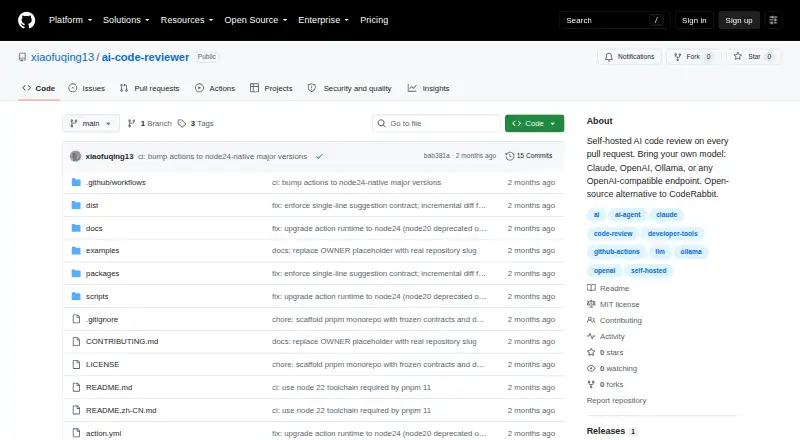
AI Code Reviewer reviews GitHub pull requests automatically and posts findings as a summary and comments on changed lines. Findings can include severity, explanations, and one-click suggestion blocks. It runs as a GitHub Action configured with a workflow file, without requiring a server or checkout step. Teams can select Anthropic, OpenAI, local Ollama, or an OpenAI-compatible endpoint as the model provider. Review controls include severity thresholds, file include and exclude patterns, and incremental reviews; a Markdown rules file can specify house style or framework conventions. The action reads diffs through the GitHub API and does not check out, build, or run pull-request code. Provider keys are passed through GitHub secrets and masked in logs. The project says it does not proxy requests through its own service; with Ollama on a self-hosted runner, code and diffs stay within the user's network. The software is MIT-licensed and free, though model-provider usage may cost money. By default, it skips reviews when more than 50 files change and limits comments to 20 per pull request.
Who it suits
It suits teams using GitHub that want automated pull-request reviews with control over model provider and review rules. The project presents self-hosting as an option for teams prioritizing control over code privacy.
What it does well
- Runs as a GitHub Action without a server
- Supports four model-provider options
- Custom Markdown rules for house conventions
- Does not check out or run pull-request code
- Free and MIT-licensed
What to know first
- Skips changes involving more than 50 files by default
- Caps inline comments at 20 per pull request
- Skips public-repository fork pull requests
Limits
By default, the action skips reviews when more than 50 files change and limits inline comments to 20 per pull request. Reviews of public-repository fork pull requests are skipped because GitHub does not expose repository secrets to those workflows.
Plans
| Plan | Billed and limits | Price |
|---|---|---|
| Free | Free; users pay only their model-provider or compute costs · Self-hosted GitHub Action · no per-seat charge · model usage billed separately | Free |
As github.com lists them, read 21 Oct 2026. The maker's own page has the final word.
Getting started
- Visit https://github.com/xiaofuqing13/ai-code-reviewer.
- Add the action to a GitHub Actions workflow file.
- Choose a supported model provider and pass its API key through GitHub secrets, or configure local Ollama.
- Set the workflow permissions for contents: read and pull-requests: write.
- Optionally configure review controls and add a Markdown rules file.
Verdict
AI Code Reviewer offers configurable automated review comments for GitHub, with several model choices and self-hosting options. Teams should account for its file and comment caps, as well as the restriction on public-fork reviews.
Questions
Is AI Code Reviewer free?
Yes. The Free plan costs nothing; users pay only their model provider’s usage, with no other cost.
Which code host does it support?
It supports GitHub pull requests and runs as a GitHub Action.
Which model providers can I use?
It supports Anthropic, OpenAI, local Ollama, and OpenAI-compatible endpoints.
Is AI Code Reviewer open source?
Yes. The project is MIT-licensed and welcomes contributions.
Does it review pull requests from public repository forks?
Those reviews are skipped because GitHub does not expose repository secrets to pull_request workflows from forks.
Does the project offer paid support?
The project README does not state a paid support offering.
Facts from AI Code Reviewer's own pages
- Chrome extension details
- The unrelated Chrome listing reports eight users, version 0.0.5, 346 KiB size and an update date of February 21, 2026. · chromewebstore.google.com, 21 Oct 2026
- Configuration
- Settings can be supplied in .github/ai-code-reviewer.yml or as action inputs, with action inputs taking precedence. · github.com, 21 Oct 2026
- Cost example
- The FAQ estimates roughly $0.05–$0.20 per typical pull request with Claude Sonnet, a few cents with Haiku and zero model charge with local Ollama apart from compute. · github.com, 21 Oct 2026
- Custom guidelines
- A Markdown rules file can provide house style or framework conventions for reviews. · github.com, 4 Oct 2026
- Custom rules
- A Markdown rules_file can add repository-specific coding guidelines, and it is read from the base branch. · github.com, 21 Oct 2026
- Data handling
- The project says it does not proxy requests through a service it runs; with Ollama on a self-hosted runner, code and diffs stay within the user’s network. · github.com, 4 Oct 2026
- Development quality bar
- Contributor documentation specifies type checking, linting, Vitest tests, action builds and at least 80% coverage for all metrics. · github.com, 21 Oct 2026
- Execution safety
- The action reads diffs through the GitHub API and does not check out, build or execute pull-request code. · github.com, 21 Oct 2026
- Incremental behavior
- When incremental mode is enabled, a new push reviews only newly added commits and rerunning the same head SHA is skipped. · github.com, 21 Oct 2026
- Installation
- Installation consists of adding a GitHub Actions workflow using xiaofuqing13/ai-code-reviewer@v1 and a provider secret; checkout and a separate server are not required. · github.com, 21 Oct 2026
- Integrations
- Documented OpenAI-compatible examples include DeepSeek, GLM, Kimi, Together, Groq, vLLM and LM Studio through a configurable base URL. · github.com, 21 Oct 2026
- Large-change handling
- For very large pull requests the reviewer caps files or chunks and reports the truncation in its summary. · github.com, 21 Oct 2026
- Licence
- The repository is released under the MIT License, permitting reuse, modification, distribution and sale subject to retaining the notice and disclaiming warranty. · github.com, 21 Oct 2026
- License and support
- The project is MIT-licensed and welcomes contributions; the README does not state a paid support offering. · github.com, 4 Oct 2026
- Limit: G2 CodeAnt listing
- Reviews on that separate CodeAnt product mention stylistic nitpicks, cautious suggestions requiring manual adjustment and integration taking time. · g2.com, 21 Oct 2026
- Limit: Product Hunt name collision
- Product Hunt discussion for the unrelated product reports single-file or text-box-only review, missed async/await errors, client-side exceptions and long-code formatting problems. · producthunt.com, 21 Oct 2026
- Maker identity
- The GitHub account displays the name xiaofuqing and lists 48 repositories, six followers and one following. · github.com, 21 Oct 2026
- Model providers
- The action supports Anthropic Claude, OpenAI, local Ollama and OpenAI-compatible endpoints. · github.com, 21 Oct 2026
- Notable limits
- The default configuration skips reviews when more than 50 files change and caps inline comments at 20 per pull request. · github.com, 4 Oct 2026
- Package status
- The package manifest describes version 0.1.0, marks the workspace private and identifies the project as an MIT-licensed self-hosted GitHub pull-request reviewer. · github.com, 21 Oct 2026
- Permissions
- The example workflow requests contents read and pull-requests write permissions. · github.com, 21 Oct 2026
- Praise: G2 CodeAnt listing
- Reviews on the separately identified CodeAnt product praise accurate actionable findings, faster reviews and catching issues missed by linters. · g2.com, 21 Oct 2026
- Privacy claim
- The project says it operates without a vendor proxy and that Ollama on a self-hosted runner keeps code and diffs inside the user network. · github.com, 21 Oct 2026
- Private repositories
- The FAQ says private repositories can run reviews for collaborator branches because their workflows can access secrets. · github.com, 21 Oct 2026
Where AI Code Reviewer stands on Freedom251
- AI Code Review Tools#1 of 48