Freedom251 › Ecommerce platforms

Crystallize
by Crystallize
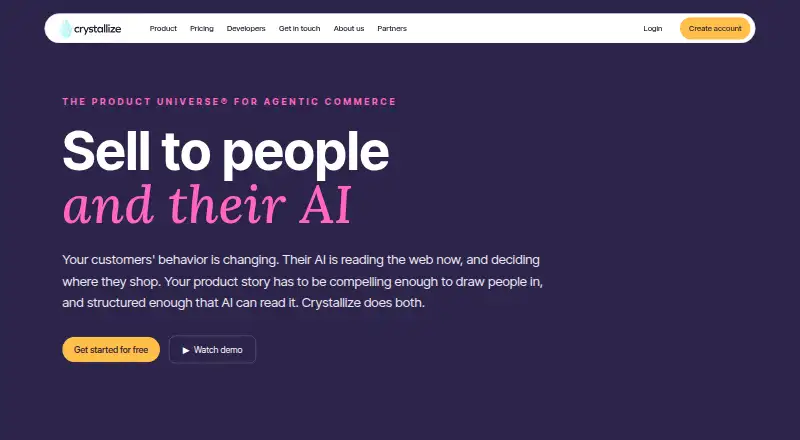
What Crystallize is
Crystallize is a hosted, composable commerce platform for managing products, content, media and commerce through one model, admin and API. Its commerce engine supports product and pricing models, subscriptions, customer hierarchies, fulfillment pipelines and checkout analytics. APIs and webhooks connect ERP, CRM, payment and logistics systems, while native GraphQL and MCP interfaces let AI agents read catalogs, draft quotes, configure subscriptions and fill carts. The headless architecture supports frontends for web, mobile, kiosk and other platforms. Official integration documentation lists payment gateways including Stripe, Klarna, Vipps, Dintero, Adyen, Mollie, Montonio, Quickpay, Two and Razorpay. The open-source CLI supports CI/CD automation. Crystallize states that it complies with GDPR and CCPA. The company was founded in 2017 and is headquartered in Skien, Telemark, Norway. A free plan is available; Atom costs $949 a month, billed plus metering. Particle and Atom allow one tenant per project, while Crystal includes three.
Who it suits
Crystallize suits businesses building omnichannel commerce across multiple frontend platforms and connecting existing business systems. Its three-tenant Crystal plan may suit teams that need production, staging and development environments.
What it does well
- Combines products, content, media and commerce in one model.
- Supports subscriptions, fulfillment pipelines and checkout analytics.
- GraphQL and MCP interfaces are available natively.
- Supports web, mobile, kiosk and other frontends.
- Free plan available; open-source CLI supports CI/CD.
What to know first
- Particle and Atom allow one tenant per project.
- Atom costs $949 a month plus metering.
- Transaction fee varies.
Limits
Particle includes one tenant per project, 25 orders, 100 items, and 5 GB of bandwidth. Atom includes one tenant, 500 orders, 5,000 items, 50 GB of bandwidth, and 500,000 API calls. Crystal includes three tenants; its order, item, and bandwidth allowances are tailored.
Plans
| Plan | Billed and limits | Price |
|---|---|---|
| Atom | + metering/month · 1 tenant per project · unlimited users · full feature set · unlimited languages · 500 orders · 5000 items · 50 GB bandwidth · 500000 API calls | $949 a month |
| Particle | + metering / month · 1 tenant per project · unlimited users · full feature set · unlimited languages · 25 orders · 100 items · 5 GB bandwidth · 25000 API calls | Free |
| Crystal | + metering / month · 3 tenants included · unlimited users · unlimited languages · enterprise features · SAML / SSO · tenant cloning | On request |
As crystallize.com lists them, read 28 Sept 2026. The maker's own page has the final word.
Getting started
- Visit https://crystallize.com/.
- Choose a plan: Particle, Atom, or Crystal.
- Use the hosted platform and its admin and API to work with products, content, media, and commerce.
- Connect systems through APIs and webhooks, or choose from the listed payment integrations.
- Build a frontend for web, mobile, kiosk, or another platform.
Crystallize is a hosted, headless commerce platform for businesses managing product data, content, and sales operations across channels. It is best suited to teams with developers who can build customer-facing experiences and connect external systems. Its broad commerce model is a strength; Atom’s $949 a month price, plus metering, makes the cost commitment substantial.
Overview
Crystallize brings products, content, media, and commerce into a shared model, admin, and API called the Product Universe. Its Commerce Engine extends that foundation with product and pricing models, subscriptions, customer hierarchies, fulfillment pipelines, and checkout analytics. This is a stronger fit for businesses that need both catalog management and commerce operations than for teams seeking a storefront ready to use as-is.
Its API-first architecture and webhooks connect with ERP, CRM, payment, and logistics systems. Official payment integrations include Stripe, Klarna, Vipps, Dintero, Adyen, Mollie, Montonio, Quickpay, Two, and Razorpay. Crystallize exposes GraphQL and MCP natively, allowing AI agents to read catalogs, draft quotes, configure subscriptions, and fill carts; those capabilities are most useful to teams able to build and maintain integrations around them.
The platform is hosted on AWS, with databases on MongoDB Atlas and search indexes on Elasticsearch Cloud. It supports passwordless login through magic links or OAuth social connections managed with AWS Cognito. Crystallize states that it complies with GDPR and CCPA. Founded in 2017, it is a New Normal Group company based in Skien, Telemark, Norway.
Key features
Catalog and commerce in one model
The shared Product Universe covers products, content, and media through one model, admin, and API. That can reduce the need to manage catalog information separately from related content, while the Commerce Engine handles subscriptions, pricing, fulfillment, and checkout analytics.
Composable connections and frontends
Crystallize is platform-agnostic: businesses can build frontends for web, mobile, kiosks, and other platforms. Its APIs and webhooks support connections to operational systems, while the open-source CLI detects the operating system, downloads the latest CLI from GitHub, and supports CI/CD automation. This flexibility gives development teams room to shape a deployment, but also puts responsibility for the customer-facing experience and integration work on them.
Commerce features
Abandoned cart recovery, digital products, and an app marketplace complement the core catalog and commerce functions. Transaction fees vary, so businesses should account for that alongside plan pricing when estimating costs.
Pricing
Crystallize uses a freemium model. Particle has no published price; Atom costs $949 a month, billed plus metering per month; Crystal has custom pricing.
| Plan | What it includes | Best suited to |
|---|---|---|
| Particle | One tenant per project, unlimited users and languages, 25 orders, 100 items, and 5 GB bandwidth. | Small projects testing the platform or operating well within its low order, item, and bandwidth caps. |
| Atom | One tenant per project, unlimited users and languages, the full feature set, 500 orders, 5,000 items, 50 GB bandwidth, and 500,000 API calls. | Businesses needing the full feature set and larger quotas, provided the monthly price and metering fit their budget. |
| Crystal | Three tenants, unlimited users and languages, and tailored orders, items, and bandwidth. | Teams that need separate production, staging, and development tenants and tailored usage limits. |
Particle’s caps make it a constrained starting point rather than an obvious choice for a busy store. Atom increases the quotas and unlocks the full feature set, but still allows just one tenant and adds metering to its monthly bill. Crystal’s three tenants suit teams that need separate environments; its tailored limits and custom pricing call for a closer fit assessment.
Platforms
Crystallize is hosted and supports API, macOS, web, and Windows. Its headless model also supports frontends for mobile, kiosk, and other platforms, making it suitable for businesses that need to reach customers beyond a conventional website.
Who it's for
Crystallize suits commerce teams with developer capacity and a need to coordinate catalog data, content, and operational systems across multiple channels. It is a weaker fit for small stores that need generous quotas at a low cost, or businesses that want a ready-made storefront without building or connecting a frontend.
Pros and cons
- Pros: Products, content, media, and commerce share one model, admin, and API, reducing separation between catalog and commerce work.
- Pros: API-first connections, webhooks, and support for varied frontend platforms give development teams flexibility across channels and back-office systems.
- Pros: Unlimited users and languages across plans avoid seat and language caps as teams grow.
- Cons: Atom costs $949 a month before metering, a significant commitment for businesses that need more than Particle’s small quotas.
- Cons: Particle and Atom each allow only one tenant, limiting environment separation unless the business moves to Crystal.
- Cons: The headless approach requires a team to build or connect its customer-facing experience.
Alternatives
For a headless platform with a free, open-source core and no license or transaction fees, consider Aimeos; it supports API, Linux, self-hosted, and web deployments, unlike Crystallize’s hosted model.
Bagisto is a free open-source download for teams prepared to self-host; its stated requirements include PHP 8.3+, MySQL 8.0.32+ or MariaDB 10.3+, and at least 4 GB RAM.
Choose Sylius if its open-source, MIT-licensed on-premise edition and community support better suit your deployment; Sylius Plus costs €800 a year.
Unchained Engine is a free, open-source option with no licensing or per-transaction fees, but its hosting infrastructure is paid by the user.
Solidus offers a free DIY edition with customer-managed infrastructure for teams that prefer to manage their own hosting.
Fabric Commerce Platform is another paid option for API and web deployments.
Medusa is a freemium, self-hosted option; its Develop plan starts at $29 a month and includes 1M edge requests per month, 1,000 emails per month, one shared server, one long-lived environment, and one preview environment.
Kibo Commerce is an alternative for web-based commerce deployments.
Browse more options in Headless Ecommerce Platforms or Ecommerce platforms.
Verdict
Choose Crystallize if your team needs a flexible commerce foundation that unifies catalog, content, and operations and has the development capacity to build across channels. Its main advantage is that unified, extensible model; its main reason to look elsewhere is the cost and metering of Atom, alongside the single-tenant limit on both lower plans.
Verdict
Crystallize brings catalog management and commerce operations together with APIs for connecting external systems. Check the plan's tenant and usage limits against your deployment needs before choosing.
Questions
Is Crystallize free?
Yes. Crystallize has a free plan called Particle. Atom is listed at $949 a month, plus metering.
What platforms does Crystallize support?
The listed platforms are API, macOS, web, and Windows. Its headless architecture supports frontends for web, mobile, kiosk, and other platforms.
Which payment integrations are listed?
The listed gateways are Stripe, Klarna, Vipps, Dintero, Adyen, Mollie, Montonio, Quickpay, Two, and Razorpay.
What does the free Particle plan include?
Particle includes one tenant per project, unlimited users and languages, 25 orders, 100 items, and 5 GB of bandwidth.
What does Atom cost?
Atom costs $949 a month, billed plus metering per month.
Where is Crystallize based?
Crystallize is based in Skien, Telemark, Norway, and was founded in 2017.
Facts from Crystallize's own pages
- Abandoned cart recovery
- Yes · crystallize.com, 20 Sept 2026
- AI interfaces
- The platform exposes GraphQL and MCP natively so AI agents can read catalogs, draft quotes, configure subscriptions, and fill carts. · crystallize.com, 28 Sept 2026
- API architecture
- Crystallize is composable and API-first, with APIs and webhooks for connecting ERP, CRM, payment, and logistics systems. · crystallize.com, 28 Sept 2026
- App marketplace
- Yes · crystallize.com, 20 Sept 2026
- Authentication
- Login is passwordless through magic links or OAuth social connections managed with AWS Cognito. · crystallize.com, 28 Sept 2026
- Commerce capabilities
- The commerce engine supports product and pricing models, subscriptions, customer hierarchies, fulfillment pipelines, and checkout analytics. · crystallize.com, 28 Sept 2026
- Company history
- Crystallize was founded in 2017 and is a New Normal Group company. · crystallize.com, 28 Sept 2026
- Developer tooling
- The Crystallize CLI is open source, detects the operating system, downloads the latest CLI from GitHub, and supports CI/CD automation. · crystallize.com, 28 Sept 2026
- Digital products
- Yes · crystallize.com, 20 Sept 2026
- Founded
- 2017 · crystallize.com, 28 Sept 2026
- Free plan
- Yes · crystallize.com, 20 Sept 2026
- Frontend platforms
- Crystallize is headless and platform-agnostic, supporting frontends for web, mobile, kiosk, and other platforms. · crystallize.com, 28 Sept 2026
- Headquarters
- Skien, Telemark, Norway · crystallize.com, 28 Sept 2026
- Hosting model
- hosted · crystallize.com, 20 Sept 2026
- Infrastructure
- Crystallize is hosted on Amazon Web Services, databases run on MongoDB Atlas, and search indexes run on Elasticsearch Cloud. · crystallize.com, 28 Sept 2026
- Integrations
- Official integration documentation lists payment gateways including Stripe, Klarna, Vipps, Dintero, Adyen, Mollie, Montonio, Quickpay, Two, and Razorpay. · crystallize.com, 28 Sept 2026
- Product type
- Crystallize is a composable commerce platform built around the Product Universe, Commerce Engine, and headless architecture. · crystallize.com, 28 Sept 2026
- Sales channels
- omnichannel · crystallize.com, 20 Sept 2026
- Security compliance
- Crystallize states that it is fully compliant with GDPR and CCPA. · crystallize.com, 28 Sept 2026
- Paid from
- 949 · crystallize.com, 20 Sept 2026
- Support
- Particle includes community support and online docs, Atom adds a Pro SLA, and Crystal includes a dedicated engineering Slack channel, Enterprise SLA, professional services, advisory access, and roadmap access. · crystallize.com, 28 Sept 2026
- Tenant limit
- Particle and Atom allow only one tenant per project or store, while Crystal includes three tenants for production, staging, and development. · crystallize.com, 28 Sept 2026
- Transaction fee
- varies · crystallize.com, 20 Sept 2026
- Unified stack
- The Product Universe combines products, content, media, and commerce in one model, admin, and API. · crystallize.com, 28 Sept 2026
Where Crystallize stands on Freedom251
- Ecommerce platforms#37 of 280
- Headless Ecommerce Platforms#7 of 28