Freedom251 › Multichannel Ecommerce Software
Kibo Commerce
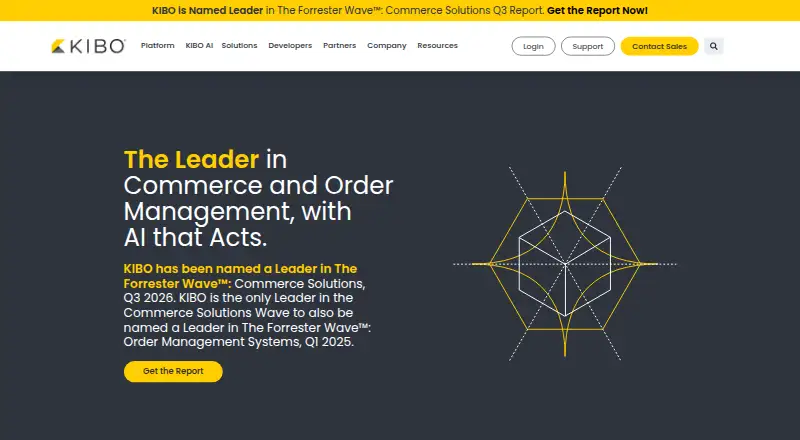
What Kibo Commerce is
Kibo Commerce is a hosted, web-based commerce platform for omnichannel sales, digital products, and app marketplace use. Its plans are organized into Order Management, B2C Commerce, and B2B Commerce offerings, with prices available on request. Order Management Starter includes inventory management, order information and returns, omnichannel fulfillment, shipping-carrier integration, payments, and customer service. Higher Order Management tiers add customizable routing and fulfillment optimization, then catalog, price-list, promotion, subscription, and dropship management. B2C plans start with catalog, cart and checkout, payments, order information and returns, service, and reporting. Higher tiers add inventory, merchandising and promotions, AI-powered search, and, in Complete, personalization, a headless CMS and page builder, point of sale, order management, and agentic commerce. B2B Essentials covers quotes, price lists, promotions, merchandising, inventory, account management, and field sales tools; higher tiers add search capabilities and, at Complete, personalization and other commerce functions. Kibo Commerce was founded in 2016 and is headquartered in Austin, Texas.
Who it suits
Kibo Commerce may suit businesses managing omnichannel sales, digital products, or different B2C and B2B commerce needs. Its plans cover order operations as well as customer-facing commerce capabilities.
What it does well
- Hosted web platform with omnichannel sales channels
- Order plans include returns and fulfillment features
- B2C plans include cart, checkout, and reporting
- B2B Essentials includes account and field sales tools
- App marketplace and digital products are supported
What to know first
- Pricing is available on request
- Platforms listed are web only
Plans
| Plan | Billed and limits | Price |
|---|---|---|
| Order Management Starter | Inventory management · Order information and returns · Omnichannel fulfillment · Shipping-carrier integration · Payments · Customer service | On request |
| Order Management Essentials | Everything in Starter · Customizable order-routing workflows · Fulfillment optimization | On request |
| Order Management Advanced | Everything in Essentials · Catalog management · Price-list management · Promotion and discount management · Subscriptions management · Dropship | On request |
| B2C Commerce Starter | Catalog management · Cart and checkout · Payments · Order information and returns · Customer service · Reporting and analytics | On request |
| B2C Commerce Essentials | Everything in Starter · Price-list management · Promotion and discount management · Merchandising tools · Inventory management | On request |
| B2C Commerce Advanced | Everything in Essentials · AI-powered search · Search and merchandising capabilities | On request |
| B2C Commerce Complete | Everything in Advanced · Personalization engine · Headless CMS and page builder · Point of sale · Order management system · Agentic commerce | On request |
| B2B Commerce Essentials | Quotes and price-list management · Promotion and discount management · Merchandising tools · Inventory management · Account management · Field sales tools | On request |
The first 8 of 14 plans, as kibocommerce.com lists them, read 20 Sept 2026. The maker's own page has the final word. Every plan
Getting started
- Visit https://kibocommerce.com/ to ask Kibo Commerce about pricing.
- Choose an Order Management, B2C Commerce, or B2B Commerce plan family.
- Select a tier based on the listed capabilities you need.
- Use the hosted, web-based platform.
Kibo Commerce combines ecommerce, order management and B2B capabilities for companies selling through multiple channels and locations. It is most suitable for established organisations with integration resources and complex fulfilment requirements. Its composable architecture and broad package coverage are compelling, but buyers must match their needs to separate plan families and obtain a custom quote.
Overview
Kibo is a hosted, multi-tenant SaaS platform built from independently deployable microservices behind an API gateway. That design gives larger teams a way to evolve commerce services separately while avoiding infrastructure management. It is less obviously suited to a small merchant looking for a simple, published-price storefront.
The portfolio separates order management, B2C commerce and B2B commerce. Kibo also supports digital products, omnichannel sales and an app marketplace, so it can accommodate mixed catalogues and channel strategies. The Austin, Texas company was founded in 2016.
Key features
Commerce and order operations
Commerce packages cover catalog management, cart and checkout, payments, promotions, merchandising and reporting. Order-management capabilities include real-time inventory visibility, order orchestration and fulfilment across locations and channels. Combining these functions can reduce coordination between separate commerce and fulfilment systems, although the required capabilities may sit in different tiers.
B2B and extensibility
B2B functionality includes account-specific pricing, quotes and self-service purchasing. REST and GraphQL APIs, webhooks and managed API extensions support custom front ends and connected workflows. KIBO Connect Hub offers pre-built integrations for ERP, fraud, ecommerce, PIM, 3PL, WMS, CRM, payments, shipping, punch-out and marketplace systems. That range is useful for integration-heavy operations, but a category-level integration list does not guarantee that a particular connector matches your process.
Security and service
Kibo describes encryption, role-based access, web application firewalls and bot protection. It says the platform maintains PCI DSS and SOC 1, 2 and 3 certifications and aligns with GDPR and CPRA. 24/7 support options and enterprise service-level agreements are available, which matters when commerce and fulfilment are business-critical.
Pricing
Kibo uses custom pricing across its paid plans, so the commercial decision depends on the package combination and requirements you present to the vendor.
Order management plans
Order Management Starter includes inventory management, order information and returns, omnichannel fulfilment, shipping-carrier integration, payments and customer service. It fits teams establishing core order operations. Essentials adds customisable order-routing workflows and fulfilment optimisation, making it the more appropriate step for differentiated routing. Advanced adds catalog, price-list, promotion and discount, subscriptions and dropship management for broader commerce operations.
B2C plans
B2C Commerce Starter provides catalog, cart and checkout, payments, order information and returns, customer service, and reporting and analytics. Essentials adds price lists, promotions and discounts, merchandising tools and inventory management. Advanced adds AI-powered search and search and merchandising capabilities. Complete adds a personalization engine, headless CMS and page builder, point of sale, an order management system and agentic commerce. The lower tiers are sensible when those advanced experiences are unnecessary; Complete is aimed at organisations wanting a wider customer-experience and store stack in one package.
B2B and combined plans
B2B Commerce Essentials covers quotes and price-list management, promotions and discounts, merchandising, inventory, account management and field-sales tools. B2B Commerce Advanced adds AI-powered search plus search and merchandising capabilities, while B2B Commerce Complete adds personalization, headless CMS and page builder, order management, point of sale and agentic commerce. Kibo also presents Essentials with starter features plus price lists, promotions and discounts, merchandising and inventory, and Complete with advanced features plus personalization, headless CMS and page builder, POS, order management, agentic commerce, dropship and reverse logistics. These overlapping families make a requirements-to-tier review essential before purchase.
Platforms
Kibo is hosted and available through web and API access. Its omnichannel orientation supports operations spanning multiple sales channels and fulfilment locations.
Who it's for
Kibo is a strong candidate for mid-sized and enterprise retailers, distributors and brands that need B2C or B2B commerce tied closely to inventory and fulfilment. It is particularly relevant when teams need headless or API-led development, account-specific B2B purchasing, dropship or reverse logistics. Smaller businesses with straightforward catalogues may find the modular, quote-led buying process more than they need.
Pros and cons
- Pro: Commerce and order management are available in one composable platform, reducing the need to coordinate separate core systems.
- Pro: REST, GraphQL, webhooks and managed extensions support varied integration and front-end strategies.
- Pro: B2B tools address account pricing, quotes, self-service and field sales.
- Pro: Security controls, stated PCI and SOC certifications, and optional 24/7 support suit business-critical deployments.
- Con: Every plan uses custom pricing, so cost and package fit require a sales-led evaluation.
- Con: Important capabilities such as AI search, personalization, POS, subscriptions and dropship are tier-dependent, which can force a higher package.
Alternatives
Choose Veeqo when a freemium shipping and inventory option with unlimited orders, users, products, SKUs, warehouses and locations is a better fit. Zoho Inventory is preferable for a low-cost starting point: its free plan allows 50 orders per month, one user and one location, while Standard costs $39 a month.
BaseLinker suits new businesses or ecommerce part-timers seeking a free plan capped at 100 orders per month. Koongo is a focused choice for channel feeds, with a free plan for one channel, 100 products and 10 orders, and paid feed plans from €24 a month. Sellbrite fits smaller multichannel sellers with a free tier allowing 30 orders per month, unlimited integrated sales channels, SKUs and users.
Linnworks, ChannelEngine and MobilityeCommerce are alternatives for buyers comparing other custom-priced commerce or marketplace operations platforms.
Verdict
Choose Kibo Commerce when you need composable B2C, B2B and order-management capabilities with strong API and integration options across an omnichannel operation. Look elsewhere if you need transparent pricing, a simple storefront, or a narrowly focused tool that can be adopted without mapping several package families.
Verdict
Kibo Commerce groups order management and B2C and B2B commerce capabilities into distinct plan families. Prospective customers need to request pricing to compare the available tiers.
Questions
How much does Kibo Commerce cost?
Pricing is available on request. Prices are not provided for the listed plans.
What plan families does Kibo offer?
The listed families are Order Management, B2C Commerce, and B2B Commerce.
What is included in Order Management Starter?
It includes inventory management, order information and returns, omnichannel fulfillment, shipping-carrier integration, payments, and customer service.
Which platforms does Kibo Commerce support?
Web is the listed platform, and the hosting model is hosted.
Does Kibo Commerce support B2B commerce?
Yes. Its B2B Essentials plan includes quotes and price-list management, promotions, merchandising, inventory, account management, and field sales tools.
Who makes Kibo Commerce?
The maker is Kibo Commerce, founded in 2016 and headquartered in Austin, Texas.
Facts from Kibo Commerce's own pages
- APIs
- KIBO states that its APIs cover REST and GraphQL and that the platform supports webhooks and managed API extensions. · kibocommerce.com, 8 Oct 2026
- App marketplace
- Yes · kibocommerce.com, 20 Sept 2026
- Architecture
- KIBO is a multi-tenant SaaS platform with independently deployable microservices and an API gateway. · kibocommerce.com, 8 Oct 2026
- B2B
- KIBO supports B2B commerce features including account-specific pricing, quotes, and self-service purchasing. · kibocommerce.com, 8 Oct 2026
- Commerce features
- Its commerce packages include catalog management, cart and checkout, payments, promotions, merchandising, and reporting, with additional capabilities in higher packages. · kibocommerce.com, 8 Oct 2026
- Company
- KIBO lists its headquarters as Austin, Texas, and its founding year as 2016. · kibocommerce.com, 8 Oct 2026
- Compliance
- KIBO says it maintains PCI DSS and SOC 1, 2, and 3 certifications and aligns with GDPR and CPRA. · kibocommerce.com, 8 Oct 2026
- Digital products
- Yes · kibocommerce.com, 20 Sept 2026
- Founded
- 2016 · kibocommerce.com, 28 Sept 2026
- Headquarters
- Austin, TX · kibocommerce.com, 28 Sept 2026
- Hosting model
- hosted · kibocommerce.com, 20 Sept 2026
- Integrations
- KIBO Connect Hub offers pre-built integrations across categories including ERP, fraud, ecommerce, PIM, 3PL, WMS, CRM, payments, shipping, punch-out, and marketplaces. · kibocommerce.com, 8 Oct 2026
- Order management
- KIBO describes order management features including real-time inventory visibility, order orchestration, and fulfillment across locations and channels. · kibocommerce.com, 8 Oct 2026
- Pricing model
- KIBO describes modular licensing by product or capability with usage-based elements, and says its platform pricing is based on order lines rather than gross merchandise value. · kibocommerce.com, 8 Oct 2026
- Product
- KIBO combines ecommerce and order management in a composable platform for launching and scaling omnichannel commerce. · kibocommerce.com, 8 Oct 2026
- Sales channels
- omnichannel · kibocommerce.com, 20 Sept 2026
- Security
- KIBO describes security measures including encryption, role-based access, web application firewalls, and bot defenses. · kibocommerce.com, 8 Oct 2026
- Support
- KIBO says 24/7 support options and enterprise service-level agreements are available. · kibocommerce.com, 8 Oct 2026
Where Kibo Commerce stands on Freedom251
- Multichannel Ecommerce Software#41 of 82
- Omnichannel Commerce Software#11 of 22
- Ecommerce platforms#161 of 279
- Headless Ecommerce Platforms#21 of 28