Freedom251 › Ecommerce platforms

Sylius
by Sylius
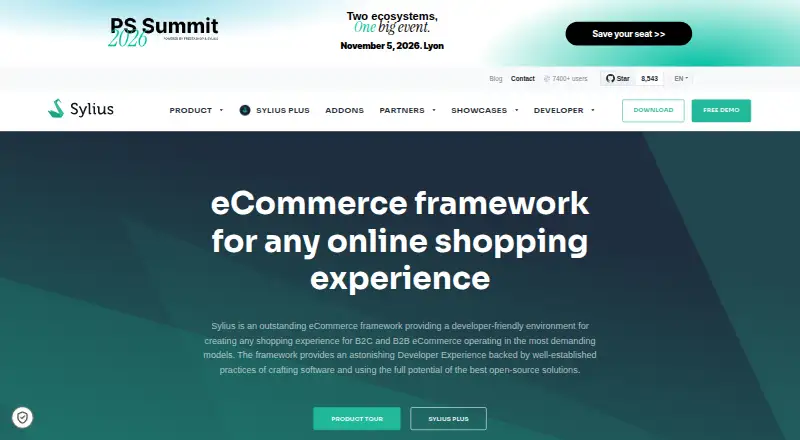
What Sylius is
Sylius is an open-source, headless eCommerce platform for mid-market and enterprise brands building custom commerce solutions. Its framework supports B2C and B2B models, and its customizable REST API, built with API Platform, can serve headless frontends and microservice architectures. Sylius Standard is a Symfony application with Sylius core as a dependency; it can be installed using Composer or Docker. Hosting can use a standard VPS, while Docker and Kubernetes are options for cloud deployments. The Addons marketplace lists plugins and third-party integrations. Sylius Plus adds commercial modules such as advanced multi-store, returns management, multi-source inventory, loyalty, partial shipment, and request for quotation. Standard is distributed on-premise under an MIT license and has community support without a response-time guarantee. Plus lists SLA-backed support with a one-day response time. Standard has no native quotation process, so customers cannot initiate price inquiries online. Sylius Plus costs €800 a year; no Standard price is listed.
Who it suits
Sylius is aimed at mid-market and enterprise brands that need custom eCommerce solutions. Its B2C and B2B support may suit businesses with demanding commerce models.
What it does well
- Supports both B2C and B2B commerce.
- Customizable REST API supports headless frontends.
- Can be installed with Composer or Docker.
- Plus offers modules for multi-store and returns management.
What to know first
- Standard support has no response-time guarantee.
- Standard has no native quotation process.
- Plus costs €800 a year.
Limits
Standard does not include a native quotation process, so customers cannot initiate price inquiries online. Its community support has no response-time guarantee. Sylius Plus starts from €800 a year.
Plans
| Plan | Billed and limits | Price |
|---|---|---|
| Sylius Plus | starts from 800€ / year · Commercial license · on-premise · SLA-backed support · one-day response time · enterprise modules | €800 a year |
| Sylius Standard | MIT license · on-premise · community support · no response guarantee | Free |
As sylius.com lists them, read 15 Oct 2026. The maker's own page has the final word.
Getting started
- Visit https://sylius.com/.
- Choose Sylius Standard or Sylius Plus based on the edition and modules you need.
- For Standard, install the Symfony application with Composer or Docker.
- Run the installation on a standard VPS, or use Docker and Kubernetes for a cloud deployment.
- Use the REST API for headless frontends or microservice architectures.
- Browse the Addons marketplace for plugins and integrations.
Sylius is an open-source, headless commerce platform for mid-market and enterprise brands building tailored B2C or B2B operations. It suits organizations with development and infrastructure capability that want to control the commerce architecture. The payoff is deep customization; the cost is running a self-hosted system and choosing between community and SLA-backed support.
Overview
Sylius is a Symfony application with an MIT-licensed Standard edition. Installation is available through Composer or Docker, and the platform can run on a conventional VPS or in Docker and Kubernetes environments. That deployment range works for teams with established infrastructure practices, but it also leaves hosting, upgrades and operational design to the customer.
The platform handles omnichannel sales and digital products, and is designed for demanding business models rather than a fixed, ready-made storefront. Its headless approach lets a business build its own customer experiences around the commerce core. Organizations wanting a managed shop with minimal engineering involvement should look elsewhere.
Key features
Headless API and extensibility
Sylius provides a customizable REST API built with API Platform. It is intended for headless front ends and microservice architectures, making it a strong foundation when commerce must connect to several interfaces or internal services. The API is a developer-oriented advantage, not a substitute for designing and maintaining those experiences.
The Sylius Addons marketplace includes plugins and an Integrations category for third-party connections. This gives implementation teams a starting point for extending the platform, while still requiring them to assess, configure and maintain the chosen additions.
Commerce modules
Sylius Plus adds advanced multi-store, returns management, multi-source inventory, loyalty, partial shipment and request-for-quotation modules. These address more complex B2C and B2B operations and can reduce the amount of bespoke module work for organizations that need them. Standard does not include a native quotation process, and customers cannot initiate price inquiries online, which is a material limitation for quote-led B2B selling.
Security and support
Sylius published a 2026 security update for its Mollie plugin addressing payment-status forgery through webhooks and customer-data exposure through order-ID enumeration. This illustrates why plugin maintenance matters in a self-hosted stack. Standard relies on community support with no response-time guarantee. Plus lists SLA-backed support with a one-day response time, a meaningful distinction for revenue-critical deployments.
Pricing
| Plan | Price | What you get |
|---|---|---|
| Sylius Standard | Open source; price not listed | MIT license, community support and on-premise distribution |
| Sylius Plus | Starts from 800€ / year | Commercial edition, SLA-backed support, commercial modules and vendor-supported distribution |
Standard is the logical choice for teams able to operate the platform themselves and willing to depend on community assistance. It preserves the open-source, on-premise model but gives up Plus modules, vendor-supported distribution and a stated support response time. Plus is aimed at organizations whose multi-store, inventory, returns, loyalty, partial-shipment or quotation requirements justify a commercial subscription, particularly when a one-day response target matters. The published Plus price starts at 800€ per year; no seats, usage quotas or trial terms are given, so budget planning should focus on the stated annual starting price and the scope of the required modules.
Platforms
Sylius is available as an API, a self-hosted deployment and a web commerce platform. Self-hosting on a VPS suits conventional operations, while Docker and Kubernetes support fits teams standardizing on containerized cloud deployments. There is no hosted SaaS option in these platform choices, so infrastructure ownership remains part of the purchase decision.
Who it's for
Sylius is best for mid-market and enterprise brands with Symfony developers and the capacity to run a customized commerce stack. It fits B2C and B2B businesses with demanding workflows, multiple stores or channels, digital products and integration-heavy architectures. Standard can suit a technically capable organization prioritizing license freedom. Plus is more appropriate when commercial modules and defined support are operational requirements.
It is a poor match for a small team seeking a turnkey storefront, managed hosting or native online price inquiries without additional development. The self-hosted model and headless implementation demand more planning than a conventional hosted ecommerce service.
Pros and cons
Pros
- Custom REST API: API Platform support enables headless front ends and microservice designs.
- Flexible deployment: VPS, Docker and Kubernetes options accommodate different infrastructure practices.
- Open-source foundation: Standard uses the MIT license and can be installed with Composer or Docker.
- Commercial expansion path: Plus adds modules for multi-store, returns, inventory, loyalty, shipments and quotations.
- Extension ecosystem: The Addons marketplace and integrations category provide routes to third-party connections.
Cons
- Operational burden: Self-hosting leaves deployment and ongoing maintenance with the customer.
- Standard support limits: Community support has no response-time guarantee.
- B2B quotation gap: Standard lacks a native quotation process and online customer price inquiries.
- Engineering commitment: The headless, Symfony-based approach is unsuitable for teams wanting a ready-made storefront.
Alternatives
Choose Crystallize instead if you want a freemium API platform with web, macOS and Windows access; its free Particle plan includes one tenant per project, unlimited users and languages, 25 orders, 100 items and 5 GB of bandwidth, while Atom is 949.00 USD.
Aimeos is the better pick when a free, open-source framework with no license or transaction fees is the priority. Bagisto suits teams wanting a free open-source download with documented PHP, database and memory requirements.
Consider Commerce Layer for API commerce across Android, iOS and web, including a Developer plan with one organization, two users, two markets, 1,000 SKUs, 10 links and 100 free live orders per month. Spree Commerce offers open-source self-hosted DTC, B2B and marketplace editions. Solidus provides a free DIY edition when bringing your own infrastructure is acceptable. Vendure is another freemium API and self-hosted framework, with platform features including B2B buying and pricing. Unchained Engine is preferable when a fully free, open-source engine with no licensing or per-transaction fees is the deciding factor.
For broader comparisons, browse Headless Ecommerce Platforms and Ecommerce platforms.
Verdict
Choose Sylius when your mid-market or enterprise business needs a highly tailored B2C or B2B commerce core, headless API control and infrastructure flexibility. Sylius Plus is the stronger operational choice when commercial modules and a one-day support response are worth the annual subscription. Look elsewhere if you need managed hosting, a turnkey storefront or native online price inquiries without building them.
Verdict
Sylius provides a customizable foundation for B2C and B2B commerce, with additional commercial modules in Plus. Standard lacks native online price inquiries and does not include a support response-time guarantee.
Questions
Is Sylius open source?
Sylius Standard is the open-source edition under the MIT license. Sylius Plus is a commercial edition.
How much does Sylius cost?
Sylius Standard has no listed price. Sylius Plus starts from €800 a year.
Where can Sylius run?
Sylius can run on-premise on a standard VPS. Docker and Kubernetes are also deployment options for cloud environments.
Does Sylius support integrations?
The Sylius Addons marketplace lists plugins and an Integrations category for third-party connections.
What support comes with each edition?
Standard has community support without a response-time guarantee. Plus lists SLA-backed support with a one-day response time.
Who makes Sylius?
Sylius is made by Sylius, founded in 2011 and headquartered in Opole, Poland.
Facts from Sylius's own pages
- API
- Sylius provides a customizable REST API built with API Platform for headless frontends and microservice architectures. · sylius.com, 2 Oct 2026
- Apple App Store app
- Control for Sylius is listed as a free iPhone and iPad business app that connects to a merchant's own Sylius store. · apps.apple.com, 15 Oct 2026
- App marketplace
- Yes · sylius.com, 20 Sept 2026
- B2B features
- Sylius Plus offers a B2B Suite with organization-oriented shopping, tailored price lists and order-management tools. · sylius.com, 15 Oct 2026
- Catalog management
- Sylius supports products, variants, attributes, images, descriptions, categorization and channel-specific pricing. · sylius.com, 15 Oct 2026
- Company history
- The official history says the open-source project began in 2011 after Paweł Jędrzejewski rewrote a family eCommerce platform on Symfony. · sylius.com, 15 Oct 2026
- Company size and founding
- LinkedIn lists Sylius as a privately held company founded in 2017 with 11–50 employees. · linkedin.com, 15 Oct 2026
- Digital products
- Yes · sylius.com, 20 Sept 2026
- Documentation
- Public documentation covers installation, configuration, APIs, customization and release policies, while the complete reference book requires login. · docs.sylius.com, 15 Oct 2026
- Download
- Sylius Standard is a Symfony application with Sylius core as a dependency and can be installed with Composer or Docker. · sylius.com, 2 Oct 2026
- Extensibility
- Sylius is delivered as Symfony packages and supports plugins distributed through its addons marketplace and Packagist. · github.com, 15 Oct 2026
- Founded
- 2011 · sylius.com, 28 Sept 2026
- Free plan
- Yes · sylius.com, 20 Sept 2026
- Google Play app
- Control for Sylius is an Android companion app for connecting to a self-hosted store, viewing orders and working offline; the listing shows 0+ downloads. · play.google.com, 15 Oct 2026
- Headless architecture
- The framework lets teams replace the data model, business logic, checkout and frontend layers. · docs.sylius.com, 15 Oct 2026
- Headquarters
- Opole, Poland · sylius.com, 28 Sept 2026
- Hosting
- Sylius can run on a standard VPS or use Docker and Kubernetes for cloud deployments. · sylius.com, 2 Oct 2026
- Hosting model
- self-hosted · sylius.com, 20 Sept 2026
- Independent pricing listing
- TrustRadius lists a Basic cloud plan at $5420 per year and indicates that a free trial is available. · trustradius.com, 15 Oct 2026
- Installation
- A new project can be created with Composer, installed with the Sylius console command and run using Symfony tooling; Docker instructions are also provided. · sylius.com, 15 Oct 2026
- Integrations
- The API is intended to connect ERP, CRM, PIM and other best-of-breed enterprise systems. · docs.sylius.com, 15 Oct 2026
- Intended customers
- Sylius describes its target audience as mid-market and enterprise brands that need custom eCommerce solutions. · sylius.com, 2 Oct 2026
- International commerce
- The documentation describes multi-currency, multi-locale and multi-channel storefronts managed from one administration interface. · docs.sylius.com, 15 Oct 2026
- Inventory
- Sylius Plus adds multi-source inventory management as a commercial module. · sylius.com, 15 Oct 2026
Where Sylius stands on Freedom251
- Ecommerce platforms#5 of 279
- B2C eCommerce Software#4 of 30
- Headless Ecommerce Platforms#5 of 28